Our pass rate is high to 98.9% and the similarity percentage between our SY0-701 study guide and real exam is 90% based on our seven-year educating experience. Do you want achievements in the CompTIA SY0-701 exam in just one try? I am currently studying for the CompTIA SY0-701 exam. Latest CompTIA SY0-701 Test exam practice questions and answers, Try CompTIA SY0-701 Brain Dumps First.
Free SY0-701 Demo Online For CompTIA Certifitcation:
NEW QUESTION 1
A cybersecurity administrator needs to implement a Layer 7 security control on a network and block potential attacks. Which of the following can block an attack at Layer 7? (Select TWO).
- A. HIDS
- B. NIPS
- C. HSM
- D. WAF
- E. NAC
- F. NIDS
- G. Stateless firewall
Answer: DF
Explanation:
A WAF (Web Application Firewall) and NIDS (Network Intrusion Detection System) are both examples of Layer 7 security controls. A WAF can block attacks at the application layer (Layer 7) of the OSI model by filtering traffic to and from a web server. NIDS can also detect attacks at Layer 7 by monitoring network traffic for suspicious patterns and behaviors. References: CompTIA Security+ Study Guide, pages 94-95, 116-118
NEW QUESTION 2
The Chief Technology Officer of a local college would like visitors to utilize the school's WiFi but must be able to associate potential malicious activity to a specific person. Which of the following would BEST allow this objective to be met?
- A. Requiring all new, on-site visitors to configure their devices to use WPS
- B. Implementing a new SSID for every event hosted by the college that has visitors
- C. Creating a unique PSK for every visitor when they arrive at the reception area
- D. Deploying a captive portal to capture visitors' MAC addresses and names
Answer: D
Explanation:
A captive portal is a web page that requires visitors to authenticate or agree to an acceptable use policy before allowing access to the network. By capturing visitors' MAC addresses and names, potential malicious activity can be traced back to a specific person.
NEW QUESTION 3
The most recent vulnerability scan flagged the domain controller with a critical vulnerability. The systems administrator researched the vulnerability and discovered the domain controller does not run the associated application with the vulnerability. Which of the following steps should the administrator take next?
- A. Ensure the scan engine is configured correctly.
- B. Apply a patch to the domain controller.
- C. Research the CVE.
- D. Document this as a false positive.
Answer: D
Explanation:
A false positive is a result that indicates a problem when there is no actual problem. In this case, the vulnerability scan flagged the domain controller with a critical vulnerability, but the domain controller does not run the application that is vulnerable. Therefore, the scan result is inaccurate and should be documented as a false positive.
* A. Ensure the scan engine is configured correctly. This is not the next step, because the scan engine may be configured correctly and still produce false positives due to various factors, such as outdated signatures, network latency, or misconfigured devices.
* B. Apply a patch to the domain controller. This is not the next step, because applying a patch to a system that does not have the vulnerability may cause unnecessary problems or conflicts.
* C. Research the CVE. This is not the next step, because the systems administrator already researched the vulnerability and discovered that it does not affect the domain controller.
* D. Document this as a false positive. This is the correct answer, because documenting false positives helps to improve the accuracy and efficiency of future scans and audits.
Reference: CompTIA Security+ Study Guide (PDF) - Netwrix, page 14.
NEW QUESTION 4
A company's public-facing website, https://www.organization.com, has an IP address of 166.18.75.6. However, over the past hour the SOC has received reports of the site's homepage displaying incorrect information. A quick nslookup search shows hitps://;www.organization.com is pointing to 151.191.122.115. Which of the following is occurring?
- A. DoS attack
- B. ARP poisoning
- C. DNS spoofing
- D. NXDOMAIN attack
Answer: C
Explanation:
The issue is DNS spoofing, where the DNS resolution has been compromised and is pointing to a malicious IP address. References: CompTIA Security+ Study Guide: Exam SY0-601, Chapter 7
NEW QUESTION 5
Audit logs indicate an administrative account that belongs to a security engineer has been locked out multiple times during the day. The security engineer has been on vacation (or a few days. Which of the following attacks can the account lockout be attributed to?
- A. Backdoor
- B. Brute-force
- C. Rootkit
- D. Trojan
Answer: B
Explanation:
The account lockout can be attributed to a brute-force attack. A brute-force attack is a type of attack where an attacker attempts to guess a user's password by continually trying different combinations of characters. In this case, it is likely that the security engineer's account was locked out due to an attacker attempting to guess their password. Backdoor, rootkit, and Trojan attacks are not relevant in this scenario.
NEW QUESTION 6
A company is switching to a remote work model for all employees. All company and employee resources will be in the cloud. Employees must use their personal computers to access the cloud computing environment. The company will manage the operating system. Which of the following deployment models is the company implementing?
- A. CYOD
- B. MDM
- C. COPE
- D. VDI
Answer: D
Explanation:
According to Professor Messer’s video1, VDI stands for Virtual Desktop Infrastructure and it is a deploy model where employees use their personal computers to access a virtual machine that runs the company’s operating system and applications.
In the scenario described, the company is implementing a virtual desktop infrastructure (VDI) deployment model [1]. This allows employees to access the cloud computing environment using their personal computers, while the company manages the operating system. The VDI model is suitable for remote work scenarios because it provides secure and centralized desktop management, while allowing employees to access desktops from any device.
NEW QUESTION 7
A security analyst is investigating what appears to be unauthorized access to a corporate web application. The security analyst reviews the web server logs and finds the following entries: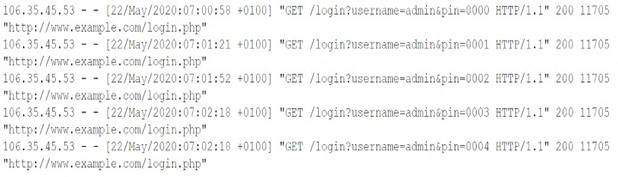
Which of the following password attacks is taking place?
- A. Dictionary
- B. Brute-force
- C. Rainbow table
- D. Spraying
Answer: D
Explanation:
Spraying is a password attack that involves trying a few common passwords against a large number of usernames. Spraying is different from brute-force attacks, which try many possible passwords against one username, or dictionary attacks, which try a list of words from a dictionary file against one username. Spraying is often used when the web application has a lockout policy that prevents multiple failed login attempts for the same username. Spraying can be detected by looking for patterns of failed login attempts from the same source IP address with different usernames and the same or similar passwords.
NEW QUESTION 8
A security administrator is managing administrative access to sensitive systems with the following requirements:
• Common login accounts must not be used for administrative duties.
• Administrative accounts must be temporal in nature.
• Each administrative account must be assigned to one specific user.
• Accounts must have complex passwords.
" Audit trails and logging must be enabled on all systems.
Which of the following solutions should the administrator deploy to meet these requirements? (Give explanation and References from CompTIA Security+ SY0-601 Official Text Book and Resources)
- A. ABAC
- B. SAML
- C. PAM
- D. CASB
Answer: C
Explanation:
PAM is a solution that enables organizations to securely manage users' accounts and access to sensitive systems. It allows administrators to create unique and complex passwords for each user, as well as assign each account to a single user for administrative duties. PAM also provides audit trails and logging capabilities, allowing administrators to monitor user activity and ensure that all systems are secure. According to the CompTIA Security+ SY0-601 Course Book, “PAM is the most comprehensive way to control and monitor privileged accounts”.
NEW QUESTION 9
A company was recently breached. Part of the company's new cybersecurity strategy is to centralize the logs from all security devices. Which of the following components forwards the logs to a central source?
- A. Log enrichment
- B. Log queue
- C. Log parser
- D. Log collector
Answer: D
Explanation:
A log collector can collect logs from various sources, such as servers, devices, applications, or network components, and forward them to a central source for analysis and storage23.
NEW QUESTION 10
While performing a threat-hunting exercise, a security analyst sees some unusual behavior occurring in an application when a user changes the display name. The security analyst decides to perform a static code analysis and receives the following pseudocode: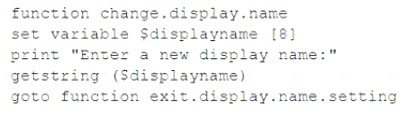
Which of the following attack types best describes the root cause of the unusual behavior?
- A. Server-side request forgery
- B. Improper error handling
- C. Buffer overflow
- D. SQL injection
Answer: D
Explanation:
SQL injection is one of the most common web hacking techniques. SQL injection is the placement of malicious code in SQL statements, via web page input12. A SQL injection attack consists of insertion or “injection” of a SQL query via the input data from the client to the application. A successful SQL injection exploit can read sensitive data from the database, modify database data (Insert/Update/Delete), execute administration operations on the database (such as shutdown the DBMS), recover the content of a given file present on the DBMS file system and in some cases issue commands to the operating system3.
According to the pseudocode given in the question, the application takes a user input for display name and concatenates it with a SQL query to update the user’s profile. This is a vulnerable practice that allows an attacker to inject malicious SQL code into the query and execute it on the database. For example, an attacker could enter something like this as their display name:
John'; DROP TABLE users; -
This would result in the following SQL query being executed:
UPDATE profile SET displayname = 'John'; DROP TABLE users; --' WHERE userid = 1;
The semicolon (;) terminates the original update statement and starts a new one that drops the users table. The double dash (–) comments out the rest of the query. This would cause a catastrophic loss of data for the application.
NEW QUESTION 11
Which of the following must be in place before implementing a BCP?
- A. SLA
- B. AUP
- C. NDA
- D. BIA
Answer: D
Explanation:
A Business Impact Analysis (BIA) is a critical component of a Business Continuity Plan (BCP). It identifies and prioritizes critical business functions and determines the impact of their disruption. References: CompTIA Security+ Study Guide 601, Chapter 10
NEW QUESTION 12
A company recently experienced a major breach. An investigation concludes that customer credit card data was stolen and exfiltrated through a dedicated business partner connection to a vendor, who is not held to the same security contral standards. Which of the following is the MOST likely source of the breach?
- A. Side channel
- B. Supply chain
- C. Cryptographic downgrade
- D. Malware
Answer: B
Explanation:
A supply chain attack occurs when a third-party supplier or business partner is compromised, leading to an attacker gaining unauthorized access to the targeted organization's network. In this scenario, the dedicated business partner connection to a vendor was used to exfiltrate customer credit card data, indicating that the vendor's network was breached and used as a supply chain attack vector.
NEW QUESTION 13
Which of the following should be addressed first on security devices before connecting to the network?
- A. Open permissions
- B. Default settings
- C. API integration configuration
- D. Weak encryption
Answer: B
Explanation:
Before connecting security devices to the network, it is crucial to address default settings first. Manufacturers often ship devices with default settings that include default usernames, passwords, and configurations. These settings are widely known and can be easily exploited by attackers. Changing default settings helps to secure the device and prevent unauthorized access. Reference: CompTIA Security+ SY0-501 Exam Objectives, Section 3.2: "Given a scenario, implement secure systems design." (https://www.comptia.jp/pdf/Security%2B%20SY0-501%20Exam%20Objectives.pdf)
NEW QUESTION 14
Which of the following best describes when an organization Utilizes a read-to-use application from a cloud provider?
- A. IaaS
- B. SaaS
- C. PaaS
- D. XaaS
Answer: B
Explanation:
SaaS stands for software as a service, which is a cloud computing model that provides ready-to-use applications over the internet. SaaS applications are hosted and managed by a cloud provider who also handles software updates, maintenance, security, and scalability. SaaS users can access the applications through a web browser or a mobile app without installing any software on their devices. SaaS applications are typically offered on a subscription or pay-per-use basis. Examples of SaaS applications include email services, online office suites, customer relationship management (CRM) systems, and video conferencing platforms.
References: https://www.comptia.org/certifications/security#examdetails
https://www.comptia.org/content/guides/comptia-security-sy0-601-exam-objectives https://www.ibm.com/cloud/learn/software-as-a-service
NEW QUESTION 15
A desktop computer was recently stolen from a desk located in the lobby of an office building. Which of the following would be the best way to secure a replacement computer and deter future theft?
- A. Installing proximity card readers on all entryway doors
- B. Deploying motion sensor cameras in the lobby
- C. Encrypting the hard drive on the new desktop
- D. Using cable locks on the hardware
Answer: D
Explanation:
Using cable locks on the hardware can be an effective way to secure a desktop computer and deter future theft. Cable locks are physical security devices that attach to the computer case and to a nearby stationary object, such as a desk or wall. This makes it more difficult for a thief to remove the computer without damaging it or attracting attention.
Installing proximity card readers on all entryway doors can enhance physical security by limiting access to authorized individuals. Deploying motion sensor cameras in the lobby can also help deter theft by capturing
images of any unauthorized individuals entering the premises or attempting to steal the computer. Encrypting the hard drive on the replacement desktop can also help protect sensitive data in the event of theft, but it does not provide physical security for the device itself.
NEW QUESTION 16
A customer called a company's security team to report that all invoices the customer has received over the last five days from the company appear to have fraudulent banking details. An investigation into the matter reveals the following
• The manager of the accounts payable department is using the same password across multiple external websites and the corporate account
• One of the websites the manager used recently experienced a data breach.
• The manager's corporate email account was successfully accessed in the last five days by an IP address located in a foreign country.
Which of the following attacks has most likely been used to compromise the manager's corporate account?
- A. Remote access Trojan
- B. Brute-force
- C. Dictionary
- D. Credential stuffing
- E. Password spraying
Answer: D
Explanation:
Credential stuffing is a type of attack that involves using stolen or leaked usernames and passwords from one website or service to gain unauthorized access to other websites or services that use the same credentials. It can exploit the common practice of reusing passwords across multiple accounts. It is the most likely attack tha has been used to compromise the manager’s corporate account, given that the manager is using the same password across multiple external websites and the corporate account, and one of the websites recently experienced a data breach.
NEW QUESTION 17
While researching a data exfiltration event, the security team discovers that a large amount of data was transferred to a file storage site on the internet. Which of the following controls would work best to reduce the risk of further exfiltration using this method?
- A. Data loss prevention
- B. Blocking IP traffic at the firewall
- C. Containerization
- D. File integrity monitoring
Answer: A
Explanation:
Data loss prevention (DLP) is a set of tools and processes that aim to prevent unauthorized access, use, or transfer of sensitive data. DLP can help reduce the risk of further exfiltration using file storage sites on the internet by monitoring and controlling data flows across endpoints, networks, and cloud services. DLP can also detect and block attempts to copy, upload, or download sensitive data to or from file storage sites based on predefined policies and rules.
References: https://www.comptia.org/certifications/security#examdetails https://www.comptia.org/content/guides/comptia-security-sy0-601-exam-objectives https://www.microsoft.com/en-us/security/business/security-101/what-is-data-loss-prevention-dlp
NEW QUESTION 18
During an investigation, the incident response team discovers that multiple administrator accounts were suspected of being compromised. The host audit logs indicate a repeated brute-force attack on a single administrator account followed by suspicious logins from unfamiliar geographic locations. Which of the following data sources would be BEST to use to assess the accounts impacted by this attack?
- A. User behavior analytics
- B. Dump files
- C. Bandwidth monitors
- D. Protocol analyzer output
Answer: A
Explanation:
User behavior analytics (UBA) would be the best data source to assess the accounts impacted by the attack, as it can identify abnormal activity, such as repeated brute-force attacks and logins from unfamiliar geographic locations, and provide insights into the behavior of the impacted accounts. References: CompTIA Security+ Study Guide, Exam SY0-601, 4th Edition, Chapter 7: Incident Response, pp. 338-341
NEW QUESTION 19
......
Recommend!! Get the Full SY0-701 dumps in VCE and PDF From Dumpscollection.com, Welcome to Download: https://www.dumpscollection.net/dumps/SY0-701/ (New 0 Q&As Version)