Exam Code: DOP-C01 (Practice Exam Latest Test Questions VCE PDF)
Exam Name: AWS Certified DevOps Engineer- Professional
Certification Provider: Amazon-Web-Services
Free Today! Guaranteed Training- Pass DOP-C01 Exam.
Check DOP-C01 free dumps before getting the full version:
NEW QUESTION 1
Which of the following services can be used to detect the application health in a Blue Green deployment in A WS.
- A. AWSCode Commit
- B. AWSCode Pipeline
- C. AWSCIoudTrail
- D. AWSCIoudwatch
Answer: D
Explanation:
The AWS Documentation mentions the following
Amazon Cloud Watch is a monitoring sen/ice for AWS Cloud resources and the applications you run on AWS.9 CloudWatch can collect and track metrics, collect and monitor log files, and set alarms. It provides system-wide visibility into resource utilization, application performance, and operational health, which are key to early detection of application health in blue/green deployments.
For more information on Blue Green deployments, please refer to the below link:
• https://dOawsstatic.com/whitepapers/AWS_Blue_Green_Deployments.pdf
NEW QUESTION 2
Your CTO has asked you to make sure that you know what all users of your AWS account are doing to change resources at all times. She wants a report of who is doing what over time, reported to her once per week, for as broad a resource type group as possible. How should you do this?
- A. Create a global AWS CloudTrail Trai
- B. Configure a script to aggregate the log data delivered to S3 once per week and deliver this to the CTO.
- C. Use CloudWatch Events Rules with an SNS topic subscribed to all AWS API call
- D. Subscribe the CTO to an email type delivery on this SNS Topic.
- E. Use AWS 1AM credential reports to deliver a CSV of all uses of 1AM UserTokens overtime to the CTO.
- F. Use AWS Config with an SNS subscription on a Lambda, and insert these changes over time into a DynamoDB tabl
- G. Generate reports based on the contents of this table.
Answer: A
Explanation:
AWS CloudTrail is an AWS service that helps you enable governance, compliance, and operational and risk auditing of your AWS account. Actions taken by a user, role, or an AWS service are recorded as events in CloudTrail. Events include actions taken in the AWS Management Console, AWS Command Line Interface, and AWS SDKs and APIs.
Visibility into your AWS account activity is a key aspect of security and operational best practices. You can use CloudTrail to view, search, download, archive, analyze, and respond to account activity across your AWS infrastructure. You can identify who or what took which action, what resources were acted upon, when the event occurred, and other details to help you analyze and respond to activity in your AWS account.
For more information on Cloudtrail, please visit the below URL:
• http://docs.aws.amazon.com/awscloudtrail/latest/userguide/cloudtrail-user-guide.html
NEW QUESTION 3
A group of developers in your organization want to migrate their existing application into Elastic Beanstalk and want to use Elastic load Balancing and Amazon SQS. They are currently using a custom application server.
How would you deploy their system to Elastic Beanstalk?
- A. Configurean Elastic Beanstalk platform using AWS OpsWorks deploy it to Elastic Beanstalkand run a script that creates a load balancer and an Amazon SQS queue.
- B. Usea Docker container that has the third party application server installed on itand that creates the load balancer and an Amazon SQS queue using the applicationsource bundle feature.
- C. Createa custom Elastic Beanstalk platform that contains the third party applicationserver and runs a script that creates a load balancer and an Amazon SQS queue.
- D. Configurean AWS OpsWorks stack that installs the third party application server andcreates a load balancer and an Amazon SQS queue and then deploys it to ElasticBeanstalk.
Answer: B
Explanation:
Below is the documentation on Clastic beanstalk and Docker
Clastic Beanstalk supports the deployment of web applications from Docker containers. With Docker containers, you can define your own runtime environment. You
can choose your own platform, programming language, and any application dependencies (such as package managers or tools), that aren't supported by other platforms. Docker containers are self- contained and include all the configuration information and software your web application requires to run.
For more information on Clastic beanstalk and Docker, please visit the link: http://docs.aws.amazon.com/elasticbeanstalk/latest/dg/create_deploy_docker. htmI
NEW QUESTION 4
Which of the following services can be used in conjunction with Cloudwatch Logs. Choose the 3 most viable services from the options given below
- A. Amazon Kinesis
- B. Amazon S3
- C. Amazon SQS
- D. Amazon Lambda
Answer: ABD
Explanation:
The AWS Documentation the following products which can be integrated with Cloudwatch logs
1) Amazon Kinesis - Here data can be fed for real time analysis
2) Amazon S3 - You can use CloudWatch Logs to store your log data in highly durable storage such as S3.
3) Amazon Lambda - Lambda functions can be designed to work with Cloudwatch log For more information on Cloudwatch Logs, please refer to the below link: link:http://docs^ws.amazon.com/AmazonCloudWatch/latest/logs/WhatlsCloudWatchLogs.html
NEW QUESTION 5
You have an ELB on AWS which has a set of web servers behind them. There is a requirement that the SSL key used to encrypt data is always kept secure. Secondly the logs of ELB should only be decrypted by a subset of users. Which of these architectures meets all of the requirements?
- A. UseElastic Load Balancing to distribute traffic to a set of web server
- B. Toprotect the SSL private key.upload the key to the load balancer and configure the load balancer to offloadthe SSL traffi
- C. Write yourweb server logs to an ephemeral volume that has been encrypted using a randomlygenerated AES key.
- D. UseElastic Load Balancing to distribute traffic to a set of web server
- E. Use TCPIoad balancing on theload balancer and configure your web servers to retrieve the private key from aprivate Amazon S3bucket on boo
- F. Write your web server logs to a private Amazon S3 bucket usingAmazon S3 server- sideencryption.
- G. UseElastic Load Balancing to distribute traffic to a set of web servers, configurethe load balancer toperform TCP load balancing, use an AWS CloudHSM to perform the SSLtransactions, and write yourweb server logs to a private Amazon S3 bucket using Amazon S3 server-sideencryption.
- H. UseElastic Load Balancing to distribute traffic to a set of web server
- I. Configurethe load balancer toperform TCP load balancing, use an AWS CloudHSM to perform the SSLtransactions, and write yourweb server logs to an ephemeral volume that has been encrypted using a randomlygenerated AES key.
Answer: C
Explanation:
The AWS CIoudHSM service helps you meet corporate, contractual and regulatory compliance requirements for data security by using dedicated Hardware Security
Module (HSM) appliances within the AWS cloud. With CIoudHSM, you control the encryption keys and cryptographic operations performed by the HSM.
Option D is wrong with the CIoudHSM option because of the ephemeral volume which this is temporary storage
For more information on cloudhsm, please refer to the link:
• https://aws.amazon.com/cloudhsm/
NEW QUESTION 6
Which of the following is not a supported platform on Elastic Beanstalk?
- A. PackerBuilder
- B. Go
- C. Nodejs
- D. JavaSE
- E. Kubernetes
Answer: E
Explanation:
Answer-C
Below is the list of supported platforms
*Packer Builder
*Single Container Docker
*Multicontainer Docker
*Preconfigured Docker
*Go
*Java SE
*Java with Tomcat
*NET on Windows Server with I IS
*Nodejs
*PHP
*Python
*Ruby
For more information on the supported platforms please refer to the below link
http://docs.aws.amazon.com/elasticbeanstalk/latest/dg/concepts.platforms. Html
NEW QUESTION 7
You currently have EC2 Instances hosting an application. These instances are part of an Autoscaling Group. You now want to change the instance type of the EC2 Instances. How can you manage the deployment with the least amount of downtime
- A. Terminate the existing Auto Scalinggrou
- B. Create a new launch configuration with the new Instance typ
- C. Attach that to the new Autoscaing Group.
- D. Use the AutoScalingRollingUpdate policy on CloudFormation Template Auto Scalinggroup
- E. Use the Rolling Update feature which is available for EC2 Instances.
- F. Manually terminate the instances, launch new instances with the new instance type and attach them to the Autoscaling group
Answer: B
Explanation:
The AWS::AutoScaling::AutoScalingGroup resource supports an UpdatePolicy attribute. This is used to define how an Auto Scalinggroup resource is updated when
an update to the Cloud Formation stack occurs. A common approach to updating an Auto Scaling group is to perform a rolling update, which is done by specifying the
AutoScalingRollingUpdate policy. This retains the same Auto Scalinggroup and replaces old instances with new ones, according to the parameters specified.
For more information on AutoScaling Rolling Update, please refer to the below link:
• https://aws.amazon.com/premiumsupport/knowledge-center/auto-scaling-group-rolling- updates/
NEW QUESTION 8
Your current log analysis application takes more than four hours to generate a report of the top 10 users of your web application. You have been asked to implement a system that can report this information in real time, ensure that the report is always up to date, and handle increases in the number of requests to your web application. Choose the option that is cost-effective and can fulfill the requirements.
- A. Publish your data to Cloud Watch Logs, and configure your application to autoscale to handle the load on demand.
- B. Publish your log data to an Amazon S3 bucke
- C. Use AWS CloudFormation to create an Auto Scalinggroup to scale your post-processing application which is configured to pull down your log files stored an Amazon S3.
- D. Post your log data to an Amazon Kinesis data stream, and subscribe your log-processing application so that is configured to process your logging data.
- E. Create a multi-AZ Amazon RDS MySQL cluster, post the logging data to MySQL, and run a map reduce job to retrieve the required information on user counts.
Answer: C
Explanation:
When you see Amazon Kinesis as an option, this becomes the ideal option to process data in real time.
Amazon Kinesis makes it easy to collect, process, and analyze real-time, streaming data so you can get timely insights and react quickly to new information. Amazon
Kinesis offers key capabilities to cost effectively process streaming data at any scale, along with the flexibility to choose the tools that best suit the requirements of
your application. With Amazon Kinesis, you can ingest real-time data such as application logs, website clickstreams, loT telemetry data, and more into your
databases, data lakes and data warehouses, or build your own real-time applications using this data. For more information on Amazon Kinesis, please visit the below URL:
• https://aws.amazon.com/kinesis
NEW QUESTION 9
Your company is planning to develop an application in which the front end is in .Net and the backend is in DynamoDB. There is an expectation of a high load on the application. How could you ensure the scalability of the application to reduce the load on the DynamoDB database? Choose an answer from the options below.
- A. Add more DynamoDB databases to handle the load.
- B. Increase write capacity of Dynamo DB to meet the peak loads
- C. Use SQS to assist and let the application pull messages and then perform the relevant operation in DynamoDB.
- D. Launch DynamoDB in Multi-AZ configuration with a global index to balance writes
Answer: C
Explanation:
When the idea comes for scalability then SQS is the best option. Normally DynamoDB is scalable, but since one is looking for a cost effective solution, the messaging in SQS can assist in managing the situation mentioned in the question.
Amazon Simple Queue Service (SQS) is a fully-managed message queuing service for reliably communicating among distributed software components and microservices - at any scale. Building applications from individual components that each perform a discrete function improves scalability and reliability, and is best practice design for modern applications. SQS makes it simple and cost- effective to decouple and coordinate the components of a cloud application. Using SQS, you can send, store, and receive messages between software components at any volume, without losing messages or requiring other services to be always available
For more information on SQS, please refer to the below URL:
• https://aws.amazon.com/sqs/
NEW QUESTION 10
You are using lifecycle hooks in your AutoScaling Group. Because there is a lifecycle hook, the instance is put in the Pending:Wait state, which means that it is not available to handle traffic yet. When the instance enters the wait state, other scaling actions are suspended. After some time, the instance state is changed to Pending:Proceed, and finally InService where the instances that are part of the Autoscaling Group can start serving up traffic. But you notice that the bootstrapping process on the instances finish much earlier, long before the state is changed to PendingiProceed.
What can you do to ensure the instances are placed in the right state after the bootstrapping process is complete?
- A. Use the complete-lifecycle-action call to complete the lifecycle actio
- B. Run this command from another EC2 Instance.
- C. Use the complete-lifecycle-action call to complete the lifecycle actio
- D. Run this command from the Command line interfac
- E. -^C Use the complete-lifecycle-action call to complete the lifecycle actio
- F. Run this command from the Simple Notification service.
- G. Use the complete-lifecycle-action call to complete the lifecycle actio
- H. Run this command from a SQS queue
Answer: B
Explanation:
The AWS Documentation mentions the following
3. If you finish the custom action before the timeout period ends, use the complete-1ifecycle-action command so that the Auto Scalinggroup can continue launching
or terminating the instance. You can specify the lifecycle action token, as shown in the following command:
3. If you finish the custom action before the timeout period ends, use the complete-lifecycle-action command so that Auto Scaling can continue launching or terminating the instance. You can specify the lifecycle action token, as shown in the following command:
For more information on lifecycle hooks, please refer to the below URL:
• http://docs.aws.amazon.com/autoscaling/latest/userguide/lifecycle-hooks.htm I
NEW QUESTION 11
You have a web application running on six Amazon EC2 instances, consuming about 45% of resources on each instance. You are using auto-scaling to make sure that six instances are running at all times. The number of requests this application processes is consistent and does not experience spikes. The application is critical to your business and you want high availability at all times. You want the load to be distributed evenly between all instances. You also want to use the same Amazon Machine Image (AMI) for all instances. Which of the following architectural choices should you make?
- A. Deploy6 EC2 instances in one availability zone and use Amazon Elastic Load Balancer.
- B. Deploy3 EC2 instances in one region and 3 in another region and use Amazon ElasticLoad Balancer.
- C. Deploy3 EC2 instances in one availability zone and 3 in another availability zone anduse Amazon Elastic Load Balancer.
- D. Deploy2 EC2 instances in three regions and use Amazon Elastic Load Balancer.
Answer: C
Explanation:
Option A is automatically incorrect because remember that the question asks for high availability. For option A, if the A2 goes down then the entire application fails.
For Option B and D, the CLB is designed to only run in one region in aws and not across multiple regions. So these options are wrong.
The right option is C.
The below example shows an Elastic Loadbalancer connected to 2 EC2 instances connected via Auto Scaling. This is an example of an elastic and scalable web tier.
By scalable we mean that the Auto scaling process will increase or decrease the number of CC2 instances as required.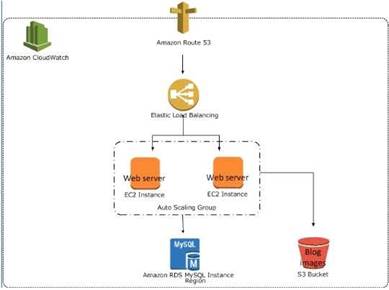
For more information on best practices for AWS Cloud applications, please visit the below URL:
• https://d03wsstatic.com/whitepapers/AWS_Cloud_Best_Practices.pdf
NEW QUESTION 12
A gaming company adopted AWS Cloud Formation to automate load-testing of theirgames. They have created an AWS Cloud Formation template for each gaming environment and one for the load- testing stack. The load-testing stack creates an Amazon Relational Database Service (RDS) Postgres database and two web servers running on Amazon Elastic Compute Cloud (EC2) that send HTTP requests, measure response times, and write the results into the database. A test run usually takes between 15 and 30 minutes. Once the tests are done, the AWS Cloud Formation stacks are torn down immediately. The test results written to the Amazon RDS database must remain accessible for visualization and analysis.
Select possible solutions that allow access to the test results after the AWS Cloud Formation load - testing stack is deleted.
Choose 2 answers.
- A. Define an Amazon RDS Read-Replica in theload-testing AWS Cloud Formation stack and define a dependency relation betweenmaster and replica via the Depends On attribute.
- B. Define an update policy to prevent deletionof the Amazon RDS database after the AWS Cloud Formation stack is deleted.
- C. Define a deletion policy of type Retain forthe Amazon RDS resource to assure that the RDS database is not deleted with theAWS Cloud Formation stack.
- D. Define a deletion policy of type Snapshotfor the Amazon RDS resource to assure that the RDS database can be restoredafter the AWS Cloud Formation stack is deleted.
- E. Defineautomated backups with a backup retention period of 30 days for the Amazon RDSdatabase and perform point-in-time recovery of the database after the AWS CloudFormation stack is deleted.
Answer: CD
Explanation:
With the Deletion Policy attribute you can preserve or (in some cases) backup a resource when its stack is deleted. You specify a DeletionPolicy attribute for each resource that you want to control. If a resource has no DeletionPolicy attribute, AWS Cloud Formation deletes the resource by default.
To keep a resource when its stack is deleted, specify Retain for that resource. You can use retain for any resource. For example, you can retain a nested stack, S3 bucket, or CC2 instance so that you can continue to use or modify those resources after you delete their stacks.
For more information on Deletion policy, please visit the below url http://docs.aws.amazon.com/AWSCIoudFormation/latest/UserGuide/aws-attri bute- deletionpolicy.html
NEW QUESTION 13
Your development team wants account-level access to production instances in order to do live debugging of a highly secure environment. Which of the following should you do?
- A. Place the credentials provided by Amazon Elastic Compute Cloud (EC2) into a secure Amazon Sample Storage Service (S3) bucket with encryption enable
- B. Assign AWS Identity and Access Management (1AM) users to each developer so they can download the credentials file.
- C. Place an internally created private key into a secure S3 bucket with server-side encryption using customer keys andconfiguration management, create a service account on al I the instances using this private key, and assign I AM users to each developer so they can download the fi le.
- D. Place each developer's own public key into a private S3 bucket, use instance profiles and configuration management to create a user account for each developer on all instances, and place the user's public keys into the appropriate accoun
- E. ^/
- F. Place the credentials provided by Amazon EC2 onto an MFA encrypted USB drive, and physically share it with each developer so that the private key never leaves the office.
Answer: C
Explanation:
An instance profile is a container for an 1AM role that you can use to pass role information to an CC2 instance when the instance starts.
A private S3 bucket can be created for each developer, the keys can be stored in the bucket and then assigned to the instance profile.
Option A and D are invalid, because the credentials should not be provided by a AWS EC2 Instance. Option B is invalid because you would not create a service account, instead you should create an instance profile.
For more information on Instance profiles, please refer to the below document link: from AWS
• http://docs.aws.amazon.com/IAM/latest/UserGuide/id_roles_use_switch-ro le-ec2_instance- profiles.htm I
NEW QUESTION 14
Which of the following are ways to ensure that data is secured while in transit when using the AWS Elastic load balancer. Choose 2 answers from the options given below
- A. Usea TCP front end listener for your ELB
- B. Usean SSL front end listenerforyourELB
- C. Usean HTTP front end listener for your ELB
- D. Usean HTTPS front end listener for your ELB
Answer: BD
Explanation:
The AWS documentation mentions the following
You can create a load balancer that uses the SSL/TLS protocol for encrypted connections (also known as SSL offload). This feature enables traffic encryption between your load balancer and the clients that initiate HTTPS sessions, and for connections between your load balancer and your L~C2 instances.
For more information on Elastic Load balancer and secure listeners, please refer to the below link: http://docs.aws.amazon.com/elasticloadbalancing/latest/classic/elb-https-load-balancers.html
NEW QUESTION 15
You have an application hosted in AWS. This application was created using Cloudformation Templates and Autoscaling. Now your application has got a surge of users which is decreasing the performance of the application. As per your analysis, a change in the instance type to C3 would resolve the issue. Which of the below option can introduce this change while minimizing downtime for end users?
- A. Copy the old launch configuration, and create a new launch configuration with the C3 instance
- B. Update the Auto Scalinggroup with the new launch configuratio
- C. Auto Scaling will then update the instance type of all running instances.
- D. Update the launch configuration in the AWS CloudFormation template with the new C3 instance typ
- E. Add an UpdatePolicy attribute to the Auto Scaling group that specifies an AutoScalingRollingUpdat
- F. Run a stack update with the updated template.
- G. Update the existing launch configuration with the new C3 instance typ
- H. Add an UpdatePolicy attribute to your Auto Scalinggroup that specifies an AutoScaling RollingUpdate in order to avoid downtime.
- I. Update the AWS CloudFormation template that contains the launch configuration with the new C3 instance typ
- J. Run a stack update with the updated template, and Auto Scaling will then update the instances one at a time with the new instance type.
Answer: B
Explanation:
Ensure first that the cloudformation template is updated with the new instance type.
The AWS::AutoScaling::AutoScalingGroup resource supports an UpdatePoIicy attribute. This is used to define how an Auto Scalinggroup resource is updated when
an update to the Cloud Formation stack occurs. A common approach to updating an Auto Scaling group is to perform a rolling update, which is done by specifying
the AutoScalingRollingUpdate policy. This retains the same Auto Scaling group and replaces old instances with new ones, according to the parameters specified.
Option A is invalid because this will cause an interruption to the users.
Option C is partially correct, but it does not have all the steps as mentioned in option B.
Option D is partially correct, but we need the AutoScalingRollingUpdate attribute to ensure a rolling update is peformed.
For more information on AutoScaling Rolling updates please refer to the below link:
• https://aws.amazon.com/premiumsupport/knowledge-center/auto-scaling-group-rolling- updates/
NEW QUESTION 16
The company you work for has a huge amount of infrastructure built on AWS. However there has been some concerns recently about the security of this infrastructure, and an external auditor has been given the task of running a thorough check of all of your company's AWS assets. The auditor will be in the USA while your company's infrastructure resides in the Asia Pacific (Sydney) region on AWS. Initially, he needs to check all of your VPC assets, specifically, security groups and NACLs You have been assigned the task of providing the auditor with a login to be able to do this. Which of the following would be the best and most secure solution to provide the auditor with so he can begin his initial investigations? Choose the correct answer from the options below
- A. Createan 1AM usertied to an administrator rol
- B. Also provide an additional level ofsecurity with MFA.
- C. Givehim root access to your AWS Infrastructure, because he is an auditor he willneed access to every service.
- D. Createan 1AM user who will have read-only access to your AWS VPC infrastructure andprovide the auditor with those credentials.
- E. Createan 1AM user with full VPC access but set a condition that will not allow him tomodify anything if the request is from any IP other than his own.
Answer: C
Explanation:
Generally you should refrain from giving high level permissions and give only the required permissions. In this case option C fits well by just providing the relevant access which is required.
For more information on 1AM please see the below link:
• https://aws.amazon.com/iam/
NEW QUESTION 17
You need to deploy a Node.js application and do not have any experience with AWS. Which deployment method will be the simplest for you to deploy?
- A. AWS Elastic Beanstalk
- B. AWSCIoudFormation
- C. AWS EC2
- D. AWSOpsWorks
Answer: A
Explanation:
With Elastic Beanstalk, you can quickly deploy and manage applications in the AWS Cloud without worrying about the infrastructure that runs those applications.
AWS Elastic Beanstalk reduces management complexity without restricting choice or control. You simply upload your application, and Elastic Beanstalk automatically handles the details of capacity provisioning, load balancing, scaling, and application health monitoring
For more information on Elastic beanstalk please refer to the below link:
• http://docs.aws.amazon.com/elasticbeanstalk/latest/dg/Welcome.html
NEW QUESTION 18
You have decided to migrate your application to the cloud. You cannot afford any downtime. You want to gradually migrate so that you can test the application with a small percentage of users and increase over time. Which of these options should you implement?
- A. Use Direct Connect to route traffic to the on-premise locatio
- B. In DirectConnect, configure the amount of traffic to be routed to the on-premise location.
- C. Implement a Route 53 failover routing policy that sends traffic back to the on-premises application if the AWS application fails.
- D. Configure an Elastic Load Balancer to distribute the traffic between the on-premises application and the AWS application.
- E. Implement a Route 53 weighted routing policy that distributes the traffic between your on- premises application and the AWS application depending on weight.
Answer: D
Explanation:
Option A is incorrect because DirectConnect cannot control the flow of traffic.
Option B is incorrect because you want to split the percentage of traffic. Failover will direct all of the traffic to the backup servers.
Option C is incorrect because you cannot control the percentage distribution of traffic.
Weighted routing lets you associate multiple resources with a single domain name (example.com) or subdomain name (acme.example.com) and choose how much traffic is routed to each resource. This can be useful for a variety of purposes, including load
balancing and testing new versions of software.
For more information on the Routing policy please refer to the below link: http://docs.aws.amazon.com/Route53/latest/DeveloperGuide/routing-policy.html
NEW QUESTION 19
Your social media marketing application has a component written in Ruby running on AWS Elastic Beanstalk. This application component posts messages to social media sites in support of various marketing campaigns. Your management now requires you to record replies to these social media messages to analyze the effectiveness of the marketing campaign in comparison to past and future efforts. You've already developed a new application component to interface with the social media site APIs in order to read the replies. Which process should you use to record the social media replies in a durable data store that can be accessed at any time for analytics of historical data?
- A. Deploythe new application component in an Auto Scaling group of Amazon EC2 instances,read the data from the social media sites, store it with Amazon Elastic BlockStore, and use AWS Data Pipeline to publish it to Amazon Kinesis for analytics.
- B. Deploythe new application component as an Elastic Beanstalk application, read thedata from the social media sites, store it in DynamoDB, and use Apache Hivewith Amazon Elastic MapReduce for analytics.
- C. Deploythe new application component in an Auto Scaling group of Amazon EC2 instances,read the data from the social media sites, store it in Amazon Glacier, and useAWS Data Pipeline to publish it to Amazon RedShift for analytics.
- D. Deploythe new application component as an Amazon Elastic Beanstalk application, readthe data from the social media site, store it with Amazon Elastic Block store,and use Amazon Kinesis to stream the data to Amazon Cloud Watch for analytics
Answer: B
Explanation:
The AWS Documentation mentions the below
Amazon DynamoDB is a fast and flexible NoSQL database sen/ice for all applications that need consistent, single-digit millisecond latency at any scale. It is a fully managed cloud database and supports both document and key-value store models. Its flexible data model, reliable performance, and automatic scaling of throughput capacity, makes it a great fit for mobile, web, gaming, ad tech, loT, and many other applications.
For more information on AWS DynamoDB please see the below link:
• https://aws.amazon.com/dynamodb/
NEW QUESTION 20
You have a requirement to automate the creation of EBS Snapshots. Which of the following can be
used to achieve this in the best way possible?
- A. Createa powershell script which uses the AWS CLI to get the volumes and then run thescript as a cron job.
- B. Usethe A WSConf ig service to create a snapshot of the AWS Volumes
- C. Usethe AWS CodeDeploy service to create a snapshot of the AWS Volumes
- D. UseCloudwatch Events to trigger the snapshots of EBS Volumes
Answer: D
Explanation:
The best is to use the inbuilt sen/ice from Cloudwatch, as Cloud watch Events to automate the creation of CBS Snapshots. With Option A, you would be restricted to
running the powrshell script on Windows machines and maintaining the script itself And then you have the overhead of having a separate instance just to run that script.
When you go to Cloudwatch events, you can use the Target as EC2 CreateSnapshot API call as shown below.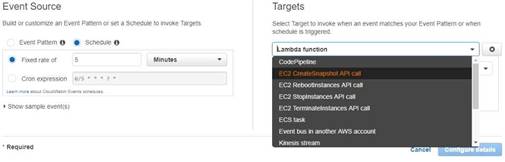
The AWS Documentation mentions
Amazon Cloud Watch Cvents delivers a near real-time stream of system events that describe changes in Amazon Web Services (AWS) resources. Using simple rules that you can quickly set up, you can match events and route them to one or more target functions or streams. Cloud Watch Cvents becomes aware of operational changes as they occur. Cloud Watch Cvents responds to these operational changes and takes corrective action as necessary, by sending messages to respond to the environment, activating functions, making changes, and capturing state information.
For more information on Cloud watch Cvents, please visit the below U RL:
• http://docs.aws.amazon.com/AmazonCloudWatch/latest/events/WhatlsCloudWatchCvents.htmI
NEW QUESTION 21
You have just recently deployed an application on EC2 instances behind an ELB. After a couple of weeks, customers are complaining on receiving errors from the application. You want to diagnose the errors and are trying to get errors from the ELB access logs. But the ELB access logs are empty. What is the reason for this.
- A. You do not have the appropriate permissions to access the logs
- B. You do not have your CloudWatch metrics correctly configured
- C. ELB Access logs are only available for a maximum of one week.
- D. Access logging is an optional feature of Elastic Load Balancing that is disabled by default
Answer: D
Explanation:
Clastic Load Balancing provides access logs that capture detailed information about requests sent to
your load balancer. Cach log contains information such as the
time the request was received, the client's IP address, latencies, request paths, and server responses.
You can use these access logs to analyze traffic patterns and to troubleshoot issues.
Access logging is an optional feature of Elastic Load Balancing that is disabled by default. After you enable access logging for your load balancer. Clastic Load
Balancing captures the logs and stores them in the Amazon S3 bucket that you specify. You can disable access logging at any time.
For more information on CLB access logs, please refer to the below document link: from AWS http://docs.aws.amazon.com/elasticloadbalancing/latest/classic/access-log-collection.html
NEW QUESTION 22
Which of the following commands for the elastic beanstalk CLI can be used to create the current application into the specified environment?
- A. ebcreate
- B. ebstart
- C. enenv
- D. enapp
Answer: A
Explanation:
Differences from Version 3 of EB CLI
CB is a command line interface (CLI) tool for Clastic Beanstalk that you can use to deploy applications quickly and more easily. The latest version of CB was introduced by Clastic Beanstalk in CB CLI 3. Although Clastic Beanstalk still supports CB 2.6 for customers who previously installed and continue to use it, you should migrate to the latest version of CB CLI 3, as it can manage environments that you launched using CB CLI 2.6 or earlier versions of CB CLI. CB CLI automatically retrieves settings from an environment created using CB if the environment is running. Note that CB CLI 3 does not store option settings locally, as in earlier versions.
CB CLI introduces the commands eb create, eb deploy, eb open, eb console, eb scale, eb setenv, eb config, eb terminate, eb clone, eb list, eb use, eb printenv, and eb ssh. In CB CLI 3.1 or later, you can also use the eb swap command. In CB CLI 3.2 only, you can use the eb abort, eb platform, and eb upgrade commands. In addition to these new commands, CB CLI 3 commands differ from CB CLI 2.6 commands in several cases:
1. eb init - Use eb init to create an .elasticbeanstalk directory in an existing project directory and create a new Clastic Beanstalk application for the project. Unlike with previous versions, CB CLI 3 and later versions do not prompt you to create an environment.
2. eb start - CB CLI 3 does not include the command eb start. Use eb create to create an environment.
3. eb stop - CB CLI 3 does not include the command eb stop. Use eb terminate to completely terminate an environment and clean up.
4. eb push and git aws.push - CB CLI 3 does not include the commands eb push or git aws.push. Use eb deploy to update your application code.
5. eb update - CB CLI 3 does not include the command eb update. Use eb config to update an environment.
6. eb branch - CB CLI 3 does not include the command eb branch.
For more information about using CB CLI 3 commands to create and manage an application, see CB CLI Command Reference. For a command reference for CB 2.6, see CB CLI 2 Commands. For a walkthrough of how to deploy a sample application using CB CLI 3, see Managing Clastic Beanstalk environments with the CB CLI. For a walkthrough of how to deploy a sample application using eb 2.6, see Getting Started with Cb. For a walkthrough of how to use CB 2.6 to map a Git branch to a specific environment, see Deploying a Git Branch to a Specific environment. https://docs.aws.amazon.com/elasticbeanstalk/latest/dg/eb-cli. html #eb-cli2-differences Note: Additionally, CB CLI 2.6 has been deprecated. It has been replaced by AWS CLI https://docs.aws.amazon.com/elasticbeanstalk/latest/dg/eb-cl i3.htm I We will replace this question soon.
NEW QUESTION 23
Which of the following are ways to secure data at rest and in transit in AWS. Choose 3 answers from the options given below
- A. Encryptall EBS volumes attached to EC2 Instances
- B. Useserver side encryption for S3
- C. UseSSL/HTTPS when using the Elastic Load Balancer
- D. UselOPS volumes when working with EBS volumes on EC2 Instances
Answer: ABC
Explanation:
The AWS documentation mentions the following
Amazon CBS encryption offers you a simple encryption solution for your EBS volumes without the need for you to build, maintain, and secure your own key management infrastructure. When you create an encrypted CBS volume and attach it to a supported instance type, the following types of data are encrypted:
Data at rest inside the volume
All data moving between the volume and the instance
All snapshots created from the volume Data protection refers to protecting data while in-transit (as it travels to and from Amazon S3) and at rest (while it is stored on disks in Amazon S3 data centers). You can protect data in transit by using SSL or by using client-side encryption. You have the following options of protecting data at rest in Amazon S3.
Use Server-Side encryption - You request Amazon S3 to encrypt your object before saving it on disks in its data centers and decrypt it when you download the objects.
Use Client-Side Encryption - You can encrypt data client-side and upload the encrypted data to Amazon S3. In this case, you manage the encryption process, the encryption keys, and related tools. You can create a load balancer that uses the SSL/TLS protocol for encrypted connections (also known as SSL offload). This feature enables traffic encryption between your load balancer and the clients that initiate HTTPS sessions, and for connections between your load balancer and your L~C2 instances. For more information on securing data at rest, please refer to the below link:
• https://dO3wsstatic.com/whitepapers/aws-securing-data-at-rest-with-encryption.pdf
NEW QUESTION 24
You are planning on configuring logs for your Elastic Load balancer. At what intervals does the logs get produced by the Elastic Load balancer service. Choose 2 answers from the options given below
- A. 5minutes
- B. 60minutes
- C. 1 minute
- D. 30seconds
Answer: AB
Explanation:
The AWS Documentation mentions
Clastic Load Balancing publishes a log file for each load balancer node at the interval you specify. You can specify a publishing interval of either 5 minutes or 60 minutes when you enable the access log for your load balancer. By default. Elastic Load Balancing publishes logs at a 60-minute interval.
For more information on Elastic load balancer logs please see the below link: http://docs.aws.amazon.com/elasticloadbalancing/latest/classic/access-log-collection.html
NEW QUESTION 25
Your finance supervisor has set a budget of 2000 USD for the resources in AWS. Which of the
following is the simplest way to ensure that you know when this threshold is being reached.
- A. Use Cloudwatch events to notify you when you reach the threshold value
- B. Use the Cloudwatch billing alarm to to notify you when you reach the threshold value
- C. Use Cloudwatch logs to notify you when you reach the threshold value
- D. Use SQS queues to notify you when you reach the threshold value
Answer: B
Explanation:
The AWS documentation mentions
You can monitor your AWS costs by using Cloud Watch. With Cloud Watch, you can create billing alerts that notify you when your usage of your services exceeds
thresholds that you define. You specify these threshold amounts when you create the billing alerts.
When your usage exceeds these amounts, AWS sends you an
email notification. You can also sign up to receive notifications when AWS prices change. For more information on billing alarms, please refer to the below URL:
• http://docs.aws.amazon.com/awsaccountbilling/latest/aboutv2/mon itor-charges.html
NEW QUESTION 26
......
Thanks for reading the newest DOP-C01 exam dumps! We recommend you to try the PREMIUM Certshared DOP-C01 dumps in VCE and PDF here: https://www.certshared.com/exam/DOP-C01/ (116 Q&As Dumps)