It is more faster and easier to pass the Amazon-Web-Services DOP-C01 exam by using Precise Amazon-Web-Services AWS Certified DevOps Engineer- Professional questuins and answers. Immediate access to the Renew DOP-C01 Exam and find the same core area DOP-C01 questions with professionally verified answers, then PASS your exam with a high score now.
Free demo questions for Amazon-Web-Services DOP-C01 Exam Dumps Below:
NEW QUESTION 1
You have a current Clouformation template defines in AWS. You need to change the current alarm threshold defined in the Cloudwatch alarm. How can you achieve this?
- A. Currently, there is no option to change what is already defined in Cloudformation templates.
- B. Update the template and then update the stack with the new templat
- C. Automatically all resources will be changed in the stack.
- D. Update the template and then update the stack with the new templat
- E. Only those resources that need to be changed will be change
- F. All other resources which do not need to be changed will remain as they are.
- G. Delete the current cloudformation templat
- H. Create a new one which will update the current resources.
Answer: C
Explanation:
Option A is incorrect because Cloudformation templates have the option to update resources.
Option B is incorrect because only those resources that need to be changed as part of the stack update are actually updated.
Option D is incorrect because deleting the stack is not the ideal option when you already have a change option available.
When you need to make changes to a stack's settings or change its resources, you update the stack instead of deleting it and creating a new stack. For example, if you
have a stack with an EC2 instance, you can update the stack to change the instance's AMI ID.
When you update a stack, you submit changes, such as new input parameter values or an updated template. AWS CloudFormation compares the changes you submit with the current state of your stack and updates only the changed resources
For more information on stack updates please refer to the below link:
• http://docs.aws.a mazon.com/AWSCIoudFormation/latest/UserGuide/using-cfn-updating- stacks.htmI
NEW QUESTION 2
You have a web application that's developed in Node.js The code is hosted in Git repository. You want to now deploy this application to AWS. Which of the below 2 options can fulfil this requirement.
- A. Create an Elastic Beanstalk applicatio
- B. Create a Docker file to install Node.j
- C. Get the code from Gi
- D. Use the command "aws git.push" to deploy the application
- E. Create an AWS CloudFormation template which creates an instance with the AWS::EC2::Container resources typ
- F. With UserData, install Git to download the Node.js application and then set it up.
- G. Create a Docker file to install Node.j
- H. and gets the code from Gi
- I. Use the Dockerfile to perform the deployment on a new AWS Elastic Beanstalk applicatio
- J. S
- K. Create an AWS CloudFormation template which creates an instance with the AWS::EC2::lnstance resource type and an AMI with Docker pre-installe
- L. With UserData, install Git to download the Node.js application and then set it up.
Answer: CD
Explanation:
Option A is invalid because there is no "awsgitpush" command
Option B is invalid because there is no AWS::CC2::Container resource type.
Clastic Beanstalk supports the deployment of web applications from Docker containers. With Docker containers, you can define your own runtime environment. You can choose your own platform, programming language, and any application dependencies (such as package managers or tools), that aren't supported by other platforms. Docker containers are self-contained and include all the configuration information and software your web application requires to run.
For more information on Docker and Clastic beanstalk please refer to the below link:
◆ http://docs.aws.a mazon.com/elasticbeanstalk/latest/dg/create_deploy_docker.html
When you launch an instance in Amazon CC2, you have the option of passing user data to the instance that can be used to perform common automated configuration tasks and even run scripts after the instance starts. You can pass two types of user data to Amazon CC2: shell scripts and cloud- init directives. You can also pass this data into the launch wizard as plain text, as a file (this is useful for launching instances using the command line tools), or as base64-encoded text (for API calls). For more information on Cc2 User data please refer to the below link:
• http://docs.aws.a mazon.com/AWSCC2/latest/UserGuide/user-data. htm I
Note: "git aws.push" with CB CLI 2.x - see a forum thread at https://forums.aws.amazon.com/thread.jspa7messageID=583202#jive-message-582979. Basically, this is a predecessor to the newer "eb deploy" command in CB CLI 31. This question kept in order to be consistent with exam.
NEW QUESTION 3
Which of the following design strategies is ideal when designing loosely coupled systems. Choose 2 answers from the options given below
- A. Having the web and worker roles running on the same set of EC2 Instances
- B. Having the web and worker roles running on separate EC2 Instances
- C. Using SNS to establish communication between the web and worker roles
- D. Using SQS to establish communication between the web and worker roles
Answer: BD
Explanation:
The below diagram shows the ideal design which uses SQS and separate environments for web and worker processes. The SQS queue manages the communication between the web and worker roles.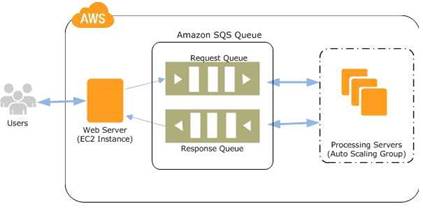
One example is the way Elastic beanstalk manages worker environments. For more information on
this, please visit the below URL:
◆ http://docs.aws.amazon.com/elasticbeanstalk/latest/dg/using-features-managing-env-tiers.htmI
NEW QUESTION 4
You have an Autoscaling Group which is launching a set of t2.small instances. You now need to replace those instances with a larger instance type. How would you go about making this change in an ideal manner?
- A. Changethe Instance type in the current launch configuration to the new instance type.
- B. Createanother Autoscaling Group and attach the new instance type.
- C. Createa new launch configuration with the new instance type and update yourAutoscaling Group.
- D. Changethe Instance type of the Underlying EC2 instance directly.
Answer: C
Explanation:
Answer - C
The AWS Documentation mentions
A launch configuration is a template that an Auto Scaling group uses to launch EC2 instances. When you create a launch configuration, you specify information for the instances such as the ID of the Amazon Machine Image (AMI), the instance type, a key pair, one or more security groups, and a block device mapping. If you've launched an EC2 instance before, you specified the same information in order to launch the instance. When you create an Auto Scalinggroup, you must specify a launch configuration. You can specify your launch configuration with multiple Auto Scaling groups.
However, you can only specify one launch configuration for an Auto Scalinggroup at a time, and you can't modify a launch configuration after you've created it.
Therefore, if you want to change the launch configuration for your Auto Scalinggroup, you must create a launch configuration and then update your Auto Scaling group with the new launch configuration.
For more information on launch configurations please see the below link:
• http://docs.aws.amazon.com/autoscaling/latest/userguide/l_au nchConfiguration.html
NEW QUESTION 5
You are a Devops Engineer for your company. There is a requirement to log each time an Instance is scaled in or scaled out from an existing Autoscaling Group. Which of the following steps can be implemented to fulfil this requirement. Each step forms part of the solution.
- A. Createa Lambda function which will write the event to Cloudwatch logs
- B. Createa Cloudwatch event which will trigger the Lambda function.
- C. Createan SQS queue which will write the event to Cloudwatch logs
- D. Createa Cloudwatch event which will trigger the SQS queue.
Answer: AB
Explanation:
The AWS documentation mentions the following
You can run an AWS Lambda function that logs an event whenever an Auto Scaling group launches or terminates an Amazon CC2 instance and whether the launch or terminate event was successful.
For more information on configuring lambda with Cloudwatch events for this scenario, please visit the URL:
◆ http://docs.aws.amazon.com/AmazonCloudWatch/latest/events/LogASGroupState.html
NEW QUESTION 6
Which of the following file needs to be included along with your source code binaries when your application uses the EC2/On-Premises compute platform, and deploy it using the AWS Code Deploy service.
- A. appspec.yml
- B. appconfig.yml
- C. appspecjson
- D. appconfigjson
Answer: A
Explanation:
The AWS Documentation mentions the below
The application specification file (AppSpec file) is a YAML-formatted file used by AWS CodeDeploy to determine:
what it should install onto your instances from your application revision in Amazon S3 or GitHub. which lifecycle event hooks to run in response to deployment lifecycle events. An AppSpec file must be named appspec.yml and it must be placed in the root of an application's source code's directory structure. Otherwise, deployments will fail. For more information on the appspec file, please visit the below URL:
http://docs.aws.amazon.com/codedeploy/latest/userguide/reference-appspec-file.html
Note: If you deploying your code on AWS Lambda compute platform. An AppSpec file can be YAML- formatted or JSON-for matted. You can also enter the contents of an AppSpec file directly into AWS CodeDeploy console when you create a deployment.
However, this question is about along with your source code binaries on an CC2/On-Premises Compute Platform. So, an AppSpec file must be a YAM L-formatted file named appspec.yml and it must be placed in the root of the directory structure of an application's source code. Otherwise, deployments fail.
NEW QUESTION 7
As part of your continuous deployment process, your application undergoes an I/O load performance test before it is deployed to production using new AMIs. The application uses one Amazon Elastic Block Store (EBS) PIOPS volume per instance and requires consistent I/O performance. Which of the following must be carried out to ensure that I/O load performance tests yield the correct results in a repeatable manner?
- A. Ensure that the I/O block sizes for the test are randomly selected.
- B. Ensure that the Amazon EBS volumes have been pre-warmed by reading all the blocks before the test.
- C. Ensure that snapshots of the Amazon EBS volumes are created as a backup.
- D. Ensure that the Amazon EBS volume is encrypted.
Answer: B
Explanation:
During the AMI-creation process, Amazon CC2 creates snapshots of your instance's root volume and any other CBS volumes attached to your instance
New CBS volumes receive their maximum performance the moment that they are available and do not require initialization (formerly known as pre-warming).
However, storage blocks on volumes that were restored from snapshots must to initialized (pulled
down from Amazon S3 and written to the volume) before you can access the block. This preliminary action takes time and can cause a significant increase in the latency of an I/O operation the first time each block is accessed. For most applications, amortizing this cost over the lifetime of the volume is acceptable.
Option A is invalid because block sizes are predetermined and should not be randomly selected. Option C is invalid because this is part of continuous integration and hence volumes can be destroyed after the test and hence there should not be snapshots created unnecessarily
Option D is invalid because the encryption is a security feature and not part of load tests normally. For more information on CBS initialization please refer to the below link:
• http://docs.aws.a mazon.com/AWSCC2/latest/UserGuide/ebs-in itialize.html
NEW QUESTION 8
Your company is planning to setup a wordpress application. The wordpress application will connect to a MySQL database. Part of the requirement is to ensure that the database environment is fault
tolerant and highly available. Which of the following 2 options individually can help fulfil this requirement.
- A. Create a MySQL RDS environment with Multi-AZ feature enabled
- B. Create a MySQL RDS environment and create a Read Replica
- C. Create multiple EC2 instances in the same A
- D. Host MySQL and enable replication via scripts between the instances.
- E. Create multiple EC2 instances in separate AZ'
- F. Host MySQL and enable replication via scripts between the instances.
Answer: AD
Explanation:
One way to ensure high availability and fault tolerant environments is to ensure Instances are located across multiple availability zones. Hence if you are hosting
MySQL yourself, ensure you have instances spread across multiple AZ's
The AWS Documentation mentions the following about the multi-AZ feature
Amazon RDS provides high availability and failover support for DB instances using Multi-AZ deployments. Amazon RDS uses several different technologies to provide failover support. Multi-AZ deployments for Oracle, PostgreSGL, MySQL, and MariaDB DB instances use Amazon's failover technology
For more information on AWS Multi-AZ deployments, please visit the below URL: http://docs.aws.amazon.com/AmazonRDS/latest/UserGuide/Concepts.MultiAZ.html
NEW QUESTION 9
Of the 6 available sections on a Cloud Formation template (Template Description Declaration, Template Format Version Declaration, Parameters, Resources, Mappings, Outputs), which is the only one required for a CloudFormation template to be accepted? Choose an answer from the options below
- A. Parameters
- B. Template Declaration
- C. Mappings
- D. Resources
Answer: D
Explanation:
If you refer to the documentation, you will see that Resources is the only mandatory field
Specifies the stack resources and their properties, such as an Amazon Elastic Compute Cloud instance or an Amazon Simple Storage Service bucket.
For more information on cloudformation templates, please refer to the below link:
• http://docs.aws.amazon.com/AWSCIoudFormation/latest/UserGuide/template-anatomy.html
NEW QUESTION 10
You are in charge of designing a Cloudformation template which deploys a LAMP stack. After deploying a stack, you see that the status of the stack is showing as CREATE_COMPLETE, but the apache server is still not up and running and is experiencing issues while starting up. You want to ensure that the stack creation only shows the status of CREATE_COMPLETE after all resources defined in the stack are up and running. How can you achieve this?
Choose 2 answers from the options given below.
- A. Definea stack policy which defines that all underlying resources should be up andrunning before showing a status of CREATE_COMPLETE.
- B. Uselifecycle hooks to mark the completion of the creation and configuration of theunderlying resource.
- C. Usethe CreationPolicy to ensure it is associated with the EC2 Instance resource.
- D. Usethe CFN helper scripts to signal once the resource configuration is complete.
Answer: CD
Explanation:
The AWS Documentation mentions
When you provision an Amazon EC2 instance in an AWS Cloud Formation stack, you might specify additional actions to configure the instance, such as install software packages or bootstrap applications. Normally, CloudFormation proceeds with stack creation after the instance has been successfully created. However, you can use a Creation Pol icy so that CloudFormation proceeds with stack creation only after your configuration actions are done. That way you'll know your applications are ready to go after stack creation succeeds.
For more information on the Creation Policy, please visit the below url https://aws.amazon.com/blogs/devops/use-a-creationpolicy-to-wait-for-on-instance-configurations/
NEW QUESTION 11
You are a Devops Engineer for your company. You are responsible for creating Cloudformation templates for your company. There is a requirement to ensure that an S3 bucket is created for all
resources in development for logging purposes. How would you achieve this?
- A. Createseparate Cloudformation templates for Development and production.
- B. Createa parameter in the Cloudformation template and then use the Condition clause inthe template to create an S3 bucket if the parameter has a value of development
- C. Createan S3 bucket from before and then just provide access based on the tag valuementioned in the Cloudformation template
- D. Usethe metadata section in the Cloudformation template to decide on whether tocreate the S3 bucket or not.
Answer: B
Explanation:
The AWS Documentation mentions the following
You might use conditions when you want to reuse a template that can create resources in different contexts, such as a test environment versus a production environment In your template, you can add an CnvironmentType input parameter, which accepts either prod or test as inputs. For the production environment, you might include Amazon CC2 instances with certain capabilities; however, for the test environment, you want to use reduced capabilities to save money. With conditions, you can define which resources are created and how they're configured for each environment type.
For more information on Cloudformation conditions please visit the below url http://docs.aws.amazon.com/AWSCIoudFormation/latest/UserGuide/cond itions-section- structure.htm I
NEW QUESTION 12
You have configured the following AWS services in your organization - Auto Scalinggroup, Elastic Load Balancer, and EC2 instances. You have been requested to terminate an instance from the Autoscaling Group when the CPU utilization is less than 30%. How can you achieve this.
- A. Createa Cloud Watch alarm to send a notification to SQ
- B. SQS can then remove oneinstance from the Autoscaling Group.
- C. Createa CloudWatch alarm to send a notification to the Auto Scalinggroup when theaggregated CPU utilization is less than 30% and configure the Auto Scalingpolicy to remove one instance.
- D. Createa CloudWatch alarm to send a notification to the EL
- E. The ELB can then removeone instance from the Autoscaling Group.
- F. Createa CloudWatch alarm to send a notification to the admin tea
- G. The admin team canthen manually terminate an instance from the Autnsraline Groun.
Answer: B
Explanation:
The AWS Documentation mentions the following
You should have two policies, one for scaling in (terminating instances) and one for scaling out (launching instances), for each event to monitor. For example, if you want to scale out when the network bandwidth reaches a certain level, create a policy specifying that Auto Scaling should start a certain number of instances to help with your traffic. But you may also want an accompanying policy to scale in by a certain number when the network bandwidth level goes back down
For more information on the scaling plans, please see the below link: http://docs.aws.amazon.com/autoscaling/latest/userguide/sca I ing_plan.htmI
NEW QUESTION 13
You currently have an Autoscalinggroup that has the following settings Min capacity-2
Desired capacity - 2 Maximum capacity - 4
The current number of instances running in the Autoscaling Group is 2. You have been notified that for a duration of an hour, you need to ensure that no new instances are launched by the Autoscaling Group Which of the below 2 actions can be carried out to fulfil this requirement
- A. Change the Maximum capacity to 2
- B. Change the Desired capacity to 4
- C. Suspend the Launch process of the Autoscaling Group
- D. Change the Minimum capacity to 2
Answer: AC
Explanation:
You can temporarily suspend the creation of new instances by either reducing the Maximum capacity to 2, so that the current instances running which is 2, matches the maximum limit.
Secondly you can suspend the launch process of the Autoscaling Group The AWS Documentation mentions
Scaling Processes
Amazon CC2 Auto Scaling supports the following scaling processes:
Launch Adds a new CC2 instance to the group, increasing its capacity. Warning
If you suspend Launch, this disrupts other processes. For example, you can't return an instance in a standby state to service if the Launch process is suspended, because the group can't scale. For more information on Autoscaling Suspend and Resume, please visit the below URL:
◆ http://docs.aws.amazon.com/autoscaling/latest/userguide/as-suspend-resume-processes.html
NEW QUESTION 14
You are a Devops Engineer for your company. You have been instructed to create a continuous integrated and continuous delivery model for the application in your organization. Which of the below services could be used for this purpose. Choose 2 answers from the options given below
- A. AWSCodeDeploy
- B. AWSCodePipeline
- C. AWSSQS
- D. AWSIAM
Answer: AB
Explanation:
The AWS Documentation mentions the below
AWS CodeDeploy is a deployment sen/ice that automates application deployments to Amazon EC2 instances or on-premises instances in your own facility.
You can deploy a nearly unlimited variety of application content, such as code, web and configuration files, executables, packages, scripts, multimedia files, and so on. AWS CodeDeploy can deploy application content stored in Amazon S3 buckets, GitHub repositories, or Bitbucket repositories.
For more information on AWS Code Deploy, please visit the below URL:
• http://docs.aws.amazon.com/codedeploy/latest/userguide/welcome.html
AWS CodePipeline is a continuous delivery service you can use to model, visualize, and automate the
steps required to release your software. You can quickly model and configure the different stages of a software release process. AWS CodePipeline automates the steps required to release your software changes continuously. For more information on AWS Code Pipeline, please visit the below URL:
• http://docs.aws.amazon.com/codepipeline/latest/userguide/welcome.html
NEW QUESTION 15
You are creating an application which stores extremely sensitive financial information. All information in the system must be encrypted at rest and in transit. Which of these is a violation of this policy?
- A. ELB SSL termination.
- B. ELB Using Proxy Protocol v1.
- C. CloudFront Viewer Protocol Policy set to HTTPS redirection.
- D. Telling S3 to use AES256 on the server-side.
Answer: A
Explanation:
If you use SSL termination, your servers will always get non-secure connections and will never know whether users used a more secure channel or not. If you are using Elastic beanstalk to configure the ELB, you can use the below article to ensure end to end encryption. http://docs.aws.amazon.com/elasticbeanstalk/latest/dg/configuring-https-endtoend.html
NEW QUESTION 16
Your team wants to begin practicing continuous delivery using CloudFormation, to enable automated builds and deploys of whole, versioned stacks or stack layers. You have a 3-tier, mission-critical system. Which of the following is NOT a best practice for using CloudFormation in a continuous delivery environment?
- A. Use the AWS CloudFormation ValidateTemplate call before publishing changes to AWS.
- B. Model your stack in one template, so you can leverage CloudFormation's state management and dependency resolution to propagate all changes.
- C. Use CloudFormation to create brand new infrastructure for all stateless resources on each push, and run integration tests on that set of infrastructure.
- D. Parametrize the template and use Mappings to ensure your template works in multiple Regions.
Answer: B
Explanation:
Answer - B
Some of the best practices for Cloudformation are
• Created Nested stacks
As your infrastructure grows, common patterns can emerge in which you declare the same components in each of your templates. You can separate out these common components and create dedicated templates for them. That way, you can mix and match different templates but use nested stacks to create a single, unified stack. Nested stacks are stacks that create other stacks. To create nested stacks, use the AWS::CloudFormation::Stackresource in your template to reference other templates.
• Reuse Templates
After you have your stacks and resources set up, you can reuse your templates to replicate your infrastructure in multiple environments. For example, you can create environments for development, testing, and production so that you can test changes before implementing them into production. To make templates reusable, use the parameters, mappings, and conditions sections so that you can customize your stacks when you create them. For example, for your development environments, you can specify a lower-cost instance type compared to your production environment, but all other configurations and settings remain the same. For more information on Cloudformation best practises, please visit the below URL: http://docs.aws.amazon.com/AWSCIoudFormation/latest/UserGuide/best-practices.html
NEW QUESTION 17
You work for an insurance company and are responsible for the day-to-day operations of your company's online quote system used to provide insurance quotes to members of the public. Your company wants to use the application logs generated by the system to better understand customer behavior. Industry, regulations also require that you retain all application logs for the system indefinitely in order to investigate fraudulent claims in the future. You have been tasked with designing a log management system with the following requirements:
- All log entries must be retained by the system, even during unplanned instance failure.
- The customer insight team requires immediate access to the logs from the past seven days.
- The fraud investigation team requires access to all historic logs, but will wait up to 24 hours before these logs are available.
How would you meet these requirements in a cost-effective manner? Choose three answers from the options below
- A. Configure your application to write logs to the instance's ephemeral disk, because this storage is free and has good write performanc
- B. Create a script that moves the logs from the instance to Amazon S3 once an hour.
- C. Write a script that is configured to be executed when the instance is stopped or terminated and that will upload any remaining logs on the instance to Amazon S3.
- D. Create an Amazon S3 lifecycle configuration to move log files from Amazon S3 to Amazon Glacier after seven days.
- E. Configure your application to write logs to the instance's default Amazon EBS boot volume, because this storage already exist
- F. Create a script that moves the logs from the instance to Amazon S3 once an hour.
- G. Configure your application to write logs to a separate Amazon EBS volume with the "delete on termination" field set to fals
- H. Create a script that moves the logs from the instance to Amazon S3 once an hour.
- I. Create a housekeeping script that runs on a T2 micro instance managed by an Auto Scaling group for high availabilit
- J. The script uses the AWS API to identify any unattached Amazon EBS volumes containing log file
- K. Your housekeeping script will mount the Amazon EBS volume, upload all logs to Amazon S3, and then delete the volume.
Answer: CEF
Explanation:
Since all logs need to be stored indefinitely. Glacier is the best option for this. One can use Lifecycle events to stream the data from S3 to Glacier
Lifecycle configuration enables you to specify the lifecycle management of objects in a bucket. The configuration is a set of one or more rules, where each rule
defines an action for Amazon S3 to apply to a group of objects. These actions can be classified as
follows:
• Transition actions - In which you define when objects transition to another storage class. For example, you may choose to transition objects to the STANDARDJA QK for infrequent access) storage class 30 days after creation, or archive objects to the GLACIER storage class one year after creation.
• Expiration actions - In which you specify when the objects expire. Then Amazon S3 deletes the expired objects on your behalf. For more information on Lifecycle events, please refer to the below link:
• http://docs.aws.a mazon.com/AmazonS3/latest/dev/object-lifecycle-mgmt.htm I You can use scripts to put the logs onto a new volume and then transfer those logs to S3.
Note:
Moving the logs from CBS volume to S3 we have some custom scripts running in the background. Inorder to ensure the minimum memory requirements for the OS and the applications for the script to execute we can use a cost effective ec2 instance.
Considering the computing resource requirements of the instance and the cost factor a tZmicro instance can be used in this case.
The following link provides more information on various t2 instances. https://docs.aws.amazon.com/AWSCC2/latest/WindowsGuide/t2-instances.html
Question is "How would you meet these requirements in a cost-effective manner? Choose three answers from the options below"
So here user has to choose the 3 options so that the requirement is fulfilled. So in the given 6 options, options C, C and F fulfill the requirement.
" The CC2s use CBS volumes and the logs are stored on CBS volumes those are marked for non- termination" - is one of the way to fulfill requirement. So this shouldn't be a issue.
NEW QUESTION 18
You have a multi-docker environment that you want to deploy to AWS. Which of the following configuration files can be used to deploy a set of Docker containers as an Elastic Beanstalk application?
- A. Dockerrun.awsjson
- B. .ebextensions
- C. Dockerrunjson
- D. Dockerfile
Answer: A
Explanation:
A Dockerrun.aws.json file is an Clastic Beanstalk-specific JSON file that describes how to deploy a set of Docker containers as an Clastic Beanstalk application. You can use aDockerrun.aws.json file for a multicontainer Docker environment.
Dockerrun.aws.json describes the containers to deploy to each container instance in the environment as well as the data volumes to create on the host instance for
the containers to mount. http://docs.aws.amazon.com/elasticbeanstalk/latest/dg/create_deploy_docker_v2config.html
NEW QUESTION 19
You currently have an application deployed via Elastic Beanstalk. You are now deploying a new application and have ensured that Elastic beanstalk has detached the current instances and deployed and reattached new instances. But the new instances are still not receiving any sort of traffic. Why is this the case.
- A. The instances are of the wrong AMI, hence they are not being detected by the ELB.
- B. It takes time for the ELB to register the instances, hence there is a small timeframe before your instances can start receiving traffic
- C. You need to create a new Elastic Beanstalk application, because you cannot detach and then reattach instances to an ELB within an Elastic Beanstalk application
- D. The instances needed to be reattached before the new application version was deployed
Answer: B
Explanation:
Before the CC2 Instances can start receiving traffic, they will be checked via the health checks of the CLB. Once the health checks are successful, the CC2 Instance
will change its state to InService and then the EC2 Instances can start receiving traffic. For more information on ELB health checks, please refer to the below link: http://docs.aws.amazon.com/elasticloadbalancing/latest/classic/elb-healthchecks.html
NEW QUESTION 20
Which of the following are advantages of using AWS CodeCommit over hosting your own source code repository system?
- A. Reduction in hardware maintenance costs
- B. Reduction in fees paid over licensing
- C. No specific restriction on files andbranches
- D. All of the above
Answer: D
Explanation:
The AWS Documentation mentions the following on CodeCommit
Self-hosted version control systems have many potential drawbacks, including: Expensive per-developer licensing fees.
High hardware maintenance costs. High support staffing costs.
Limits on the amount and types of files that can be stored and managed.
Limits on the number of branches, the amount of version history, and other related metadata that can be stored. For more information on CodeCommit please refer to the below link
• http://docs.aws.amazon.com/codecommit/latest/userguide/wel come.html
NEW QUESTION 21
Explain what the following resource in a CloudFormation template does? Choose the best possible answer.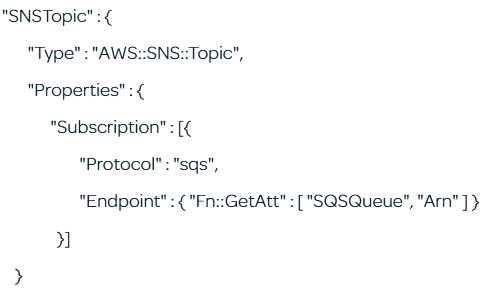
- A. Createsan SNS topic which allows SQS subscription endpoints to be added as a parameteron thetemplate
- B. Createsan SNS topic that allow SQS subscription endpoints
- C. Createsan SNS topic and then invokes the call to create an SQS queue with a logicalresource name of SQSQueue
- D. Creates an SNS topic and adds asubscription ARN endpoint for the SQS resource created under the logical nameSQSQueue
Answer: D
Explanation:
The intrinsic function Fn::GetAtt returns the value of an attribute from a resource in the template. This has nothing to do with adding parameters (Option A is wrong) or allowing endpoints (Option B is wrong) or invoking relevant calls (Option C is wrong)
For more information on Fn:: GetAtt function please refer to the below link
http://docs.aws.a mazon.com/AWSCIoudFormation/latest/UserGuide/intrinsic-function -reference- getatt.htm I
NEW QUESTION 22
A company has EC2 instances running in AWS. The EC2 instances are running via an Autoscaling solution. There is a lot of requests being lost because of the load on the servers. The Autoscaling solution is launching new instances to take the load but there are still some requests which are being lost. Which of the following is likely to provide the most cost-effective solution to avoid losing recently submitted requests? Choose the correct answer from the options given below
- A. UseanSQS queue to decouple the application components
- B. Keepone extra EC2 instance always powered on in case a spike occurs
- C. Uselarger instances for your application
- D. Pre -warmyour Elastic Load Balancer
Answer: A
Explanation:
Amazon Simple Queue Service (SQS) is a fully-managed message queuing service for reliably communicating among distributed software components and microservices - at any scale. Building applications from individual components that each perform a discrete function improves scalability and reliability, and is best practice design for modern applications
For more information on SQS, please refer to the below link:
• https://aws.amazon.com/sqs/
NEW QUESTION 23
You are a Devops Engineer and are designing an Opswork stack in AWS. The company has some custom recipes that are part of their on-premise Chef configuration. These same recipes need to be run whenever an instance is launched in Opsworks. Which of the following steps need to be carried out to to ensure this requirement gets fulfilled. Choose 2 answers from the options given below
- A. Ensurethe custom cookbooks option is set in Opswork stack.
- B. Ensurethe custom cookbooks option is set in Opswork layer.
- C. Ensurethe recipe is placed as part of the Setup Lifecycle event as part of the Layersetting.
- D. Ensurethe recipe is placed as part of the Setup Lifecycle event as part of the Stacksetting.
Answer: AC
Explanation:
The AWS Documentation mentions the below
Each layer has a set of built-in recipes assigned to each lifecycle event, although some layers lack Undeploy recipes. When a lifecycle event occurs on an instance,
AWS OpsWorks Stacks runs the appropriate set of recipes for the associated layer.
The below diagram shows a snapshot in the stack settings where you can enable custom cookbooks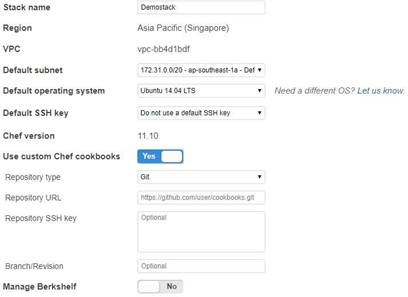
For more information on automating recipe's, please visit the below URL: http://docs.aws.amazon.com/opsworks/latest/userguide/workingcookbook-assigningcustom.html
NEW QUESTION 24
Which of the following will you need to consider so you can set up a solution that incorporates single sign-on from your corporate AD or LDAP directory and restricts access for each user to a designated user folder in a bucket? Choose 3 Answers from the options below
- A. Setting up a federation proxy or identity provider
- B. Using AWS Security Token Service to generate temporary tokens
- C. Tagging each folder in the bucket
- D. Configuring 1AM role
- E. Setting up a matching 1AM user for every user in your corporate directory that needs access to a folder in the bucket
Answer: ABD
Explanation:
The below diagram showcases how authentication is carried out when having an identity broker. This is an example of a SAML connection, but the same concept
holds true for getting access to an AWS resource.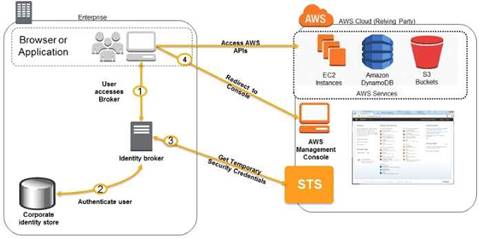
For more information on federated access, please visit the below link: http://docs.aws.amazon.com/IAM/latest/UserGuide/id_roles_com mon-scenarios_federated- users.htm I
https://docs.aws.a mazon.com/IAM/latest/UserGuide/id_roles_create_for-idp_sam I. html?icmpid=docs_iam_console
https://aws.ama zon.com/blogs/secu rity/writing-iam-policies-grant-access-to-user-specific-folders-in-an-amazon-s3-bucket/
NEW QUESTION 25
You are responsible for your company's large multi-tiered Windows-based web application running on Amazon EC2 instances situated behind a load balancer. While reviewing metrics, you've started noticing an upwards trend for slow customer page load time. Your manager has asked you to come up with a solution to ensure that customer load time is not affected by too many requests per second. Which technique would you use to solve this issue?
- A. Re-deploy your infrastructure usingan AWS CloudFormation templat
- B. Configure Elastic Load Balancing health checks to initiate a new AWS CloudFormation stack when health checks return failed.
- C. Re-deploy your infrastructure using an AWS CloudFormation templat
- D. Spin up a second AWS CloudFormation stac
- E. Configure Elastic Load Balancing SpillOver functionality to spill over any slow connections to the second AWS CloudFormation stack.
- F. Re-deploy your infrastructure using AWS CloudFormation, Elastic Beanstalk, and Auto Scalin
- G. Setup your Auto Scalinggroup policies to scale based on the number of requests per second as well as the current customer load tim
- H. •>/D- Re-deploy your application using an Auto Scaling templat
- I. Configure the Auto Scaling template to spin up a new Elastic Beanstalk application when the customer load time surpasses your threshold.
Answer: C
Explanation:
Auto Scaling helps you ensure that you have the correct number of Amazon CC2 instances available to handle the load for your application. You create collections of
CC2 instances, called Auto Scaling groups. You can specify the minimum number of instances in each Auto Scaling group, and Auto Scaling ensures that your group
never goes below this size. You can specify the maximum number of instances in each Auto Scaling group, and Auto Scaling ensures that yourgroup never goes
above this size. If you specify the desired capacity, either when you create the group or at any time thereafter. Auto Scaling ensures that yourgroup has this many
instances. If you specify scaling policies, then Auto Scaling can launch or terminate instances as demand on your application increases or decreases.
Option A and B are invalid because Autoscaling is required to solve the issue to ensure the application can handle high traffic loads.
Option D is invalid because there is no Autoscaling template.
For more information on Autoscaling, please refer to the below document link: from AWS http://docs.aws.amazon.com/autoscaling/latest/userguide/Whatl sAutoScaling.html
NEW QUESTION 26
......
P.S. Surepassexam now are offering 100% pass ensure DOP-C01 dumps! All DOP-C01 exam questions have been updated with correct answers: https://www.surepassexam.com/DOP-C01-exam-dumps.html (116 New Questions)