It is impossible to pass Microsoft AZ-202 exam without any help in the short term. Come to us soon and find the most advanced, correct and guaranteed AZ-202 Dumps Questions. You will get a surprising result by our AZ-202 Dumps Questions.
Microsoft AZ-202 Free Dumps Questions Online, Read and Test Now.
NEW QUESTION 1
You are developing a solution that requires serverless code execution in Azure.
The solution has two functions that must run in a specific order.
You need to ensure that the second function can use the output from the first function,
How should you complete the code? To answer, select the appropriate options in the answer area, NOTE: Each correct selection is worth one point.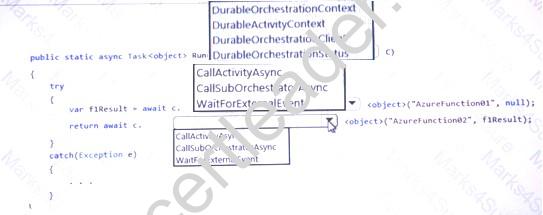
Answer:
Explanation: 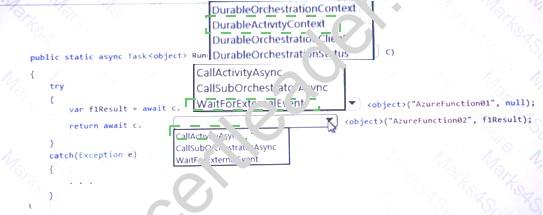
NEW QUESTION 2
Note: In this section you will see one or more sets of questions with the same scenario and problem. Each question presents a unique solution to the problem, and you must determine whether the solution meets the stated goals. More than one solution might solve the problem. It is also possible that none of the solutions solve the problem.
After you answer a question in this section, you will NOT be able to return to it. As a result, these questions will not appear in the review screen.
Note: This question is part of a series of questions that present the same scenario. Each question in the series contains a unique solution. Determine whether the solution meets the stated goals.
You need to meet the vendor notification requirement.
Solution: Update the Delivery API to send emails by using a Microsoft Office 365 SMTP server. Does the solution meet the goal?
- A. Yes
- B. No
Answer: B
Explanation: Use a custom outbound Azure API Management policy. Scenario:
If a vendor is nearing the number of calls or bandwidth limit, the API must trigger email notifications to the vendor.
(API usage must not exceed 5,000 calls and 50,000 kilobytes of bandwidth per hour per vendor.) References:
https://docs.microsoft.com/en-us/azure/api-management/api-management-howto-policies
NEW QUESTION 3
Note: This question is part of a series of questions that present the same scenario. Each question in the series contains a unique solution. Determine whether the solution meets the stated goals.
You develop an entertainment application where users can buy and trade virtual real estate. The application must scale to support thousands of users.
The current architecture includes five Azure Virtual Machines (VM) that connect to an Azure SQL Database for account information and Azure Table Storage for backend services. A user interacts with these components in the cloud at any given time
- Routing Service – Routes a request to the appropriate service and must not persist data across sessions
- Account Service – Stores and manages all account information and authentication and requires data to persist across sessions.
- User Service – Stores and manages all user information and requires data to persist across sessions.
- Housing Network Service – Stores and manages the current real-estate economy and requires data to persist across sessions.
- Trade Service – Stores and manages virtual trade between accounts and requires data to persist across sessions.
Due to volatile user traffic, a microservices solution is selected for scale agility.
You need to migrate to a distributed microservices solution on Azure Service Fabric.
Solution: Create a Service Fabric Cluster with a stateful Reliable Service for Routing Service. Deploy a Guest Executable to Service Fabric for each component.
Does the solution meet the goal?
- A. YES
- B. NO
Answer: B
Explanation: We should use stateful services when we want data to persist, and stateless service when data must not persist. References:
https://docs.microsoft.com/en-us/azure/service-fabric/service-fabric-reliable-services-introduction
NEW QUESTION 4
Note: This question is part of a series of questions that present the same scenario. Each question in the series contains a unique solution.
Determine whether the solution meets the stated goals. You need to meet the vendor notification requirement.
Solution: Create and apply a custom outbound Azure API Management policy. Does the solution meet the goal?
- A. Yes
- B. No
Answer: A
Explanation: Scenario:
If a vendor is nearing the number of calls or bandwidth limit, the API must trigger email notifications to the vendor.
(API usage must not exceed 5,000 calls and 50,000 kilobytes of bandwidth per hour per vendor.)
In Azure API Management (APIM), policies are a powerful capability of the system that allow the publisher to change the behavior of the API through configuration. Policies are a collection of Statements that are executed sequentially on the request or response of an API. Popular Statements include format conversion from XML to JSON and call rate limiting to restrict the amount of incoming calls from a developer. Many more policies are available out of the box.
References:
https://docs.microsoft.com/en-us/azure/api-management/api-management-howto-policies
NEW QUESTION 5
You are creating a bot for a company by using QnA Maker.
You need to ensure that the company can update the bot without third-party assistance. What should you use? To answer, select the appropriate options in the answer area. NOTE: Each correct selection is worth one point.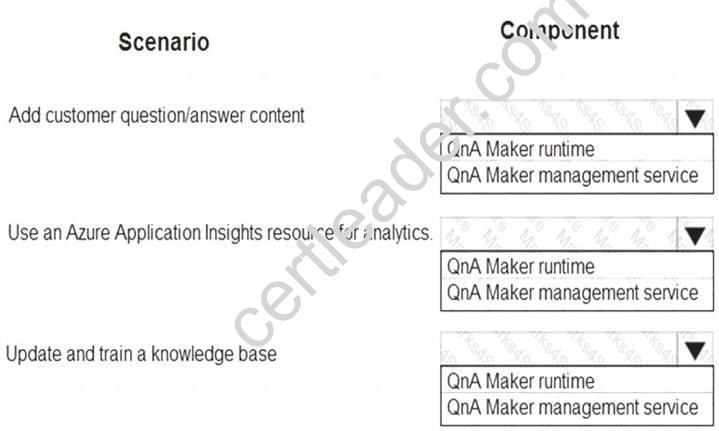
Answer:
Explanation: 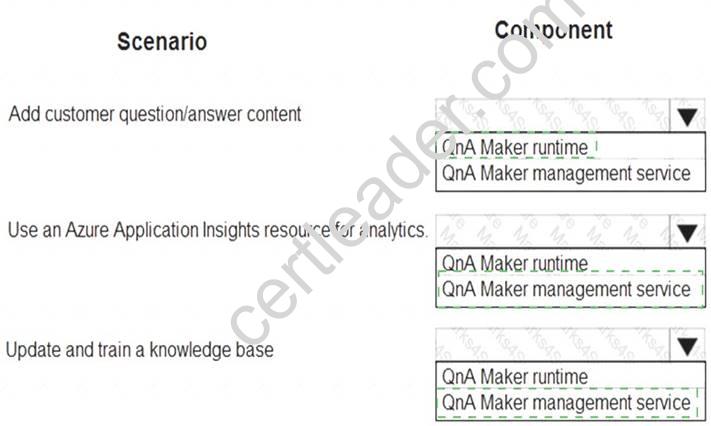
NEW QUESTION 6
You are developing a workflow solution using Azure technologies.
What should you Implement to meet each requirement? To answer, select the appropriate options in the answer area.
NOTE: Each correct selection is worth one point.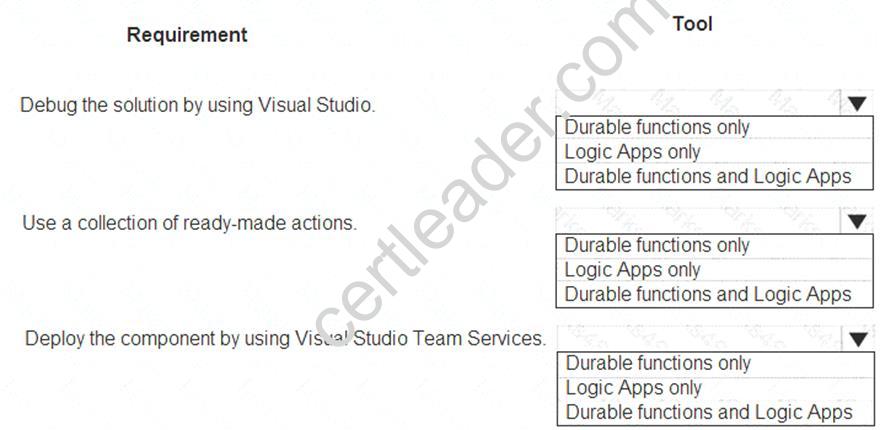
Answer:
Explanation: Box 1: Logic Apps only
You can manually trigger a logic app deployed in Azure from Visual Studio. On the Logic App Designer toolbar, choose Run Trigger.
To check the status and diagnose problems with logic app runs, you can review the details, such as inputs and outputs, for those runs in Visual Studio.
Box 2: Durable functions only
Box 3: Durable functions and Logic Apps References:
https://docs.microsoft.com/en-us/azure/logic-apps/manage-logic-apps-with-visual-studio https://docs.microsoft.com/en-us/azure/azure-functions/durable/durable-functions-create-portal
NEW QUESTION 7
You are a developer tot a SaaS company that otters many web services. All web services tot the company must meet the following requirements:
• Use API Management to access the services
• Use OpenID Connect for authentication.
• Prevent anonymous usage
A recent security audit found that several web services can be called without any authentication. Which API Management policy should you implement?
- A. validate-jwt
- B. authentication-certificate
- C. check-header
- D. jsonp
Answer: B
NEW QUESTION 8
You manage a web application that is hosted in multiple Azure regions. The application uses Azure Append blobs to store audit logs. Each hosted instance of the application maintains its own audit logs.
You have a central Append blob that serves as a master record of all audit logs. The master audit log is updated on a schedule to include all local copies from each region. The local copies are then discarded.
You need to append each of the local audit logs to the master audit log. Which method should you use?
- A. Start-AzureStorageBlobCopy PowerShell command
- B. Append Block operation of the Azure Storage Services REST API
- C. Copy Blob operation of the Azure Storage Services REST API
- D. AzCopy tool with the /BlobType:Append parameter
Answer: B
NEW QUESTION 9
Note: This question is part of a series of questions that present the same scenario. Each question in the series contains a unique solution. Determine whether the solution meets the stated goals.
You have the following resource groups: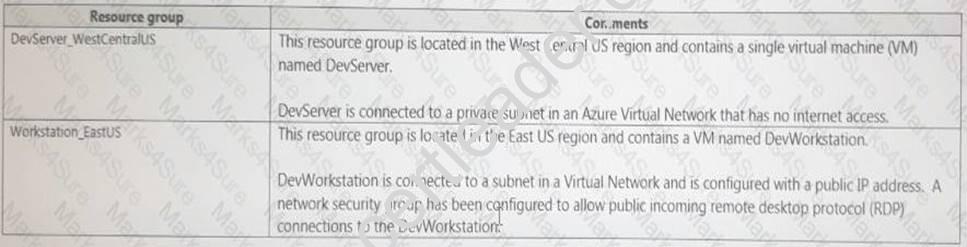
Developers must conned to DevServer only through DevWorkstation. To maintain security, DevServer must not accept connections (rom the internet.
You need to create a private connection between the DevWorkstation and DevServer.
Solution: Configure a VNet-to-VNet VPN connection between the two private Virtual Networks using VPN gati allow connectivity between the DevServer and the DevWorkstation using their private IP addresses.
Does the solution meet the goal?
- A. Yes
- B. No
Answer: B
NEW QUESTION 10
You need to ensure the security policies are met. What code do you add at line CS07?
A)
B)
C)
D)
- A. Option A
- B. Option B
- C. Option C
- D. Option D
Answer: D
NEW QUESTION 11
You need to update the chatbot to greet the user when they sign in.
Which two rich card formats can you use? Each correct answer presents a complete solution. NOTE: Each correct selection is worth one point
- A. Thumbnail
- B. Adaptive
- C. Sign-in
- D. Hero
- E. Animation
Answer: AC
Explanation: Scenario: The chatbot greeting interface must match the formatting of the following example: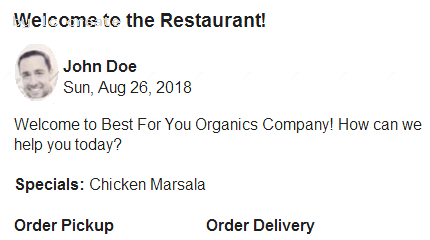
A message exchange between user and bot can contain one or more rich cards rendered as a list or carousel. The Attachments property of the Activity object contains an array of Attachment objects that represent the rich cards and media attachments within the message.
The Bot Framework currently supports eight types of rich cards:
Thumbnail Card. A card that typically contains a single thumbnail image, one or more buttons, and text.
SignIn Card. A card that enables a bot to request that a user sign-in. It typically contains text and one or more buttons that the user can click to initiate the sign-in process.
NEW QUESTION 12
Note: This question is part of a series of questions that present the same solution. Each question in the series contains a unique solution. Determine whether the meets the stated goals.
You connect to Azure by using a workstation that has a slow internet connection. You have two Azure file shares. You plan to transfer a series of large files from one container to another container. The workstation does not have sufficient disk space to store the files.
You define the following variables in Azure PowerShell:
You need to simultaneously transfer the large files as efficiently as possible. Solution: Run the following Azure PowerShell command:
Does the solution meet the goal?
- A. Yes
- B. No
Answer: B
NEW QUESTION 13
You need to deploy a new version of the LabelMaker application.
Which three actions should you perform in sequence? To answer, move the appropriate actions from the list of
actions to the answer area and arrange them in the correct order. NOTE: Each correct selection is worth one point.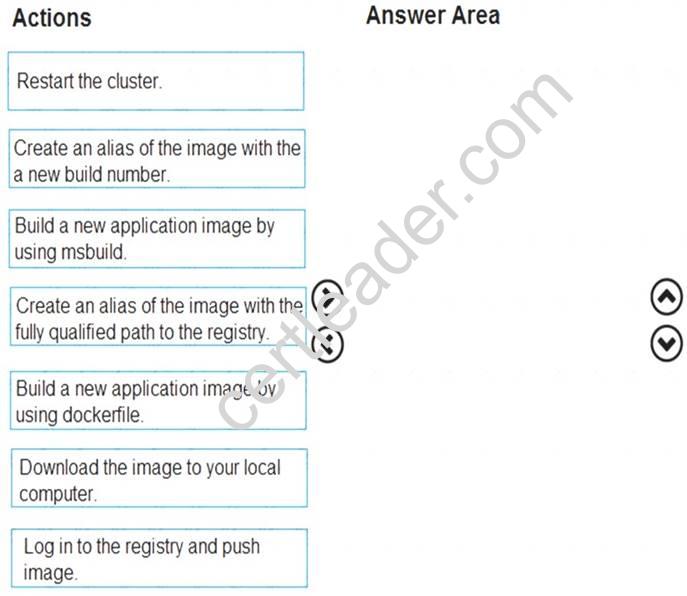
Answer:
Explanation: Step 1: Build a new application image by using dockerfile
Step 2: Create an alias if the image with the fully qualified path to the registry
Before you can push the image to a private registry, you’ve to ensure a proper image name. This can be achieved using the docker tag command. For demonstration purpose, we’ll use Docker’s hello world image, rename it and push it to ACR.
# pulls hello-world from the public docker hub
$ docker pull hello-world
# tag the image in order to be able to push it to a private registry
$ docker tag hello-word <REGISTRY_NAME>/hello-world
# push the image
$ docker push <REGISTRY_NAME>/hello-world Step 3: Log in to the registry and push image
In order to push images to the newly created ACR instance, you need to login to ACR form the Docker CLI. Once logged in, you can push any existing docker image to your ACR instance.
Scenario:
Coho Winery plans to move the application to Azure and continue to support label creation. LabelMaker app
Azure Monitor Container Health must be used to monitor the performance of workloads that are deployed to Kubernetes environments and hosted on Azure Kubernetes Service (AKS).
You must use Azure Container Registry to publish images that support the AKS deployment.
References:
https://thorsten-hans.com/how-to-use-a-private-azure-container-registry-with-kubernetes-9b86e67b93b6 https://docs.microsoft.com/en-us/azure/container-registry/container-registry-tutorial-quick-task
NEW QUESTION 14
You are developing an online order website that uses Azure Durable Functions- You develop the following processes for the website: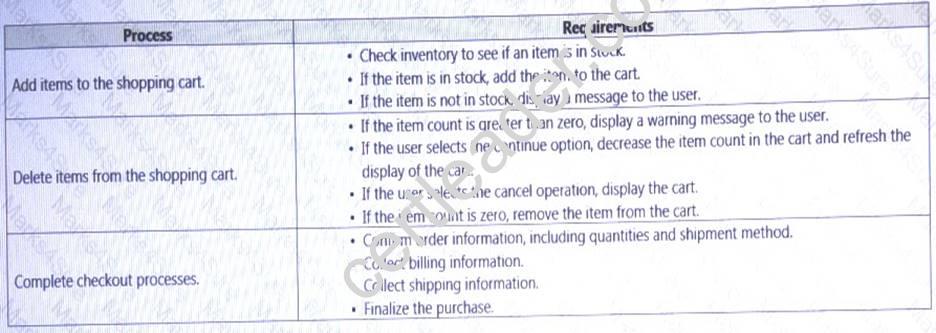
You need to identity what types of functions to use for each step of the process.
Which function types should you use? To answer, drag the appropriate function types to the correct operations. Each function type may be used once, more than once, or not at all. You may need to drag the split bar between panes or scroll to view content.
NOTE: Each correct selection is worth one point.
You need to identify what types of functions to use for each step of the process.
Which function types should you use? To answer, drag the appropriate function types to the correct operations. Each function type may be used once, more than once, or not at all. You may need to drag the split bar between panes or scroll to view content.
NOTE: Each correct selection is worth one point.
Answer:
Explanation: 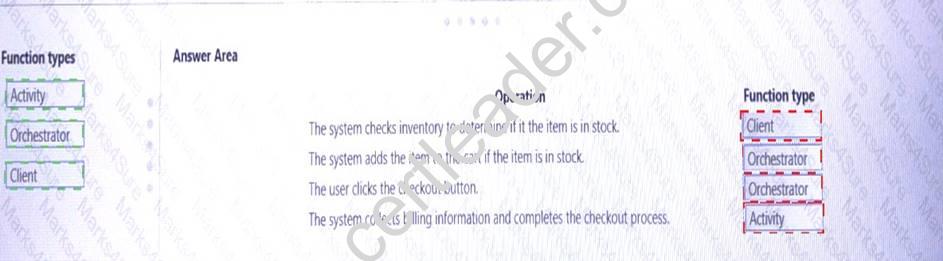
NEW QUESTION 15
Note: This question is part of a series of questions that present the same scenario. Each question in the series contains a unique solution. Determine whether the solution meets the stated goals.
You need to meet the LabelMaker application security requirement.
Solution: Create a Microsoft Azure Active Directory service principal and assign it to the Azure Kubernetes Service (AKS) cluster.
Does the solution meet the goal?
- A. Yes
- B. No
Answer: A
NEW QUESTION 16
You need to meet the scaling requirement for Policy Service. What should you store in Azure Redis Cache?
- A. HttpContext.Items
- B. ViewState
- C. Session state
- D. TempData
Answer: C
NEW QUESTION 17
You have an Azure App Service API that allows users to upload documents to the cloud with a mobile device. A mobile app connects to the service by using REST API calls. When new document is uploaded to the service, the service extracts the document metadata. Usage statistics for the app show significant increases in app usage.
The extraction process is CPU-intensive. You plan to modify the API to use a queue.
You need to ensure that the solution scales, handles request spikes, and reduces costs between request spikes. What should you do?
- A. Configure a CPU Optimized virtual machine (VM) and install the Web App service
- B. Move the extraction logic into an Azure Functio
- C. Create a queue triggered
- D. Move the extraction logic into WebJob
- E. Configure WebJobs to run in a loop and process a queue.
- F. Move the extraction logic into Azure Batc
- G. Configure Azure Batch to process from a queue across a pool of virtual machine (VM) nodes.
Answer: D
NEW QUESTION 18
You plan to create a Docker image that runs an ASP.NET Core application named ContosoApp. You have a setup script named setupScript.psl and a series of application files including ConlosoApp.dll.
You need to create a Dockertile document that meets the following requirements:
• Call setupScript.psl when the container is built.
• Run ContosoApp.dll when the container starts.
The Dockerfile document must be created in the same folder where ContosoApp.dll and setupScript.psl are stored.
Which four commands should you use to develop the solution? To answer, move the appropriate commands from the list of commands to the answer area and arrange them in the correct order.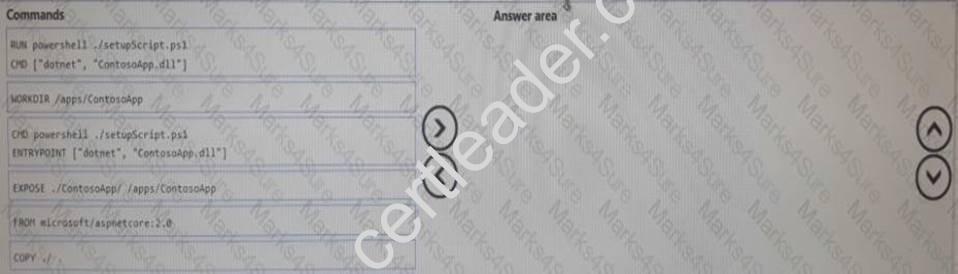
Answer:
Explanation: 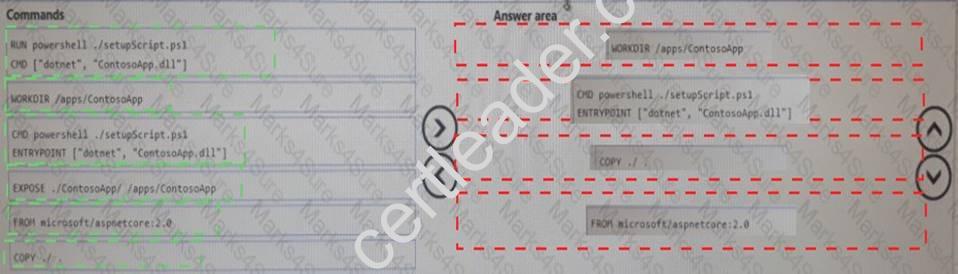
NEW QUESTION 19
You are developing a .NET Core Web Job that is triggered by an Azure Storage Queue.
The project uses dependency injection from the NuGet package Microosft.Extensions.DependencyInjection. The Webjob logic is contained in the Worker class. The program.cs file contains the following code: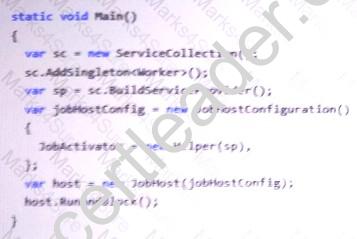
You need to ensure that the Worker class can run when an Azure Storage Queue message arrives.
Which code segments should you use to complete the code? To answer, drag the appropriate code segments to the correct locations. Each code segment may be used once, more than once, or not at all. You may need to drag the split bar between panes or scroll to view content
NOTE: Each correct selection is worth one point.
Answer:
Explanation: 
NEW QUESTION 20
You are developing a mobile instant messaging app for a company. The mobile app must meet the following requirements:
• Support offline data sync.
• Update the latest messages during normal sync cycles. You need to implement Offline Data Sync.
Which two actions should you perform? Each conn I answer presents part of the solution. NOTE: Each correct selection is worth one point.
- A. Retrieve records from Offline Data Sync on every call to the PullAsync method.
- B. Retrieve records from Offline Data Sync using an Incremental Sync.
- C. Push records to Offline Data Sync using an Incremental Sync.
- D. Return the updatedAt column from the Mobile Service Backend and implement sorting by using the column.
- E. Return the updatedAt column from the Mobile Service Backend and implement sorting by the message id.
Answer: BD
100% Valid and Newest Version AZ-202 Questions & Answers shared by 2passeasy, Get Full Dumps HERE: https://www.2passeasy.com/dumps/AZ-202/ (New 150 Q&As)