We offers AZ-202 Free Practice Questions. "Microsoft Azure Developer Certification Transition", also known as AZ-202 exam, is a Microsoft Certification. This set of posts, Passing the AZ-202 exam with AZ-202 Dumps, will help you answer those questions. The AZ-202 Dumps covers all the knowledge points of the real exam. 100% real AZ-202 Exam Questions and revised by experts!
Free demo questions for Microsoft AZ-202 Exam Dumps Below:
NEW QUESTION 1
You need to resolve the delivery API error. What should you do?
- A. Implement simple retry by using the EnableRetryOnFailure feature of Entity Framework.
- B. Implement exponential backoff by using the EnableRetryOnFailure feature of Entity Framework.
- C. Implement the Circuit Breaker pattern by using the EnableRetryOnFailure feature of Entity Framework.
- D. Invoke accustom execution strategy in Entity Framework.
Answer: A
Explanation: Scenario: The Delivery API intermittently throws the following exception:
A useful method to get rid of this error is to use RETRY LOGIC of Entity Framework 1.1.0 services.AddDbContext<DbContext>(options => options.UseSqlServer('yourconnectionstring',
…sqlServerOptionsAction: sqlOptions =>
…{
……sqlOptions.EnableRetryOnFailure(
………maxRetryCount: 5,
………maxRetryDelay: TimeSpan.FromSeconds(30),
………errorNumbersToAdd: new List<int>() { 19 });
…}));
In Retry logic, error 19 is not included. So you have to pass the error code 19 to set retry logic for error code 19.
References:
https://stackoverflow.com/questions/47558062/error-19-physical-connection-error/47559967
NEW QUESTION 2
You use Azure Table storage to store customer information for an application. The data contains customer details and is partitioned by last name. You need to create a query that returns all customers with the last name Smith. Which code segment should you use?
- A. TableQuery.GeneratePilterCondition("LastName", QueryComparisons.Equal, "Smith")
- B. TableQuery.GeneratefilterCondition("PartitionKey", QueryComparison
- C. Equal, "Smith")
- D. TableQue.GenerateFilterCondition("PartitionKey", Equals, "Smith")
- E. TableQuer
- F. GenerateFilterCondition("LastName", Equals, "Smith")
Answer: D
NEW QUESTION 3
You need to provision and deploy the order workflow.
Which three components should you include? Each correct answer presents part of the solution. NOTE: Each correct selection is worth one point
- A. Workflow definition
- B. Connections
- C. Resources
- D. Functions
- E. On-premises Data Gateway
Answer: CDE
NEW QUESTION 4
You are creating a collaborative image hosting platform as an ASP.NET MVC web application. Users add, update, and modify images on the platform. Images are stored in Azure Blob storage.
More than one user at a time must be able to modify the same image. You need to implement optimistic concurrency for uploading images.
Which four actions should you perform in sequence? To answer, move the appropriate actions from the list of actions to the answer area and arrange them in the correct order.
NOTE: Each correct solution is worth one point.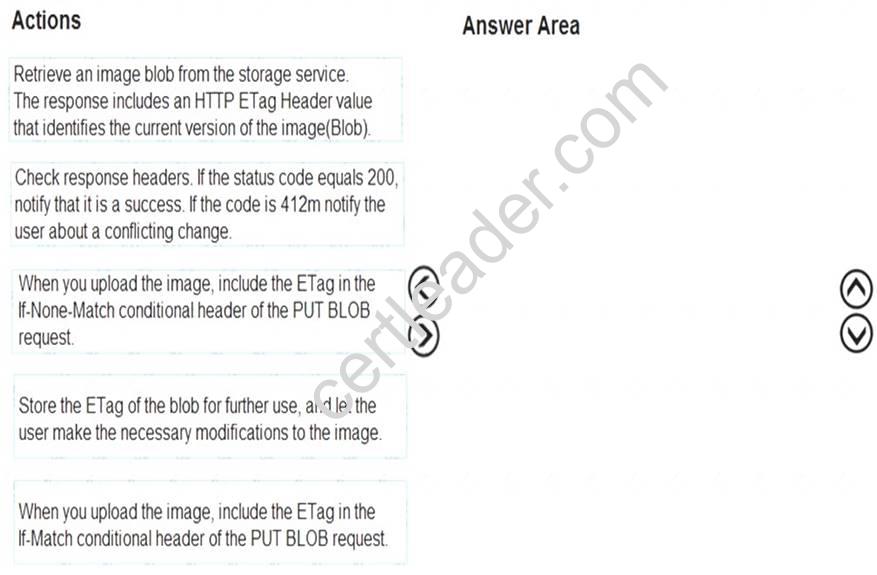
Answer:
Explanation: Optimistic concurrency means allowing concurrency conflicts to happen, and then reacting appropriately if they do.
For the PUT method, If-Match can be used to prevent the lost update problem. It can check if the modification of a resource that the user wants to upload will not override another change that has been done since the original resource was fetched. If the request cannot be fulfilled, the 412 (Precondition Failed) response is returned.
References:
https://developer.mozilla.org/en-US/docs/Web/HTTP/Headers/If-Match
NEW QUESTION 5
You need to troubleshoot the order workflow.
What should you do? Each correct answer presents part of the solution. NOTE: Each correct selection is worth one point.
- A. Review the run history.
- B. Review the trigger history.
- C. Review the API connections.
- D. Review the activity log.
Answer: BD
Explanation: Scenario: The order workflow fails to run upon initial deployment to Azure.
Deployment errors arise from conditions that occur during the deployment process. They appear in the activity log.
References:
https://docs.microsoft.com/en-us/azure/azure-resource-manager/resource-group-audit
NEW QUESTION 6
You are developing an IoT solution. The solution requires bidirectional communication between a .NET application and Azure IoT Hub.
You need to obtain connection information for a single test device.
Which three commands should you use to develop the solution? To answer, move the appropriate commands from the list of commands to the answer area and arrange them in the correct order.
NOTE: Each correct selection is worth one point.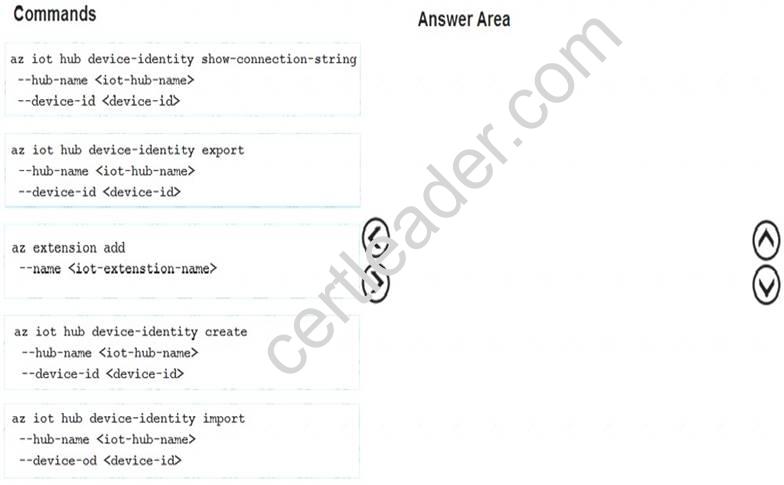
Answer:
Explanation: Run the following command in the command-line environment where you are using the Azure CLI to install the IoT extension:
Step 1: az extension add
--name <iot-extension-name>
Run the following command in the command-line environment where you are using the Azure CLI to install the IoT extension:
az extension add --name azure-cli-iot-ext Step 2: az iot hub device-identity create
--hub-name <iot-hub-name>
--device-id <device-id>
Create a new device in the IoT Hub “DemoHub”
Command: az iot hub device-identity create --hub-name DemoHub --device-id testDevice Step 3: az iot hub device-identity show-connection-string
--hub-name { iot-hub-name }
--device-id <device-id> References:
https://github.com/MicrosoftDocs/azure-docs/blob/master/includes/iot-hub-get-started-create-device-identity.md
NEW QUESTION 7
You are developing a project management service by using ASP.NET. The service hosts conversations, files, to-do lists, and a calendar that users can interact with at any time.
The application uses Azure Search for allowing users to search for keywords in the project data.
You need to implement code that creates the object which is used to create indexes in the Azure Search service.
Which two objects should you use? Each correct answer presents part of the solution. NOTE: Each correct selection is worth one point.
- A. SearchService
- B. SearchlndexCIient
- C. SearchServiceClient
- D. SearchCredentials
Answer: CD
NEW QUESTION 8
You maintain an existing Azure SQL Database instance. Management of the database is performed by an external party. All cryptographic keys are stored in an Azure Key Vault.
You must ensure that the external party cannot access the data in the SSN column of the Person table.
Will each protection method meet the requirement? To answer, drag the appropriate responses to the correct protection methods. Each response may be used once, more than once, or not at all. You may need to drag the split bar between panes or scroll to view content.
NOTE: Each correct selection is worth one point.
Answer:
Explanation: 
NEW QUESTION 9
You have an Azure subscription.
You must create a file share with a quota of 2,048 GB. You create the following variables: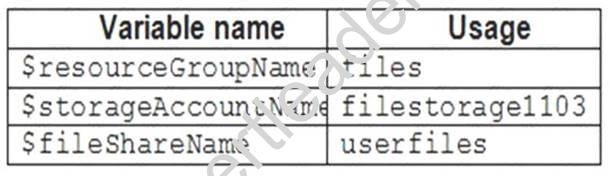
In which order should you arrange the Azure CLI commands to develop the solution? To answer, move all the commands from the list of commands to the answer area and arrange them in the correct order.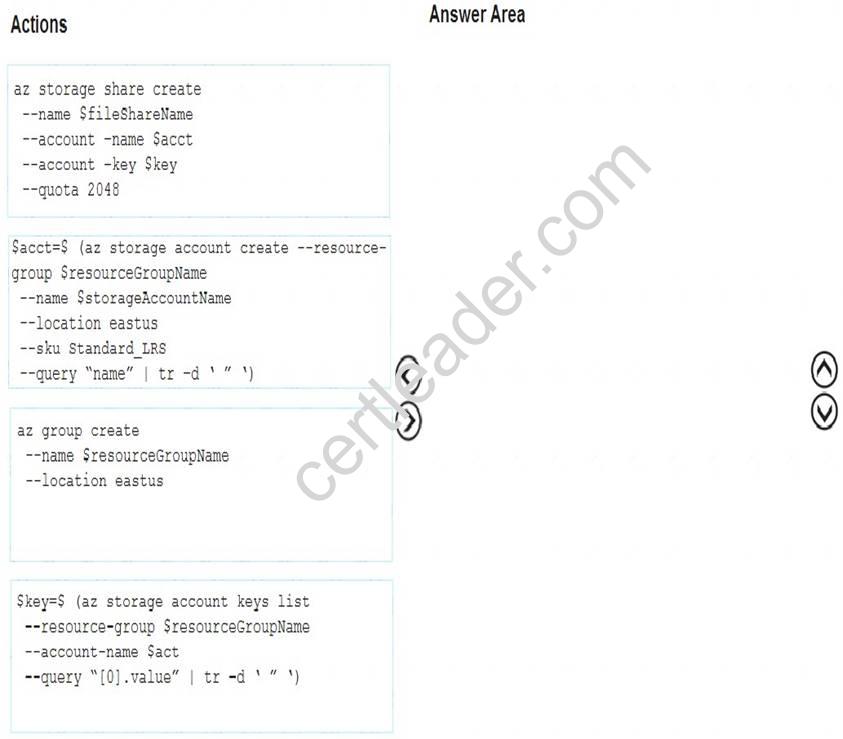
Answer:
Explanation: Step 1:
Create a resource group
A resource group is a logical container in which Azure resources are deployed and managed. If you don't already have an Azure resource group, you can use the az group create command to create one.
The following example creates a resource group named myResourceGroup in the East US location: az group create --name myResourceGroup --location eastus
Step 2:
Create a storage account
The following example creates a storage account named mystorageaccount<random number> by using the az storage account create command, and then puts the name of that storage account in the $STORAGEACCT variable.
STORAGEACCT=$(az storage account create
--resource-group "myResourceGroup"
--name "mystorageacct$RANDOM"
--location eastus
--sku Standard_LRS
--query "name" | tr -d '"') Step 3:
Get the storage account key
Storage account keys control access to resources in a storage account. The keys are automatically created when you create a storage account. You can get the storage account keys for your storage account by using the az storage account keys list command:
STORAGEKEY=$(az storage account keys list
--resource-group "myResourceGroup"
--account-name $STORAGEACCT
--query "[0].value" | tr -d '"') Step 4:
Now, you can create your Azure file share. Create file shares by using the az storage share create command. This example creates an Azure file share named myshare:
az storage share create
--account-name $STORAGEACCT
--account-key $STORAGEKEY
--name "myshare" References:
https://docs.microsoft.com/en-us/azure/storage/files/storage-how-to-use-files-cli
NEW QUESTION 10
You are creating an loT solution using Azure Time Series Insight.
You configure the environment to ensure that all data for the current year is available What should you do?
- A. Change the pricing tier.
- B. Add a disaster recovery (DR) strategy.
- C. Set a value for the Data Retention time setting.
- D. a reference data
Answer: C
Explanation: The data is retained in Time Series Insights based on the selected retention days or maximum limits. Retention is configurable in the Azure portal. The longest allowable retention period is a rolling year of 12
months + 1 month, which is defined as 400 days.
References:
https://azure.microsoft.com/en-us/pricing/details/time-series-insights/
NEW QUESTION 11
You are developing an Azure Function App by using Visual Studio. The app will process orders Queue Storage.
You need to review the Azure Function App code shown below.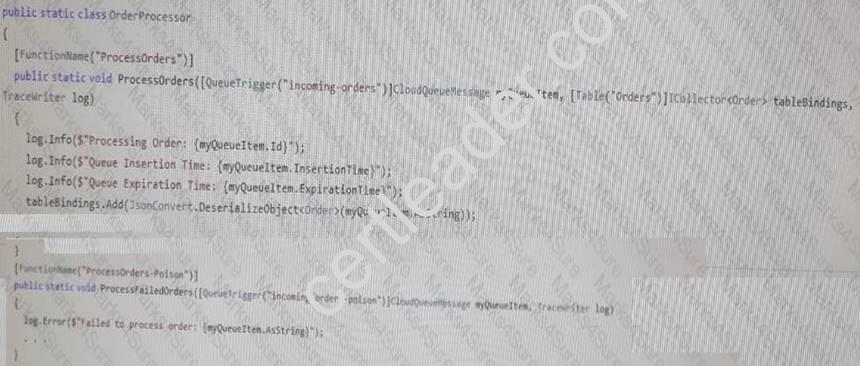
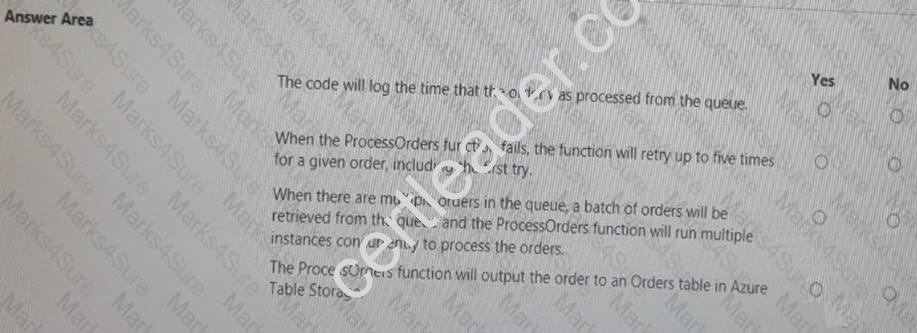
Answer:
Explanation: 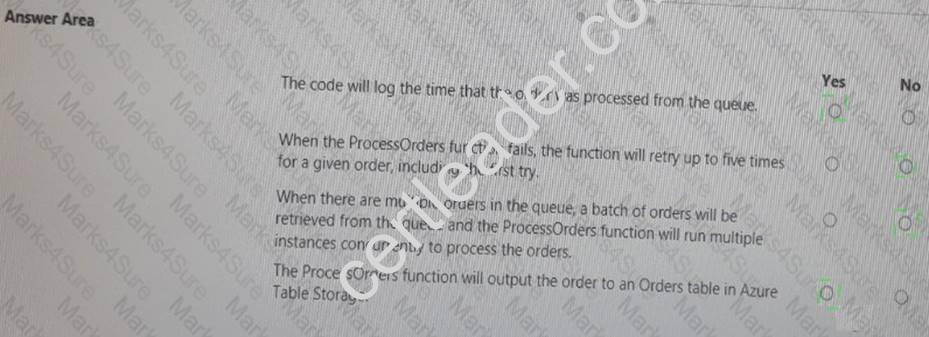
NEW QUESTION 12
You host an on-premises ASP.NET Web API at the company headquarters. The Web API is consumed by applications running at the company's branch offices using the Azure Relay service. All the users of the applications are on the same Azure Active Directory (Azure AD).
You need to ensure that the applications can consume the Web API. What should you do?
- A. Create separate Azure AD groups named Senders and Receiver
- B. In Access Control (IAM) for the Relay namespace, assign Senders the Reader role and assign Receivers the Reader role.
- C. Create dedicated Azure AD identities named Sender and Receive
- D. Assign Sender the Azure AD Identity Reader rol
- E. Assign Receiver the Azure AD Identity Reader rol
- F. Configure applications to use the respective identities.
- G. Create a Shared Access policy for the namespac
- H. Use a connection string in Web API and use a different connection string in consumer applications.
- I. Create a Shared Access policy for Send permissions and another for Receive permissions.
Answer: C
Explanation: To begin using Service Bus messaging entities in Azure, you must first create a namespace with a name that is unique across Azure. A namespace provides a scoping container for addressing Service Bus resources within your application.
When you publish an application through Azure Active Directory Application Proxy, you create an external URL for your users to go to when they're working remotely. This URL gets the default domain yourtenant.msappproxy.net.
References:
https://docs.microsoft.com/en-us/azure/active-directory/manage-apps/application-proxy-configure-custom-doma
NEW QUESTION 13
You are implementing an order processing system. A point of sale application publishes orders to topics in an Azure Service Bus queue. The label property for the topic includes the following data:
The system has the following requirements for subscriptions: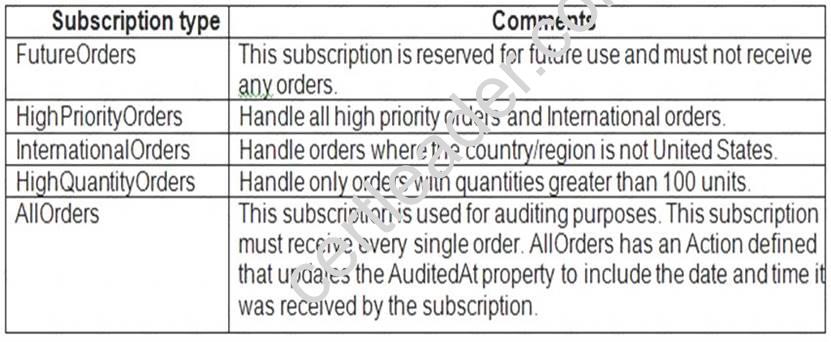
You need to implement filtering and maximize throughput while evaluating filters.
Which filter types should you implement? To answer, drag the appropriate filter types to the correct subscriptions. Each filter type may be used once, more than once, or not at all. You may need to drag the split bar between panes or scroll to view content.
NOTE: Each correct selection is worth one point.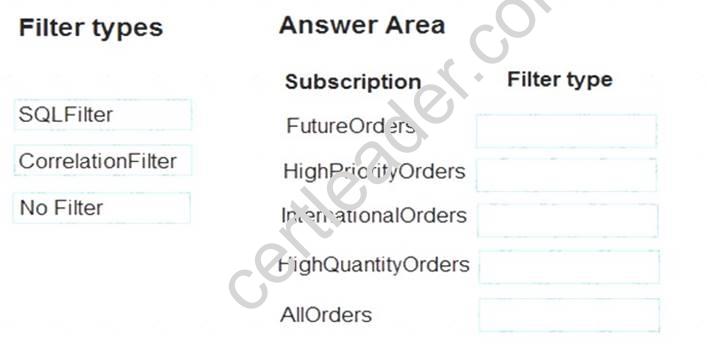
Answer:
Explanation: FutureOrders: SQLFilter HighPriortyOrders: CorrelationFilter CorrelationID only InternationalOrders: SQLFilter
Country NOT USA requires an SQL Filter
HighQuantityOrders: SQLFilter
Need to use relational operators so an SQL Filter is needed. AllOrders: No Filter
SQL Filter: SQL Filters - A SqlFilter holds a SQL-like conditional expression that is evaluated in the broker against the arriving messages' user-defined properties and system properties. All system properties must be prefixed with sys. in the conditional expression. The SQL-language subset for filter conditions tests for the existence of properties (EXISTS), as well as for null-values (IS NULL), logical NOT/AND/OR, relational operators, simple numeric arithmetic, and simple text pattern matching with LIKE.
Correlation Filters - A CorrelationFilter holds a set of conditions that are matched against one or more of an arriving message's user and system properties. A common use is to match against the CorrelationId property, but the application can also choose to match against ContentType, Label, MessageId, ReplyTo, ReplyToSessionId, SessionId, To, and any user-defined properties. A match exists when an arriving message's value for a property is equal to the value specified in the correlation filter. For string expressions, the comparison is case-sensitive. When specifying multiple match properties, the filter combines them as a logical AND condition, meaning for the filter to match, all conditions must match.
Boolean filters - The TrueFilter and FalseFilter either cause all arriving messages (true) or none of the arriving messages (false) to be selected for the subscription.
References:
https://docs.microsoft.com/en-us/azure/service-bus-messaging/topic-filters
NEW QUESTION 14
You are developing a .NET Core MVC application for customers to research hotels. The application will use Azure Search. The application will search the index using various criteria to local domains to hotels. The index will include search fields for rate, a list of amenities, and distance to the nearest airport.
The application must support the following scenarios for specifying search criteria and organizing results:
• Search the index by using regular expressions.
• Organize results by counts for name-value pairs.
• List hotels within a specified distance to an airport and that fall within a specific price range. You need to configure the Search Para meters class.
Which properties should you configure? To answer, select the appropriate options in the answer area. NOTE: Each correct selection is worth one point.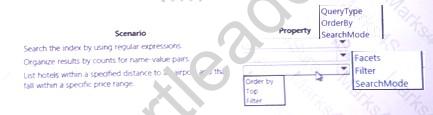
Answer:
Explanation: 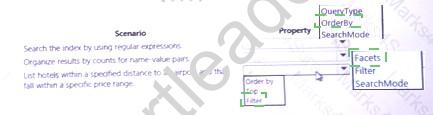
NEW QUESTION 15
You need to ensure that the solution can meet the scaling requirements for Policy Service. Which Azure Application Insights data model should you use?
- A. an Application Insights metric
- B. an Application Insights dependency
- C. an Application Insights trace
- D. an Application Insights event
Answer: D
NEW QUESTION 16
Note: this question is part of a series of questions that present the same scenario. Each question in the series contains a unique solution that might meet the stated goals. Some question sets might have more than one correct solution, while others might not have correct solution.
After you answer a question in this section, you will NOT be able to return to it. As a result, these questions will not appear in the review screen.
You use ASP.NET Core MVC with ADO.NET to develop an application. You implement database sharding for the application by using Azure SQL Database. You establish communication to implement a strategy that allows a group of operations that are performed on multiple Azure databases to be rolled back on all database if any of the operations fail.
Solution
• Create stored procedures in each Azure SQL database instance to perform operations for each respective database.
• Invoke a named transaction and use the same name for the transaction in each stored procedure.
• Establish a new transaction scope in a using block. Within the block, establish connections to each Azure SQL Database instance and run the stored procedure.
• If no exception occurs, commit the scoped transaction. Does the solution meet the goal?
- A. Yes
- B. No
Answer: B
NEW QUESTION 17
You ate creating a flight reservations chatbot in a web app. You use Language Understanding Intelligence Services (LUIS) and Microsoft Cognitive Service APIs to create the chatbot. You add a pre built domain and provide intents and utterances. You need more than the intent name for your chatbot to act on concepts. You need to choose entities for those concepts that have actions assigned for the app.
Which entities should you use? To answer, select the appropriate options in the answer area. NOTE: Each correct selection is worth one point
Answer:
Explanation: 
NEW QUESTION 18
You develop software solutions for a web services company. You have the following code. (Line numbers are for reference only.)
You need to implement an immediate response customer support solution for the company’s website. For each of the following statements, select Yes if the statement is true. Otherwise, select No. NOTE: Each correct selection is worth one point.
Answer:
Explanation: 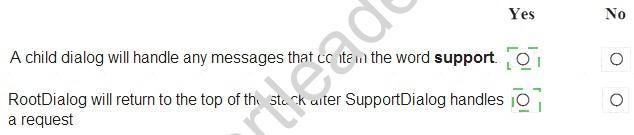
NEW QUESTION 19
A company is developing a software as a service (SaaS) solution in Azure for other business to manage customers. The solution includes the following Azure SQL Database instances. Customer data exists in all databases.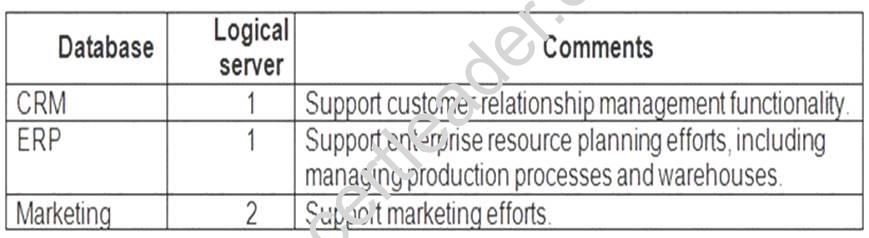
Customers may request that the company remove data that relates to the customer. If a customer makes a deletion request, all details from the customer must be removed from the solution. All deletions for a customer must occur in one distributed transaction that includes the CRM, ERP, and Marketing databases.
You need to activate support for transactions over multiple databases on the same logical server and activate support for transactions over multiple servers.
Which actions and Azure PowerShell command should you use? To answer, select the appropriate options in the answer area.
NOTE: Each correct selection is worth one point.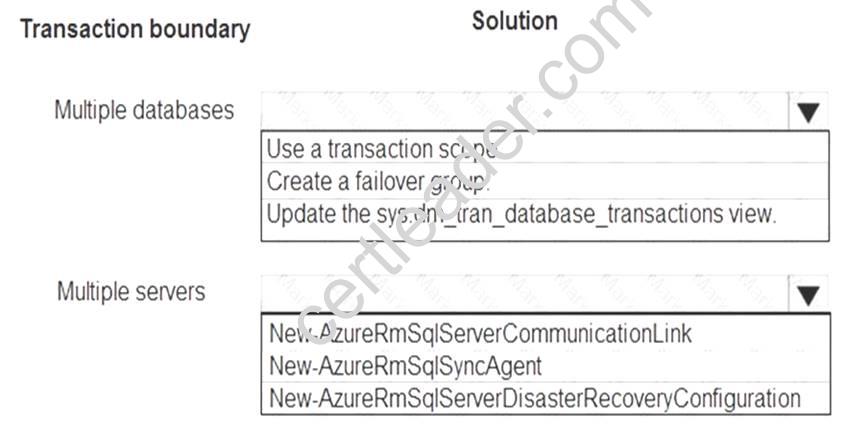
Answer:
Explanation: Box 1: Use a transaction scope
The TransactionScope class establishes an ambient transaction in .NET. (An “ambient transaction” is one that lives in the current thread.) All connections opened within the TransactionScope participate in the transaction. If different databases participate, the transaction is automatically elevated to a distributed transaction.
Box 2: New-AzureRmSqlServerCommunicationLink
New-AzureRmSqlServerCommunicationLink: Use this cmdlet to create a new communication relationship between two logical servers in Azure SQL DB. The relationship is symmetric which means both servers can initiate transactions with the other server.
References:
https://docs.microsoft.com/en-us/azure/sql-database/sql-database-elastic-transactions-overview
NEW QUESTION 20
You develop a website. You plan to host the website in Azure. You expect the website to experience high traffic volumes after it is published. You must ensure that the website remains available and responsive while minimizing cost. You need to deploy the website. What should you do?
- A. Deploy the website to an App Service that uses the Shared service tie
- B. Configure the App Service plan to automatically scale when the CPU load is high.
- C. Deploy the website to a virtual machin
- D. Configure the virtual machine to automatically scale when the CPU load is high.
- E. Deploy the website to an App Service that uses the Standard service tie
- F. Configure the App Service plan to automatically scale when the CPU load is high.
- G. Deploy the website to a virtual machin
- H. Configure a Scale Set to increase the virtual machine instance count when the CPU load
Answer: C
100% Valid and Newest Version AZ-202 Questions & Answers shared by 2passeasy, Get Full Dumps HERE: https://www.2passeasy.com/dumps/AZ-202/ (New 150 Q&As)