It is more faster and easier to pass the AZ-202 Exam Questions by using AZ-202 Braindumps. Immediate access to the AZ-202 Study Guides and find the same core area AZ-202 Exam Questions with professionally verified answers, then PASS your exam with a high score now.
Free demo questions for Microsoft AZ-202 Exam Dumps Below:
NEW QUESTION 1
A company backs up all manufacturing data to Azure Blob Storage. Admins move blobs from hot storage to archive tier storage every month.
You must automatically move blocks to Archive tier after they have not been accessed for 180 days. The path for any item that is not archived must be placed in an existing queue. This operation must be performed automatically once a month. You set the value of TierAgeInDays to 180.
How should you configure the Logic App? To answer, drag the appropriate triggers or action blocks to the correct trigger or action slots. Each trigger or action block may be used once, more than once, or not at all. You may need to drag the split bar between panes or scroll to view content.
NOTE: Each correct selection is worth one point.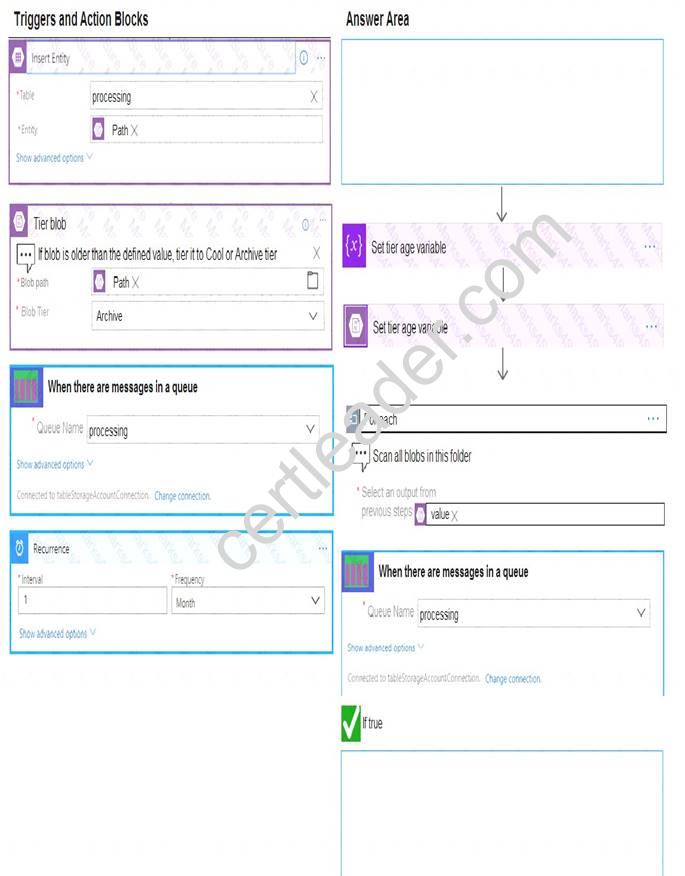
Answer:
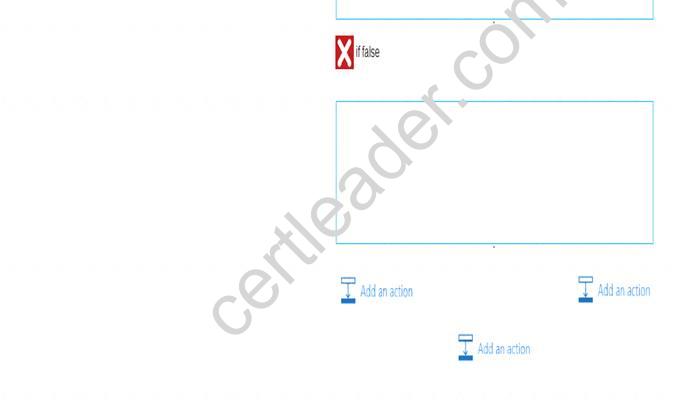
Explanation: Box 1: Recurrence Box 2: Insert Entity
Box 3 (if true): Tier Blob
Box 4: (if false): Leave blank. References:
https://docs.microsoft.com/en-us/azure/logic-apps/logic-apps-perform-data-operations
NEW QUESTION 2
A company is migrating an existing on-premises third-party website to Azure. The website is stateless. The company does not have access to the source code for the website. They do have the original installer. The number of visitors at the website vanes throughout the year.
The on-premises infrastructure was resized to accommodate peaks but the extra capacity was not used. You need to implement a virtual machine scale set instance.
What should you do?
- A. Use only default diagnostics metrics to trigger autoscaling.
- B. Create 100 autoscale settings per resource.
- C. Scale out by one instance when the average CPU usage of one of the instances is over 80 percent
- D. Use Azure Monitor to create autoscale settings using custom metrics
Answer: D
Explanation: Azure Monitor autoscaling allows you to scale the number of running instances up or down, based on telemetry data (metrics).
References:
https://docs.microsoft.com/en-us/azure/monitoring-and-diagnostics/insights-autoscale-common-metrics
NEW QUESTION 3
A company is creating an loT solution for connecting to smart refrigerators. You plan to use the Azure IoT Hub Device Provisioning Service for this process.
You need to provision the devices automatically. Which feature of Device Provisioning Service should you use?
- A. Error policy
- B. Device registration and configuration
- C. Template registration
- D. Remote monitoring
Answer: B
Explanation: Azure IoT auto-provisioning can be broken into three phases:
- Service configuration - a one-time configuration of the Azure IoT Hub and IoT Hub Device Provisioning Service instances, establishing them and creating linkage between them.
- Device enrollment - the process of making the Device Provisioning Service instance aware of the devices that will attempt to register in the future.Note: The Device Provisioning Service is a helper service that enables just-in-time provisioning of devices to an IoT hub, without requiring human intervention. After successful provisioning, devices connect directly with their designated IoT Hub. This process is referred to as auto-provisioning, and provides an out-of-the-box registration and initial configuration experience for devices.
- Device registration and configuration - initiated upon boot up by registration software, which is built using a Device Provisioning Service client SDK appropriate for the device and attestation mechanism. The software establishes a connection to the provisioning service for authentication of the device, and subsequent registration in the IoT Hub. Upon successful registration, the device is provided with its IoT Hub unique device ID and connection information, allowing it to pull its initial configuration and begin the telemetry process. In production environments, this phase can occur weeks or months after the previous two phases.
References:
https://docs.microsoft.com/en-us/azure/iot-dps/concepts-auto-provisioning
NEW QUESTION 4
An application that you manage has several web front-end instances- Each web front end communicates with a set of back-end worker processes by using an Azure queue.
You are developing code for the worker processes.
You have a function named DoWork() that handles data processing tasks.
You need to develop code for the worker processes that meets the following requirements:
• Properly access an item from the queue and be resistant to failure.
• Run on multiple background processes.
•Ensure that items are available to other workers two minutes after a worker process fails.
• Ensure that messages regarding failed processes are logged to the console.
How should you complete the code? To answer, select the appropriate options in the answer area. NOTE: Each connect selection its worth one point
Answer:
Explanation: 
NEW QUESTION 5
A company is developing a solution that allows smart refrigerators to send temperature information to a central location.
The solution must receive and store messages until they can be processed. You create an Azure Service Bus instance by providing a name, pricing tier, subscription, resource group, and location.
You need to complete the configuration.
Which Azure CLI on PowerShell command should you run?
A)
B)
C)
D)
- A. Option A
- B. Option B
- C. Option C
- D. Option D
Answer: D
Explanation: Topic 4, Proseware, Inc
Background
You are a developer for Proseware, Inc. You are developing an application that applies a set of governance policies for Proseware's internal services, external services, and applications. The application will also provide a shared library for common functionality.
Requirements Policy service
You develop and deploy a stateful ASP.NET Core 2.1 web application named Policy service to an Azure App Service Web App. The application reacts to events from Azure Event Grid and performs policy actions based on those events.
The application must include the Event Grid Event ID field in all Application Insights telemetry.
Policy service must use Application Insights to automatically scale with the number of policy actions that it is performing.
Policies Log policy
All Azure App Service Web Apps must write logs to Azure Blob storage. All log files should be saved to a container named logdrop. Logs must remain in the container for 15 days.
Authentication events
Authentication events are used to monitor users signing in and signing out. All authentication events must be processed by Policy service. Sign outs must be processed as quickly as possible.
Policylib
You have a shared library named PolicyLib that contains functionality common to all ASP.NET Core web services and applications. The Policy Lib library must
• Exclude non-user actions from Application Insights telemetry.
• Provide methods that allow a web service to scale itself.
• Ensure that scaling actions do not disrupt application usage.
Other
Anomaly detection service
You have an anomaly detection service that analyzes log information for anomalies. It is implemented as an Azure as a web service.
If an anomaly is detected, an Azure Function that emails administrators is called by using an HTTP WebHook.
Health monitoring
All web applications and services have health monitoring at the /health service endpoint.
Issues Policy loss
When you deploy Policy service, policies may not be applied if they were in the process of being applied during the deployment.
Performance issue
When under heavy load, the anomaly detection service undergoes slowdowns and rejects connections.
Notification latency
Users report that anomaly detection emails can sometimes arrive several minutes after an anomaly is detected.
App code EnventGridController.cs
Relevant portions of the app files are shown below. Line numbers are included for reference only and include a two-character prefix that denotes the specific file to which they belong.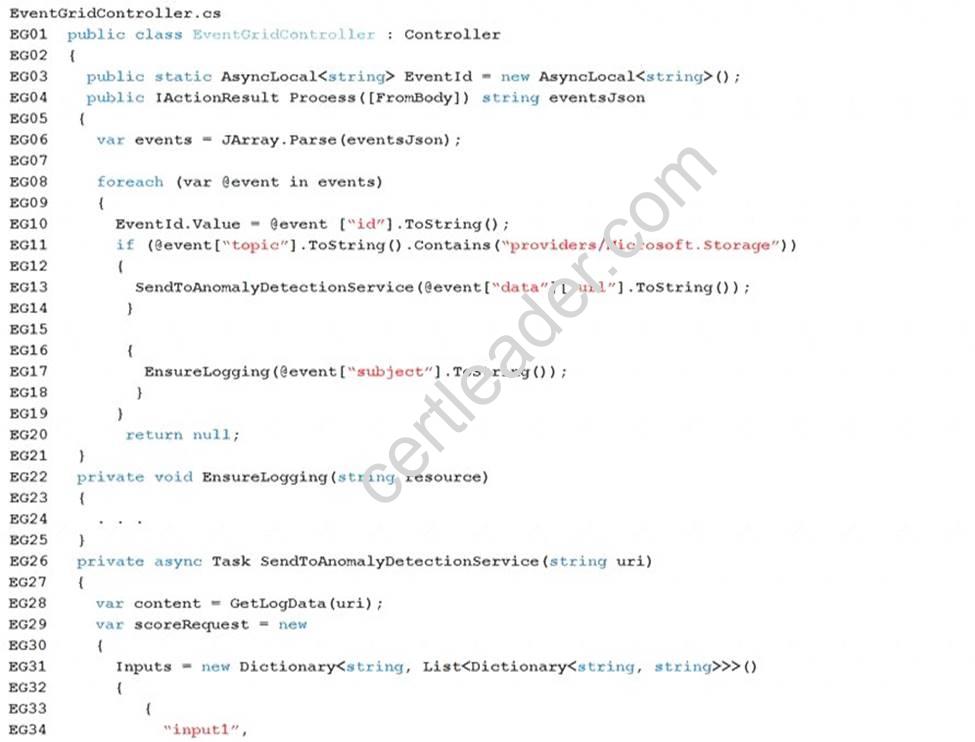

LoginEvents.cs
Relevant portions of the app files are shown below. Line numbers are included for reference only and include a two-character prefix that denotes the specific file to which they belong.
NEW QUESTION 6
Note: This question is part of a series of questions that present the same scenario. Each question in the series contains a unique solution. Determine whether the solution meets the stated goals.
You need to ensure that authentication events are triggered and processed according to the policy. Solution: Create a new Azure Event Grid topic and add a subscription for the events.
Does the solution meet the goal?
- A. Yes
- B. No
Answer: B
Explanation: Use a separate Azure Event Grid topics and subscriptions for sign-in and sign-out events.
Scenario: Authentication events are used to monitor users signing in and signing out. All authentication events must be processed by Policy service. Sign outs must be processed as quickly as possible.
NEW QUESTION 7
Note: This question is part of a series of questions that present the same scenario. Each question in the series contains a unique solution. Determine whether the solution meets the stated goals.
You develop an entertainment application where users can buy and trade virtual real estate. The application must scale to support thousands of users.
The current architecture includes five Azure Virtual Machines (VM) that connect to an Azure SQL Database for account information and Azure Table Storage for backend services. A user interacts with these components in the cloud at any given time
- Routing Service – Routes a request to the appropriate service and must not persist data across sessions
- Account Service – Stores and manages all account information and authentication and requires data to persist across sessions.
- User Service – Stores and manages all user information and requires data to persist across sessions.
- Housing Network Service – Stores and manages the current real-estate economy and requires data to persist across sessions.
- Trade Service – Stores and manages virtual trade between accounts and requires data to persist across sessions.
Due to volatile user traffic, a microservices solution is selected for scale agility.
You need to migrate to a distributed microservices solution on Azure Service Fabric. Solution: Deploy a Windows container to Azure Service Fabric for each component. Does the solution meet the goal?
- A. YES
- B. NO
Answer: B
Explanation: We should use stateful services when we want data to persist, and stateless service when data must not persist. https://docs.microsoft.com/en-us/azure/service-fabric/service-fabric-reliable-services-introduction References:
https://docs.microsoft.com/en-us/azure/service-fabric/service-fabric-reliable-services-introduction
NEW QUESTION 8
Your company is migrating applications to Azure. The U department must allow internal developers to communicate with Microsoft support.
The service agents of the IT department must only have view resources and create support ticket permissions to all subscriptions. A new custom role must be created by reusing a default role definition and changing the permissions.
You need to create the custom role.
To answer, select the appropriate options in the answer area. NOTE: Each correct selection is worth one point.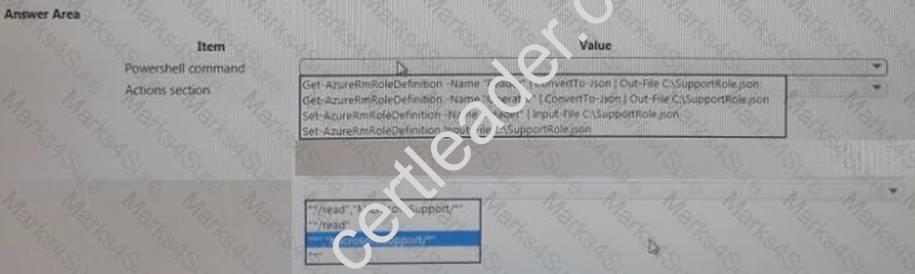
Answer:
Explanation: 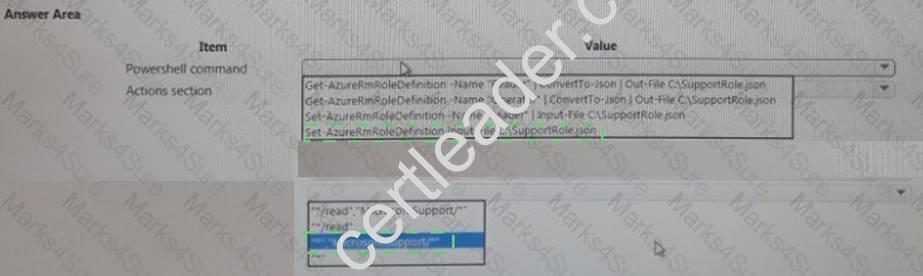
NEW QUESTION 9
You need to implement the Log policy.
How should you complete the Azure Event Grid subscription? To answer, drag the appropriate JSON segments to the correct locations. Each (SON segment may be used once, more than once, or not at all. You may need to drag the split bar between panes or scroll to view content.
NOTE: Each correct selection is worth one point.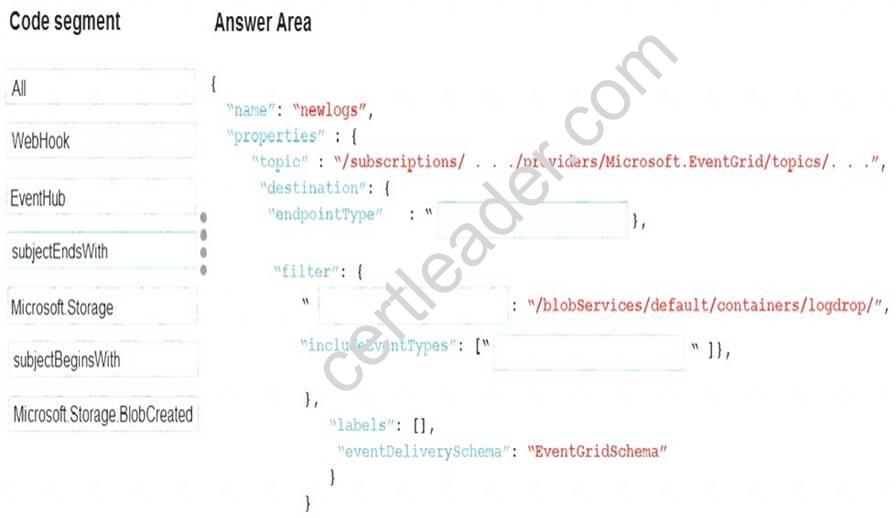
Answer:
Explanation: Box 1:WebHook
Scenario: If an anomaly is detected, an Azure Function that emails administrators is called by using an HTTP
WebHook.
endpointType: The type of endpoint for the subscription (webhook/HTTP, Event Hub, or queue). Box 2: SubjectBeginsWith
Box 3: Microsoft.Storage.BlobCreated Scenario: Log Policy
All Azure App Service Web Apps must write logs to Azure Blob storage. All log files should be saved to a container named logdrop. Logs must remain in the container for 15 days.
Example subscription schema
{
"properties": { "destination": {
"endpointType": "webhook", "properties": {
"endpointUrl": "https://example.azurewebsites.net/api/HttpTriggerCSharp1?code=VXbGWce53l48Mt8wuotr0GPmyJ/nDT4hgd
}
},
"filter": {
"includedEventTypes": [ "Microsoft.Storage.BlobCreated", "Microsoft.Storage.BlobDeleted" ], "subjectBeginsWith": "blobServices/default/containers/mycontainer/log",
"subjectEndsWith": ".jpg", "isSubjectCaseSensitive ": "true"
}
}
}
References:
https://docs.microsoft.com/en-us/azure/event-grid/subscription-creation-schema
NEW QUESTION 10
A company is developing a gaming platform. Users can join teams to play online and see leaderboards that include player statistics. The solution includes an entity named Team.
You plan to implement an Azure Redis Cache instance to improve the efficiency of data operations for entities that rarely change.
You need to invalidate the cache when team data is changed.
How should you complete the code? To answer, select the appropriate options in the answer area.
NOTE: Each correct selection is worth one point.
Answer:
Explanation: 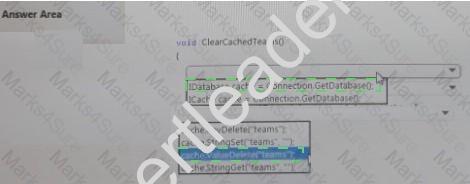
NEW QUESTION 11
Note: This question is part of a series of questions that present the same scenario. Each question in the series contains a unique solution.
Determine whether the solution meets the stated goals. You need to meet the LabelMaket application
Solution; Create a conditional access policy and assign it to the Azure Kubernetes service cluster. Does the solution meet the goal?
- A. Yes
- B. No
Answer: B
Explanation: Scenario: The LabelMaker applications must be secured by using an AAD account that has full access to all namespaces of the Azure Kubernetes Service (AKS) cluster.
Before an Azure Active Directory account can be used with the AKS cluster, a role binding or cluster role binding needs to be created.
References:
https://docs.microsoft.com/en-us/azure/aks/aad-integration
NEW QUESTION 12
Note: This question is part of a series of questions that present the same scenario. Each question in the series contains a unique solution. Determine whether the solution meets the stated goals.
You develop an entertainment application where users can buy and trade virtual real estate. The application must scale to support thousands of users.
The current architecture includes five Azure Virtual Machines (VM) that connect to an Azure SQL Database for account information and Azure Table Storage for backend services. A user interacts with these components in the cloud at any given time
- Routing Service – Routes a request to the appropriate service and must not persist data across sessions
- Account Service – Stores and manages all account information and authentication and requires data to persist across sessions.
- User Service – Stores and manages all user information and requires data to persist across sessions.
- Housing Network Service – Stores and manages the current real-estate economy and requires data to persist across sessions.
- Trade Service – Stores and manages virtual trade between accounts and requires data to persist across sessions.
Due to volatile user traffic, a microservices solution is selected for scale agility.
You need to migrate to a distributed microservices solution on Azure Service Fabric.
Solution: Create a Service Fabric Cluster with a stateless Reliable Service for Routing Service. Create stateful Reliable Services for all other components.
Does the solution meet the goal?
- A. YES
- B. NO
Answer: A
Explanation: We should use stateful services when we want data to persist, and stateless service when data must not persist. Note:
For stateful services, the Reliable Services programming model allows you to consistently and reliably store your state right inside your service by using Reliable Collections.
A stateless service is one where there is no state maintained within the service across calls. Any state that is present is entirely disposable and doesn't require synchronization, replication, persistence, or high availability.
References:
https://docs.microsoft.com/en-us/azure/service-fabric/service-fabric-reliable-services-introduction
NEW QUESTION 13
Note: This question is part of a series of questions that present the same scenario. Each question in the series contains a unique solution. Determine whether the solution meets the stated goals.
You connect to Azure by using a workstation that has a slow internet connection. You have two Azure file shares. You plan to transfer a series of large files from one container to another container. The workstation does not have sufficient disk space to store the files.
You define the following variables in Azure PowerShell.
You need to simultaneously transfer the large files as efficiently as possible.
Solution: Write a C# application that uses the Azure .NET API method CloudFile.StartCopyAsync to transfer files to the destination container.
Does the solution meet the goal?
- A. Yes
- B. No
Answer: B
NEW QUESTION 14
Contoso. Ltd. provides an API to customers by using Azure API Management (ARM). The API authorizes users with a JWT token
You must implement response caching for the APIM gateway. The caching mechanism must detect the user ID of the client that accesses data for a given location and cache the response for that user ID.
You need to add the following policies to the policies file:
• a set-variable policy to store the detected user identity
• a cache-lookup-value policy
• a cache-store-value policy
• a find-and-replace policy to update the response body with the user profile information
To which policy section should you add the policies? To answer, drag the appropriate sections to the correct policies. Each section may be used once, more than once, or not at all.
You may need to drag the split bar between panes or scroll to view content. NOTE: Each correct selection is worth one point.
Answer:
Explanation: 
NEW QUESTION 15
You are developing an internal website for employees to view sensitive data. The website uses Azure Active Directory (AAD) for authentication. You need to implement multifactor authentication for the website.
What should you do? Each correct answer presents part of the solution. NOTE; Each correct selection is worth one point.
- A. In Azure AD, create a new conditional access policy.
- B. In Azure AD, enable application proxy.
- C. Configure the website to use Azure AD B2C.
- D. In Azure AD conditional access, enable the baseline policy.
- E. Upgrade to Azure AD Premium.
Answer: CE
NEW QUESTION 16
You develop a bot by using Language Understanding Intelligence Service (LUIS) and the .NET Bot framework. You use LUIS in the Azure portal to optimize the bot.
You review the utterances and determine that users are requesting time and venue information for events. You need to improve the prediction efficiency of the bot.
Which three actions should you perform in sequence? To answer, move the appropriate actions from the list of actions to the answer area and arrange them in the correct order.
NOTE: Each correct selection is worth one point.
Answer:
Explanation: Step 1: Create an intent for each event type Identify your intents
Step 2: Add example utterances
Create example utterances for each intent Step 3: Create a List Entity
Identify your entities
A list entity is an explicitly specified list of values. Each value consists of one or more synonyms. In a travel app, you might choose to create a list entity to represent airport names.
References:
https://docs.microsoft.com/en-us/azure/cognitive-services/luis/luis-how-plan-your-app
NEW QUESTION 17
You are configuring Azure Redis Cache for a production web application.
The web application and Azure Redis Cache must be able to withstand a catastrophic t configuration changes. You create a storage account to persist cache data if needed
You need to implement a solution. What should you do?
- A. Run the Set-AzureRmRedisCache Azure PowerShell command with the size and sku parameters and specify a connection string to the storage account.
- B. In the Azure portal, enable Redis DataBase (RDB) persistence and configure persistence settings to save cache data tyo the storage account.
- C. In the Azure portal, enable Append Only File (AOF) persistence and configure persistence sttings to save cache data to the storage account.
- D. Run Reset-AzureRmRedisCache Azure PowerShell command with the ShardID parameter and specify a connection string to the storage account.
Answer: C
NEW QUESTION 18
You need to resolve a notification latency issue.
Which two actions should you perform? Each correct answer presents part of the solution.
NOTE: Each correct selection is worth one point
- A. Ensure that the Azure Function is using an App Service plan.
- B. Set Always On to false
- C. Ensure that the Azure Function is set to use a consumption plan.
- D. Set Always On to true.
Answer: AD
Explanation: Azure Functions can run on either a Consumption Plan or a dedicated App Service Plan. If you run in a dedicated mode, you need to turn on the Always On setting for your Function App to run properly. The Function runtime will go idle after a few minutes of inactivity, so only HTTP triggers will actually "wake up" your functions. This is similar to how WebJobs must have Always On enabled.
Scenario: Notification latency: Users report that anomaly detection emails can sometimes arrive several minutes after an anomaly is detected.
Anomaly detection service: You have an anomaly detection service that analyzes log information for anomalies. It is implemented as an Azure Machine Learning model. The model is deployed as a web service.
If an anomaly is detected, an Azure Function that emails administrators is called by using an HTTP WebHook. References:
https://github.com/Azure/Azure-Functions/wiki/Enable-Always-On-when-running-on-dedicated-App-Service-Pl
NEW QUESTION 19
You are developing an application that consists of an ASP.NET Core Web API website and a WebJob that starts automatically and runs continuously. You are building the deployment process for the application.
You need to ensure that both the website and the WebJob are deployed.
How should you structure the deployment folders? To answer, drag the appropriate path segments to the correct locations. Each path segment may be used once, more than once, or not at all. You may need to drag the split bar between panes or scroll to view content.
NOTE: Each correct selection is worth one point.
Answer:
Explanation: 
NEW QUESTION 20
You maintain an Azure Web App that runs in a container. The container is using a Dockerfile that is copied to numerous places and consumes a large amount of storage. You need to optimize the Dockerfile.
What should you do?
- A. Use multiple RUN instructions for cached operation.
- B. Configure the CU with a .dockerignore file.
- C. Minimize layers by concatenating all RUN instructions on one line.
- D. Minimize layers by grouping actions in as few RUN instructions as possible
Answer: D
Explanation: Minimize the number of layers.
Prior to Docker 17.05, and even more, prior to Docker 1.10, it was important to minimize the number of layers in your image.C
In Docker 1.10 and higher, only RUN, COPY, and ADD instructions create layers. References:
https://docs.docker.com/v17.09/engine/userguide/eng-image/dockerfile_best-practices
P.S. 2passeasy now are offering 100% pass ensure AZ-202 dumps! All AZ-202 exam questions have been updated with correct answers: https://www.2passeasy.com/dumps/AZ-202/ (150 New Questions)