Cause all that matters here is passing the Microsoft AZ-103 exam. Cause all that you need is a high score of AZ-103 Microsoft Azure Administrator exam. The only one thing you need to do is downloading Ucertify AZ-103 exam study guides now. We will not let you down with our money-back guarantee.
Also have AZ-103 free dumps questions for you:
NEW QUESTION 1
Note: This question is part of a series of questions that present the same scenario. Each question in the series contains a unique solution that might meet the stated goals. Some question sets might have more than one correct solution, while others might not have a correct solution.
After you answer a question in this section, you will NOT be able to return to it. As a result, these questions will not appear in the review screen.
You have an Azure subscription named Subscription1. Subscription1 contains a resource group named RG1. RG1 contains resources that were deployed by using templates.
You need to view the date and time when the resources were created in RG1.
Solution: From the Subscriptions blade, you select the subscription, and then click Programmatic deployment.
Does this meet the goal?
- A. Yes
- B. No
Answer: B
NEW QUESTION 2
Note: This question is part of a series of questions that present the same scenario. Each question in the series contains a unique solution that might meet the stated goals. Some question sets might have more than one correct solution, while others might not have a correct solution.
After you answer a question in this section, you will NOT be able to return to it. As a result, these questions will not appear in the review screen.
You have an Azure subscription that contains 10 virtual networks. The virtual networks are hosted in separate resource groups.
Another administrator plans to create several network security groups (NSGs) in the subscription.
You need to ensure that when an NSG is created, it automatically blocks TCP port 8080 between the virtual networks.
Solution: You configure a custom policy definition, and then you assign the policy to the subscription. Does this meet the goal?
- A. Yes
- B. No
Answer: A
Explanation:
Resource policy definition used by Azure Policy enables you to establish conventions for resources in your organization by describing when the policy is enforced and what effect to take. By defining conventions, you can control costs and more easily manage your resources.
References: https://docs.microsoft.com/en-us/azure/azure-policy/policy-definition
NEW QUESTION 3
You have an Azure subscription named Subscription1 and two Azure Active Directory (Azure AD) tenants named Tenant1 and Tenant2.
Subscnption1 is associated to Tenant1 Multi-factor authentication (MFA) is enabled for all the users in Tenant1.
You need to enable MFA for the users in Tenant2. The solution must maintain MFA forTenant1. What should you do first?
- A. Transfer the administration of Subscription1 to a global administrator of Tenants.
- B. Configure the MFA Server setting in Tenant1.
- C. Create and link a subscription to Tenant2.
- D. Change the directory for Subscription1.
Answer: C
NEW QUESTION 4
You have an Azure subscription that contains the resources in the following table.
To which subnets can you apply NSG1?
- A. the subnets on VNet2 only
- B. the subnets on VNet1 only
- C. the subnets on VNet2 and VNet3 only
- D. the subnets on VNet1, VNet2, and VNet3
- E. the subnets on VNet3 only
Answer: E
Explanation:
All Azure resources are created in an Azure region and subscription. A resource can only be created in a virtual network that exists in the same region and subscription as the resource.
References: https://docs.microsoft.com/en-us/azure/virtual-network/virtual-network-vnet-plan-design- arm
NEW QUESTION 5
You have an Active Directory forest named contoso.com.
You install and configure Azure AD Connect to use password hash synchronization as the single sign- on (SSO) method. Staging mode is enabled.
You review the synchronization results and discover that the Synchronization Service Manager does not display any sync jobs.
You need to ensure that the synchronization completes successfully. What should you do?
- A. From Synchronization Service Manager, run a full import.
- B. Run Azure AD Connect and set the SSO method to Pass-through Authentication.
- C. From Azure PowerShell, run Start-AdSyncSyncCycle -PolicyType Initial.
- D. Run Azure AD Connect and disable staging mode.
Answer: D
Explanation:
Staging mode must be disabled. If the Azure AD Connect server is in staging mode, password hash synchronization is temporarily disabled.
References: https://docs.microsoft.com/en-us/azure/active-directory/connect/active-directory- aadconnectsync-troubleshoot-password-hash-synchronization#no-passwords-are-synchronized- troubleshoot-by-using-the-troubleshooting-task
NEW QUESTION 6
You have an azure subscription named Subscription that contains the resource groups shown in the following table.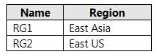
In RG1, you create a virtual machine named VM1 in the East Asia location. You plan to create a virtual network named VNET1.
You need to create VNET, and then connect VM1 to VNET1.
What are two possible ways to achieve this goal? Each correct answer presents a complete a solution.
NOTE: Each correct selection is worth one point.
- A. Create VNET1 in RG2, and then set East Asia as the location.
- B. Create VNET1 in a new resource group in the West US location, and then set West US as the location.
- C. Create VNET1 in RG1, and then set East Asia as the location
- D. Create VNET1 in RG1, and then set East US as the location.
- E. Create VNET1 in RG2, and then set East US as the location.
Answer: AC
NEW QUESTION 7
You have a Recovery Service vault that you use to test backups. The test backups contain two protected virtual machines.
You need to delete the Recovery Services vault. What should you do first?
- A. From the Recovery Service vault, stop the backup of each backup item.
- B. From the Recovery Service vault, delete the backup data.
- C. Modify the disaster recovery properties of each virtual machine.
- D. Modify the locks of each virtual machine.
Answer: A
Explanation:
You can't delete a Recovery Services vault if it is registered to a server and holds backup data. If you try to delete a vault, but can't, the vault is still configured to receive backup data.
Remove vault dependencies and delete vault
In the vault dashboard menu, scroll down to the Protected Items section, and click Backup Items. In this menu, you can stop and delete Azure File Servers, SQL Servers in Azure VM, and Azure virtual machines.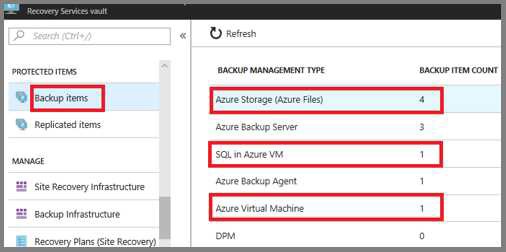
References: https://docs.microsoft.com/en-us/azure/backup/backup-azure-delete-vault
NEW QUESTION 8
Your company registers a domain name of contoso.com.
You create an Azure DNS named contoso.com and then you add an A record to the zone for a host named www that has an IP address of 131.107.1.10.
You discover that Internet hosts are unable to resolve www.contoso.com to the 131.107.1.10 IP address.
You need to resolve the name resolution issue.
Solution: You modify the name server at the domain registrar. Does this meet the goal?
- A. Yes
- B. No
Answer: B
Explanation:
Modify the Name Server (NS) record.
References: https://docs.microsoft.com/en-us/azure/dns/dns-delegate-domain-azure-dns
NEW QUESTION 9
HOTSPOT
You have an Azure subscription that contains several virtual machines and an Azure Log Analytics workspace named Workspace1. You create a log search query as shown in the following exhibit.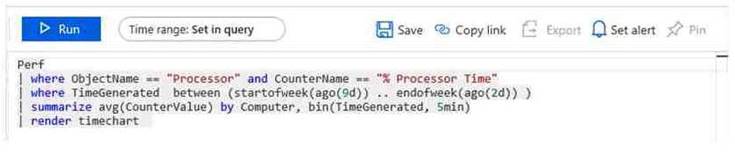
Use the drop-down menus to select the answer choice that completes each statement based on the information presented in the graphic.
NOTE: Each correct selection is worth one point.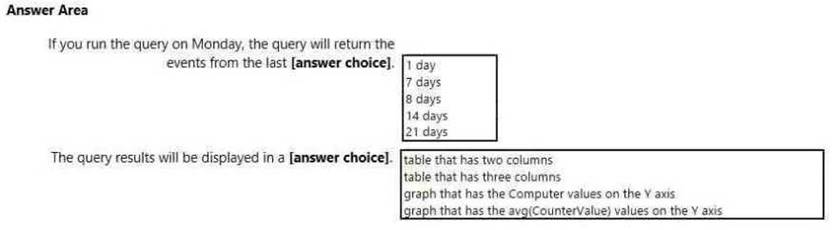
- A. Mastered
- B. Not Mastered
Answer: A
Explanation:
Box 1: 14 days
Two weeks will be covered.
Note: Startofweek returns the start of the week containing the date, shifted by an offset, if provided. Start of the week is considered to be a Sunday.
Endofweek returns the end of the week containing the date, shifted by an offset, if provided. Last day of the week is considered to be a Saturday.
Box 2:
The render operator renders results in as graphical output. Timechart is a Line graph, where the first column is x-axis, and should be datetime. Other columns are y-axes. In this case the Y axis has avg(CounterValue) Values.
References:
https://docs.microsoft.com/en-us/azure/azure-monitor/log-query/log-query-overview
https://docs-analytics-eus.azurewebsites.net/queryLanguage/query_language_renderoperator.html
NEW QUESTION 10
Note: This question is part of a series of questions that present the same scenario. Each question in the series contains a unique solution that might meet the stated goals. Some question sets might have more than one correct solution, while others might not have a correct solution.
After you answer a question in this section, you will NOT be able to return to it. As a result, these questions will not appear in the review screen.
You have an Azure subscription that contains 10 virtual networks. The virtual networks are hosted in
separate resource groups.
Another administrator plans to create several network security groups (NSGs) in the subscription.
You need to ensure that when an NSG is created, it automatically blocks TCP port 8080 between the virtual networks.
Solution: You create a resource lock, and then you assign the lock to the subscription. Does this meet the goal?
- A. Yes
- B. No
Answer: B
Explanation:
How can I freeze or lock my production/critical Azure resources from accidental deletion? There is way to do this with both ASM and ARM resources using Azure resource lock.
References: https://blogs.msdn.microsoft.com/azureedu/2021/04/27/using-azure-resource-manager- policy-and-azure-lock-to-control-your-azure-resources/
NEW QUESTION 11
You are planning the move of App1 to Azure. You create a network security group (NSG).
You need to recommend a solution to provide users with access to App1. What should you recommend?
- A. Create an outgoing security rule for port 443 from the Interne
- B. Associate the NSG to all the subnets.
- C. Create an incoming security rule for port 443 from the Interne
- D. Associate the NSG to all the subnets.
- E. Create an incoming security rule for port 443 from the Interne
- F. Associate the NSG to the subnet thatcontains the web servers.
- G. Create an outgoing security rule for port 443 from the Interne
- H. Associate the NSG to the subnet thatcontains the web servers.
Answer: C
Explanation:
As App1 is public-facing we need an incoming security rule, related to the access of the web servers. Scenario: You have a public-facing application named App1. App1 is comprised of the following three tiers: a SQL database, a web front end, and a processing middle tier.
Each tier is comprised of five virtual machines. Users access the web front end by using HTTPS only.
NEW QUESTION 12
You have two Azure virtual networks named VNet1 and VNet2. VNet1 contains an Azure virtual machine named VM1. VNet2 contains an Azure virtual machine named VM2.
VM1 hosts a frontend application that connects to VM2 to retrieve dat a.
Users report that the frontend application is slower than usual.
You need to view the average round-trip time (RTT) of the packets from VM1 to VM2. Which Azure Network Watcher feature should you use?
- A. NSG flow logs
- B. Connection troubleshoot
- C. IP flow verify
- D. Connection monitor
Answer: D
Explanation:
The Connection Monitor feature in Azure Network Watcher is now generally available in all public regions. Connection Monitor provides you RTT values on a per-minute granularity. You can monitor a direct TCP connection from a virtual machine to a virtual machine, FQDN, URI, or IPv4 address. References:
https://azure.microsoft.com/en-us/updates/general-availability-azure-network-watcher-connection- monitor-in-all-public-regions/
NEW QUESTION 13
You plan to move services from your on-premises network to Azure.
You identify several virtual machines that you believe can be hosted in Azure. The virtual machines are shown in the following table.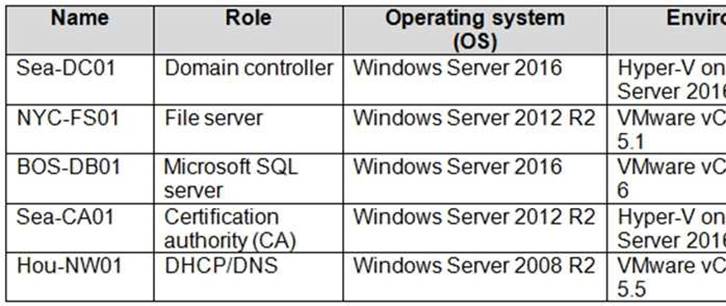
Which two virtual machines can you access by using Azure migrate? Each correct answer presents a complete solution.
NOTE: Each correct selection is worth one point.
- A. Sea-CA0l
- B. Hou-NW01
- C. NYC-FS01
- D. Sea-DC01
- E. BOS-DB01
Answer: CE
NEW QUESTION 14
HOTSPOT
You have an Azure subscription named Subscription1 that contains the resources in the following table.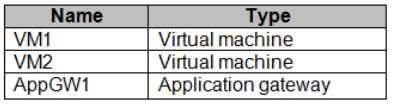
VM1 and VM2 run the websites in the following table.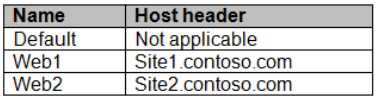
AppGW1 has the backend pools in the following table.
DNS resolves site1.contoso.com, site2.contoso.com, and site3.contoso.com to the IP address of AppGW1.
AppGW1 has the listeners in the following table.
AppGW1 has the rules in the following table.
For each of the following statements, select Yes if the statement is true. Otherwise, select No.
NOTE: Each correct selection is worth one point.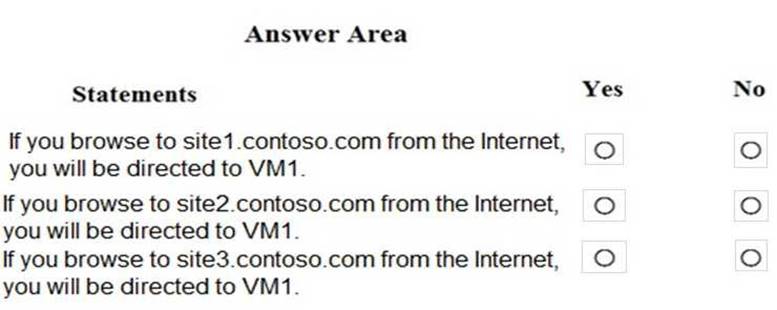
- A. Mastered
- B. Not Mastered
Answer: A
Explanation:
Vm1 is in Pool1. Rule2 applies to Pool1, Listener 2, and site2.contoso.com
NEW QUESTION 15
HOTSPOT
You have an Azure subscription named Subscroption1. In Subscription1, you create an alert rule named Alert1.
The Alert1 action group is configured as shown in the following exhibit.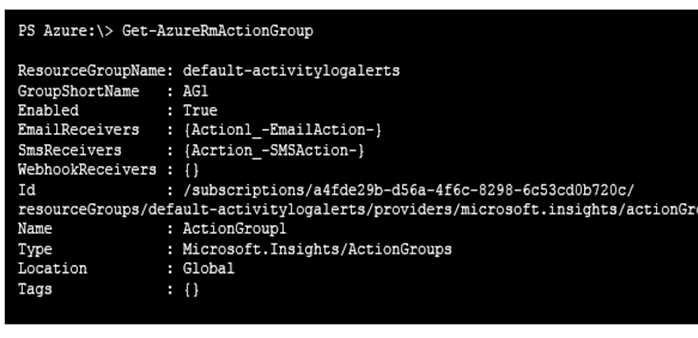
Alert1 alert criteria is triggered every minute.
Use the drop-down menus to select the answer choice that completes each statement based on the information presented in the graphic.
NOTE: Each correct selection is worth one point.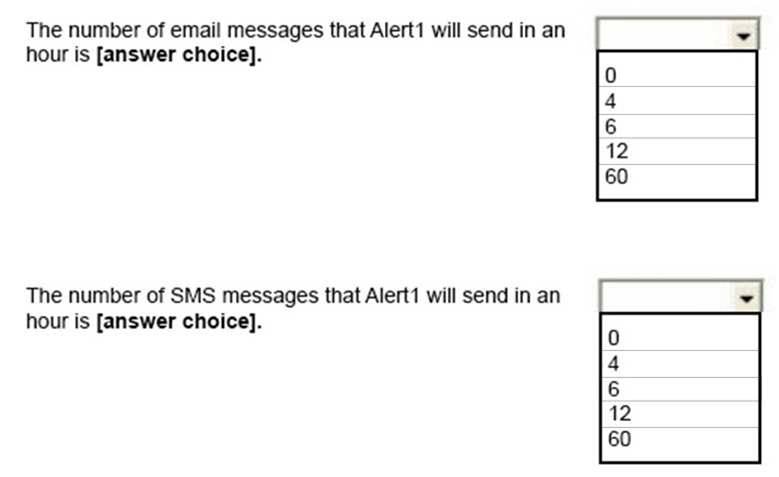
- A. Mastered
- B. Not Mastered
Answer: A
Explanation:
Box 1: 60
One alert per minute will trigger one email per minute. Box 2: 12
No more than 1 SMS every 5 minutes can be send, which equals 12 per hour.
Note: Rate limiting is a suspension of notifications that occurs when too many are sent to a particular phone number, email address or device. Rate limiting ensures that alerts are manageable and actionable.
The rate limit thresholds are:
SMS: No more than 1 SMS every 5 minutes. Voice: No more than 1 Voice call every 5 minutes. Email: No more than 100 emails in an hour.
Other actions are not rate limited. References:
https://github.com/MicrosoftDocs/azure-docs/blob/master/articles/monitoring-and- diagnostics/monitoring-overview-alerts.md
NEW QUESTION 16
You have an Azure Active Directory (Azure AD) tenant named contoso.onmicrosoft.com that contains 100 user accounts.
You purchase 10 Azure AD Premium P2 licenses for the tenant.
You need to ensure that 10 users can use all the Azure AD Premium features. What should you do?
- A. From the Groups blade of each user, invite the users to a group.
- B. From the Licenses blade of Azure AD, assign a license.
- C. From the Directory role blade of each user, modify the directory role.
- D. From the Azure AD domain, add an enterprise application.
Answer: B
Explanation:
To assign a license, under Azure Active Directory > Licenses > All Products, select one or more products, and then select Assign on the command bar.
References: https://docs.microsoft.com/en-us/azure/active-directory/fundamentals/license-users- groups
NEW QUESTION 17
Your marketing team creates a new website that you must load balance for 99.99 percent availability.
You need to deploy and configure a solution for both machines in the Web-AS availability set to load balance the website over HTTP. The solution must use the load balancer your resource group.
What should you do from the Azure portal?
- A. Mastered
- B. Not Mastered
Answer: A
Explanation:
To distribute traffic to the VMs in the availability set, a back-end address pool contains the IP addresses of the virtual NICs that are connected to the load balancer. Create the back-end address pool to include the VMs in the availability set.
Step 1:
Select All resources on the left menu, and then select LoadBalancer from the resource list. Step 2:
Under Settings, select Backend pools, and then select Add. Step 3:
On the Add a backend pool page, select the Web-AS availability set, and then select OK: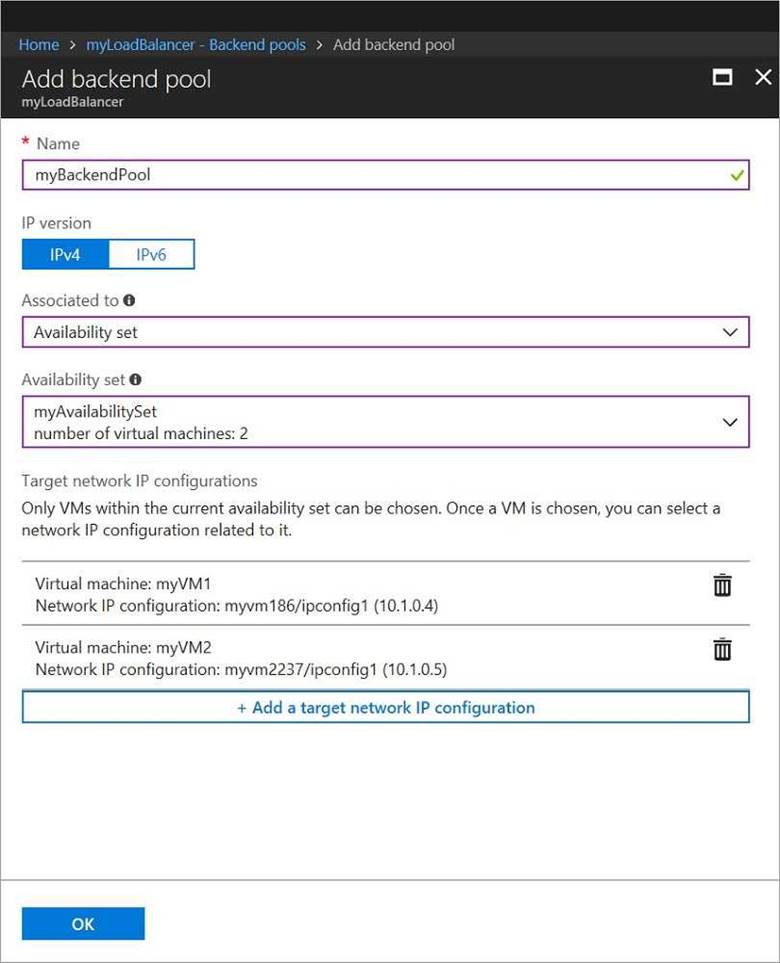
References:
https://docs.microsoft.com/en-us/azure/load-balancer/quickstart-create-basic-load-balancer-portal
NEW QUESTION 18
DRAG DROP
You need to configure the Azure ExpressRoute circuits.
How should you configure Azure ExpressRoute routing? To answer, drag the appropriate configurations to the correct locations. Each configuration may be used once, more than once, or not at all. You may need to drag the split bar between panes or scroll to view content.
NOTE: Each correct selection is worth one point.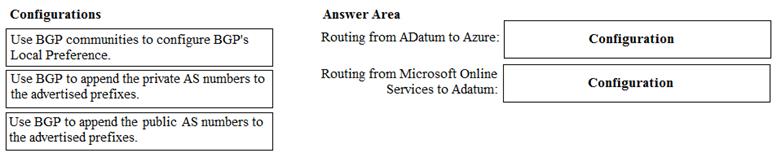
- A. Mastered
- B. Not Mastered
Answer: A
Explanation: 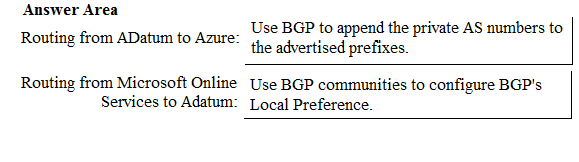
NEW QUESTION 19
You have an Azure tenant that contains two subscriptions named Subscription1 and Subscription2.
In Subscription1, you deploy a virtual machine named Server1 that runs Windows Server 2021. Server1 uses managed disks.
You need to move Server1 to Subscription2. The solution must minimize administration effort. What should you do first?
- A. In Subscription2, create a copy of the virtual disk.
- B. From Azure PowerShell, run the Move-AzureRmResource cmdlet.
- C. Create a snapshot of the virtual disk.
- D. Create a new virtual machine in Subscription2.
Answer: B
Explanation:
To move existing resources to another resource group or subscription, use the Move-AzureRmResource cmdlet. References:
https://docs.microsoft.com/en-in/azure/azure-resource-manager/resource-group-move- resources#moveresources
NEW QUESTION 20
You have an Azure subscription that contains a virtual machine named VM1. VM1 hosts a line-of- business application that is available 24 hours a day. VM1 has one network interface and one managed disk. VM1 uses the D4s v3 size.
You plan to make the following changes to VM1:
Change the size to D8s v3.
Add a 500-GB managed disk.
Add the Puppet Agent extension.
Attach an additional network interface. Which change will cause downtime for VM1?
- A. Add a 500-GB managed disk.
- B. Attach an additional network interface.
- C. Add the Puppet Agent extension.
- D. Change the size to D8s v3.
Answer: D
Explanation:
While resizing the VM it must be in a stopped state.
References: https://azure.microsoft.com/en-us/blog/resize-virtual-machines/
NEW QUESTION 21
You have an Azure subscription named Subscription1.
You have 5 TB of data that you need to transfer to Subscription. You plan to use an Azure Import/Export job.
What can you use as the destination of the imported data?
- A. Azure SQL Database
- B. Azure Data Factory
- C. A virtual machine
- D. Azure Blob storage
Answer: D
Explanation:
References:
https://docs.microsoft.com/en-us/azure/storage/common/storage-import-export-service
NEW QUESTION 22
You have an Azure virtual network named VNet1 that contains a subnet named Subnet1. Subnet1 contains three Azure virtual machines. Each virtual machine has a public IP address.
The virtual machines host several applications that are accessible over port 443 to user on the Internet.
Your on-premises network has a site-to-site VPN connection to VNet1.
You discover that the virtual machines can be accessed by using the Remote Desktop Protocol (RDP) from the Internet and from the on-premises network.
You need to prevent RDP access to the virtual machines from the Internet, unless the RDP connection is established from the on-premises network. The solution must ensure that all the applications can still be accesses by the Internet users.
What should you do?
- A. Modify the address space of the local network gateway.
- B. Remove the public IP addresses from the virtual machines.
- C. Modify the address space of Subnet1.
- D. Create a deny rule in a network security group (NSG) that is linked to Subnet1.
Answer: D
Explanation:
You can filter network traffic to and from Azure resources in an Azure virtual network with a network security group. A network security group contains security rules that allow or deny inbound network traffic to, or outbound network traffic from, several types of Azure resources.
References:
https://docs.microsoft.com/en-us/azure/virtual-network/security-overview
NEW QUESTION 23
Note: This question is part of a series of questions that present the same scenario goals. Some question sets might have more than one correct solution, while others ion in the series contains a unique solution that might meet the stated not have a correct solution.
After you answer a question in this section, you will NOT be able to return to it. As a result, these questions will not appear in the review screen.
You have an Azure web app named Appl. App1 runs in an Azure App Service plan named Plan1. Plan1 is associated to the Free pricing tier.
You discover that App1 stops each day after running continuously for 60 minutes.
You need to ensure that App1 can run continuously for the entire day. Solution: You add a triggered WebJob to App1.
Does this meet the goal?
- A. Yes
- B. No
Answer: B
Explanation:
You need to change to Basic pricing Tier.
Note: The Free Tier provides 60 CPU minutes / day. This explains why App1 is stops. The Basic tier has no such cap.
References:
https://azure.microsoft.com/en-us/pricing/details/app-service/windows/
NEW QUESTION 24
You have five Azure virtual machines that run Windows Server 2021.
You have an Azure load balancer named LB1 that provides load balancing se
You need to ensure that visitors are serviced by the same web server for each
request.
What should you configure?
- A. Floating IP (direct server return) to Disable
- B. Session persistence to Client IP
- C. a health probe
- D. Session persistence to None
Answer: B
Explanation:
You can set the sticky session in load balancer rules with setting the session persistence as the client IP.
References:
https://cloudopszone.com/configure-azure-load-balancer-for-sticky-sessions/
NEW QUESTION 25
Note: This question is part of a series of questions that present the same scenario. Each question in the series contains a unique solution that might meet the stated goals. Some question sets might have more than one correct solution, while others might not have a correct solution.
After you answer a question in this section, you will NOT be able to return to it. As a result,
these questions will not appear in the review screen.
You have an Azure virtual machine named VM1. VM1 was deployed by using a custom Azure Resource Manager template named ARM1.json.
You receive a notification that VM1 will be affected by maintenance. You need to move VM1 to a different host immediately.
Solution: From the Update management blade, you click enable. Does this meet the goal?
- A. Yes
- B. No
Answer: B
Explanation:
You would need to Redeploy the VM.
References: https://docs.microsoft.com/en-us/azure/virtual-machines/windows/redeploy-to-new-node
NEW QUESTION 26
DRAG DROP
You have an Azure subscription that contains the following resources:
• a virtual network named VNet1
• a replication policy named ReplPolicy1
• a Recovery Services vault named Vault1
• an Azure Storage account named Storage1
You have an Amazon Web Services (AWS) EC2 virtual machine named VM1 that runs Windows Server
You need to migrate VM1 to VNet1 by using Azure Site Recovery.
Which three actions should you perform in sequence? To answer, move the appropriate actions from the list of actions to the answer area and arrange them in the correct order.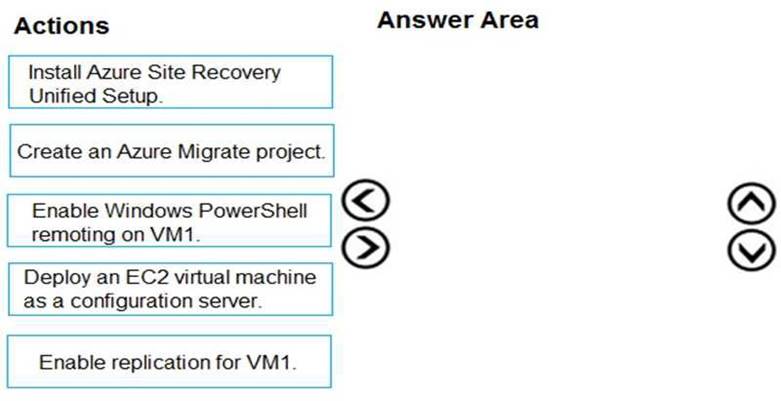
- A. Mastered
- B. Not Mastered
Answer: A
Explanation:
Step 1: Deploy an EC2 virtual machine as a configuration server Prepare source include:
1. Use an EC2 instance that's running Windows Server 2012 R2 to create a configuration server and register it with your recovery vault.
2. Configure the proxy on the EC2 instance VM you're using as the configuration server so that it can access the service URLs.
Step 2: Install Azure Site Recovery Unified Setup.
Download Microsoft Azure Site Recovery Unified Setup. You can download it to your local machine and then copy it to the VM you're using as the configuration server.
Step 3: Enable replication for VM1.
Enable replication for each VM that you want to migrate. When replication is enabled, Site Recovery automatically installs the Mobility service.
References:
https://docs.microsoft.com/en-us/azure/site-recovery/migrate-tutorial-aws-azure
NEW QUESTION 27
You have an Azure subscription named Subscription1. Subscription1 contains the resource groups in the following table.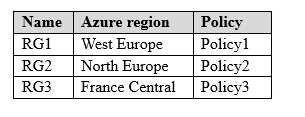
RG1 has a web app named WebApp1. WebApp1 is located in West Europe. You move WebApp1 to RG2. What is the effect of the move?
- A. The App Service plan to WebApp1 moves to North Europ
- B. Policy2 applies to WebApp1.
- C. The App Service plan to WebApp1 moves to North Europ
- D. Policy1 applies to WebApp1.
- E. The App Service plan to WebApp1 remains to West Europ
- F. Policy2 applies to WebApp1.
- G. The App Service plan to WebApp1 remains to West Europ
- H. Policy1 applies to WebApp1.
Answer: C
Explanation:
You can move an app to another App Service plan, as long as the source plan and the target plan are in the same resource group and geographical region.
The region in which your app runs is the region of the App Service plan it's in. However, you cannot change an App Service plan's region.
References: https://docs.microsoft.com/en-us/azure/app-service/app-service-plan-manage
NEW QUESTION 28
You have a Basic App Service plan named ASP1 that hosts an Azure App Service named App1. You need to configure a custom domain and enable backups for App1.
What should you do first?
- A. Configure a WebJob for App1.
- B. Scale up ASP1.
- C. Scale out ASP1.
- D. Configure the application settings for App1.
Answer: D
NEW QUESTION 29
......
100% Valid and Newest Version AZ-103 Questions & Answers shared by Certstest, Get Full Dumps HERE: https://www.certstest.com/dumps/AZ-103/ (New 303 Q&As)