It is impossible to pass Microsoft DP-203 exam without any help in the short term. Come to Ucertify soon and find the most advanced, correct and guaranteed Microsoft DP-203 practice questions. You will get a surprising result by our Up to date Data Engineering on Microsoft Azure practice guides.
Check DP-203 free dumps before getting the full version:
NEW QUESTION 1
You have a data model that you plan to implement in a data warehouse in Azure Synapse Analytics as shown in the following exhibit.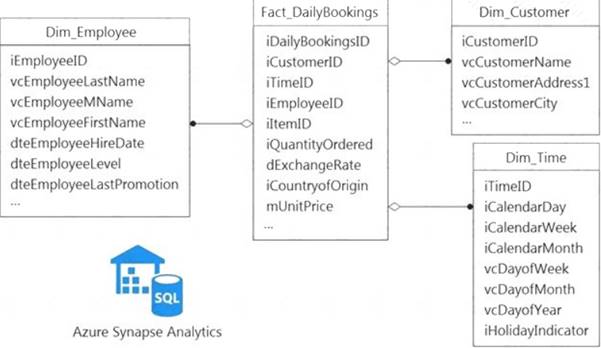
All the dimension tables will be less than 2 GB after compression, and the fact table will be approximately 6 TB.
Which type of table should you use for each table? To answer, select the appropriate options in the answer area.
NOTE: Each correct selection is worth one point.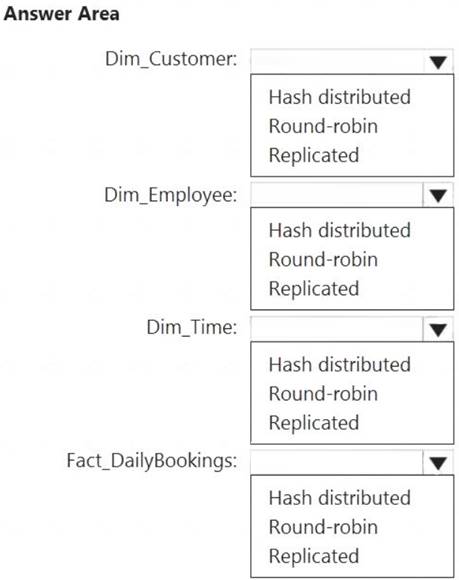
- A. Mastered
- B. Not Mastered
Answer: A
Explanation: 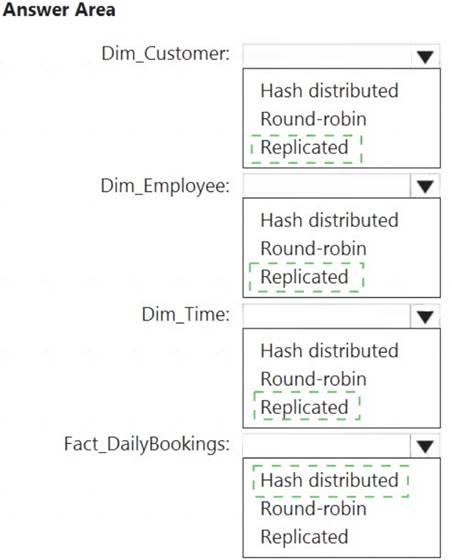
NEW QUESTION 2
You plan to ingest streaming social media data by using Azure Stream Analytics. The data will be stored in files in Azure Data Lake Storage, and then consumed by using Azure Datiabricks and PolyBase in Azure Synapse Analytics.
You need to recommend a Stream Analytics data output format to ensure that the queries from Databricks and PolyBase against the files encounter the fewest possible errors. The solution must ensure that the tiles can be queried quickly and that the data type information is retained.
What should you recommend?
- A. Parquet
- B. Avro
- C. CSV
- D. JSON
Answer: B
Explanation:
The Avro format is great for data and message preservation.Avro schema with its support for evolution is essential for making the data robust for streaming architectures like Kafka, and with the metadata that schema provides, you can reason on the data. Having a schema provides robustness in providing meta-data about the data stored in Avro records which are self- documenting the data.References: http://cloudurable.com/blog/avro/index.html
NEW QUESTION 3
You have an Azure Stream Analytics query. The query returns a result set that contains 10,000 distinct values for a column named clusterID.
You monitor the Stream Analytics job and discover high latency. You need to reduce the latency.
Which two actions should you perform? Each correct answer presents a complete solution. NOTE: Each correct selection is worth one point.
- A. Add a pass-through query.
- B. Add a temporal analytic function.
- C. Scale out the query by using PARTITION BY.
- D. Convert the query to a reference query.
- E. Increase the number of streaming units.
Answer: CE
Explanation:
C: Scaling a Stream Analytics job takes advantage of partitions in the input or output. Partitioning lets you
divide data into subsets based on a partition key. A process that consumes the data (such as a Streaming Analytics job) can consume and write different partitions in parallel, which increases throughput.
E: Streaming Units (SUs) represents the computing resources that are allocated to execute a Stream Analytics job. The higher the number of SUs, the more CPU and memory resources are allocated for your job. This capacity lets you focus on the query logic and abstracts the need to manage the hardware to run your Stream Analytics job in a timely manner.
References:
https://docs.microsoft.com/en-us/azure/stream-analytics/stream-analytics-parallelization https://docs.microsoft.com/en-us/azure/stream-analytics/stream-analytics-streaming-unit-consumption
NEW QUESTION 4
You have an Apache Spark DataFrame named temperatures. A sample of the data is shown in the following table.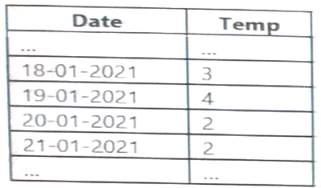
You need to produce the following table by using a Spark SQL query.
How should you complete the query? To answer, drag the appropriate values to the correct targets. Each value may be used once more than once, or not at all. You may need to drag the split bar between panes or scroll to view content.
NOTE: Each correct selection is worth one point.
- A. Mastered
- B. Not Mastered
Answer: A
Explanation: 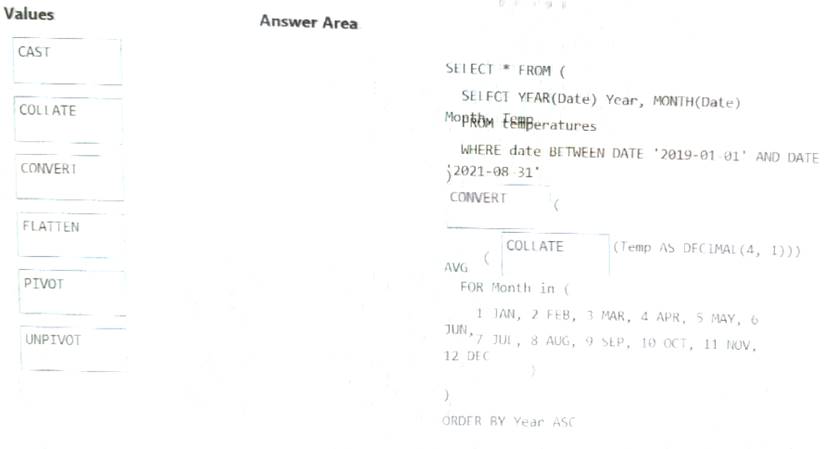
NEW QUESTION 5
You use Azure Data Factory to prepare data to be queried by Azure Synapse Analytics serverless SQL pools. Files are initially ingested into an Azure Data Lake Storage Gen2 account as 10 small JSON files. Each file contains the same data attributes and data from a subsidiary of your company.
You need to move the files to a different folder and transform the data to meet the following requirements:  Provide the fastest possible query times.
 Automatically infer the schema from the underlying files.
How should you configure the Data Factory copy activity? To answer, select the appropriate options in the answer area.
NOTE: Each correct selection is worth one point.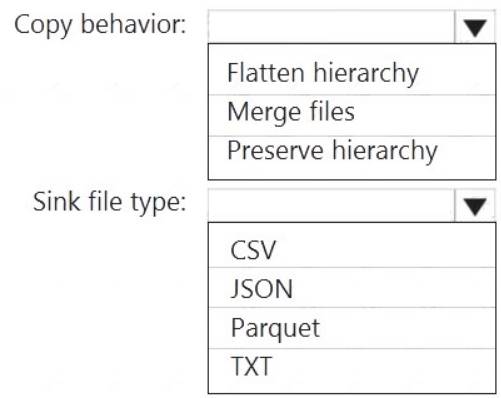
- A. Mastered
- B. Not Mastered
Answer: A
Explanation:
Box 1: Preserver herarchy
Compared to the flat namespace on Blob storage, the hierarchical namespace greatly improves the performance of directory management operations, which improves overall job performance.
Box 2: Parquet
Azure Data Factory parquet format is supported for Azure Data Lake Storage Gen2. Parquet supports the schema property.
Reference:
https://docs.microsoft.com/en-us/azure/storage/blobs/data-lake-storage-introduction https://docs.microsoft.com/en-us/azure/data-factory/format-parquet
NEW QUESTION 6
You plan to implement an Azure Data Lake Storage Gen2 container that will contain CSV files. The size of the files will vary based on the number of events that occur per hour.
File sizes range from 4.KB to 5 GB.
You need to ensure that the files stored in the container are optimized for batch processing. What should you do?
- A. Compress the files.
- B. Merge the files.
- C. Convert the files to JSON
- D. Convert the files to Avro.
Answer: D
NEW QUESTION 7
You are implementing Azure Stream Analytics windowing functions.
Which windowing function should you use for each requirement? To answer, select the appropriate options in the answer area.
NOTE: Each correct selection is worth one point.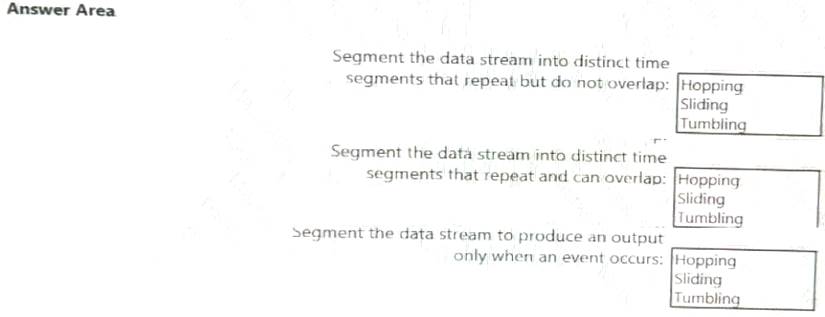
- A. Mastered
- B. Not Mastered
Answer: A
Explanation: 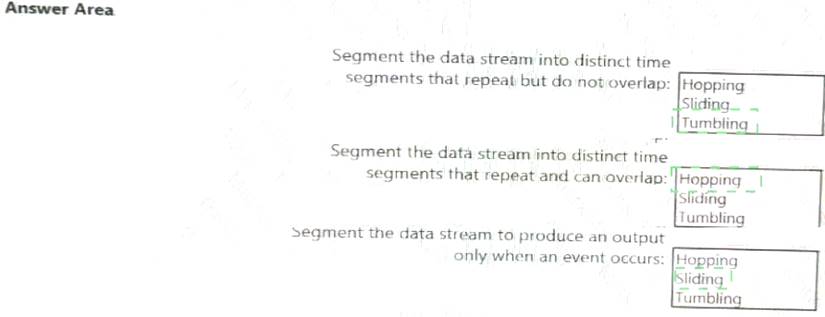
NEW QUESTION 8
You have the following Azure Stream Analytics query.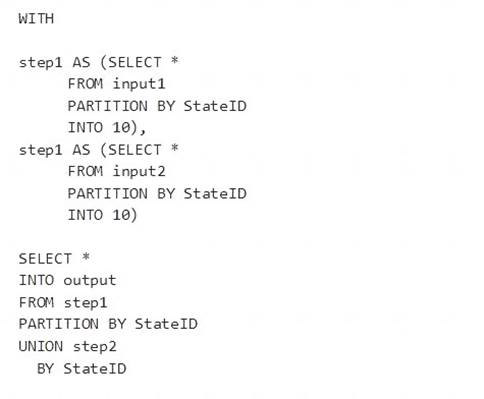
For each of the following statements, select Yes if the statement is true. Otherwise, select No.
NOTE: Each correct selection is worth one point.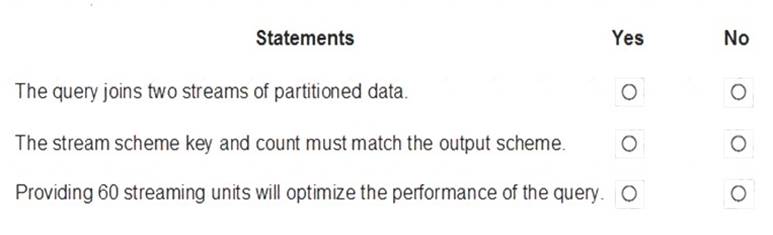
- A. Mastered
- B. Not Mastered
Answer: A
Explanation:
Box 1: Yes
You can now use a new extension of Azure Stream Analytics SQL to specify the number of partitions of a stream when reshuffling the data.
The outcome is a stream that has the same partition scheme. Please see below for an example: WITH step1 AS (SELECT * FROM [input1] PARTITION BY DeviceID INTO 10),
step2 AS (SELECT * FROM [input2] PARTITION BY DeviceID INTO 10)
SELECT * INTO [output] FROM step1 PARTITION BY DeviceID UNION step2 PARTITION BY DeviceID Note: The new extension of Azure Stream Analytics SQL includes a keyword INTO that allows you to specify
the number of partitions for a stream when performing reshuffling using a PARTITION BY statement.
Box 2: Yes
When joining two streams of data explicitly repartitioned, these streams must have the same partition key and partition count.
Box 3: Yes
10 partitions x six SUs = 60 SUs is fine.
Note: Remember, Streaming Unit (SU) count, which is the unit of scale for Azure Stream Analytics, must be adjusted so the number of physical resources available to the job can fit the partitioned flow. In general, six SUs is a good number to assign to each partition. In case there are insufficient resources assigned to the job, the system will only apply the repartition if it benefits the job.
Reference:
https://azure.microsoft.com/en-in/blog/maximize-throughput-with-repartitioning-in-azure-stream-analytics/
NEW QUESTION 9
You have the following table named Employees.
You need to calculate the employee _type value based on the hire date value.
How should you complete the Transact-SQL statement? To answer, drag the appropriate values to the correct targets. Each value may be used once, more than once, or not at all. You may need to drag the split bar between panes or scroll to view content
NOTE: Each correct selection is worth one point.
- A. Mastered
- B. Not Mastered
Answer: A
Explanation: 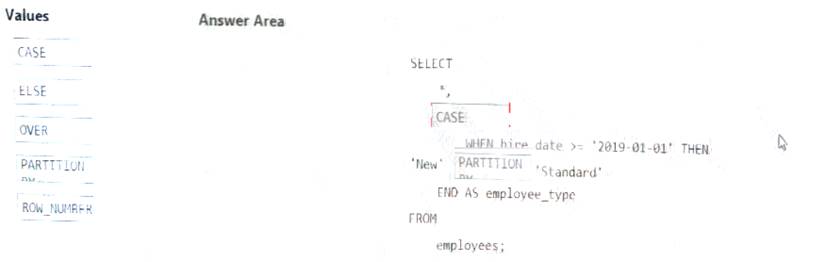
NEW QUESTION 10
You have an Azure data factory.
You need to examine the pipeline failures from the last 60 days. What should you use?
- A. the Activity log blade for the Data Factory resource
- B. the Monitor & Manage app in Data Factory
- C. the Resource health blade for the Data Factory resource
- D. Azure Monitor
Answer: D
Explanation:
Data Factory stores pipeline-run data for only 45 days. Use Azure Monitor if you want to keep that data for a longer time.
Reference:
https://docs.microsoft.com/en-us/azure/data-factory/monitor-using-azure-monitor
NEW QUESTION 11
You have an Azure subscription that contains a logical Microsoft SQL server named Server1. Server1 hosts an Azure Synapse Analytics SQL dedicated pool named Pool1.
You need to recommend a Transparent Data Encryption (TDE) solution for Server1. The solution must meet the following requirements: Track the usage of encryption keys.
 Maintain the access of client apps to Pool1 in the event of an Azure datacenter outage that affects the availability of the encryption keys.
What should you include in the recommendation? To answer, select the appropriate options in the answer area.
NOTE: Each correct selection is worth one point.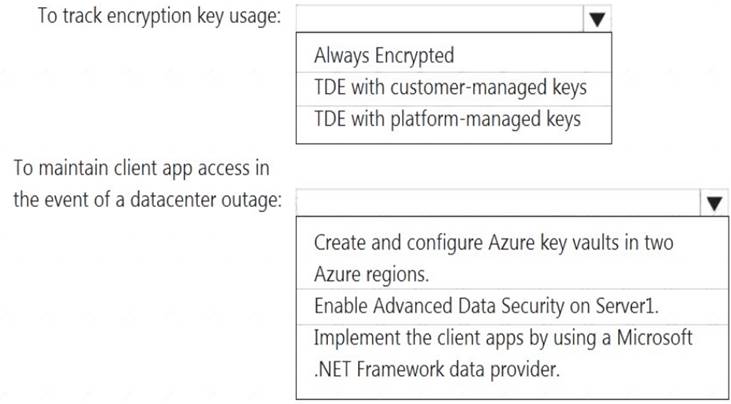
- A. Mastered
- B. Not Mastered
Answer: A
Explanation:
Box 1: TDE with customer-managed keys
Customer-managed keys are stored in the Azure Key Vault. You can monitor how and when your key vaults are accessed, and by whom. You can do this by enabling logging for Azure Key Vault, which saves information in an Azure storage account that you provide.
Box 2: Create and configure Azure key vaults in two Azure regions
The contents of your key vault are replicated within the region and to a secondary region at least 150 miles away, but within the same geography to maintain high durability of your keys and secrets.
Reference:
https://docs.microsoft.com/en-us/azure/synapse-analytics/security/workspaces-encryption https://docs.microsoft.com/en-us/azure/key-vault/general/logging
NEW QUESTION 12
You are developing a solution that will stream to Azure Stream Analytics. The solution will have both streaming data and reference data.
Which input type should you use for the reference data?
- A. Azure Cosmos DB
- B. Azure Blob storage
- C. Azure IoT Hub
- D. Azure Event Hubs
Answer: B
Explanation:
Stream Analytics supports Azure Blob storage and Azure SQL Database as the storage layer for Reference Data.
Reference:
https://docs.microsoft.com/en-us/azure/stream-analytics/stream-analytics-use-reference-data
NEW QUESTION 13
You develop data engineering solutions for a company.
A project requires the deployment of data to Azure Data Lake Storage.
You need to implement role-based access control (RBAC) so that project members can manage the Azure Data Lake Storage resources.
Which three actions should you perform? Each correct answer presents part of the solution. NOTE: Each correct selection is worth one point.
- A. Assign Azure AD security groups to Azure Data Lake Storage.
- B. Configure end-user authentication for the Azure Data Lake Storage account.
- C. Configure service-to-service authentication for the Azure Data Lake Storage account.
- D. Create security groups in Azure Active Directory (Azure AD) and add project members.
- E. Configure access control lists (ACL) for the Azure Data Lake Storage account.
Answer: ADE
Explanation:
References:
https://docs.microsoft.com/en-us/azure/data-lake-store/data-lake-store-secure-data
NEW QUESTION 14
You need to design a data storage structure for the product sales transactions. The solution must meet the sales transaction dataset requirements.
What should you include in the solution? To answer, select the appropriate options in the answer area. NOTE: Each correct selection is worth one point.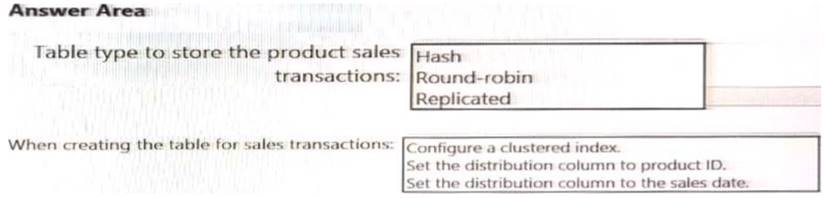
- A. Mastered
- B. Not Mastered
Answer: A
Explanation: 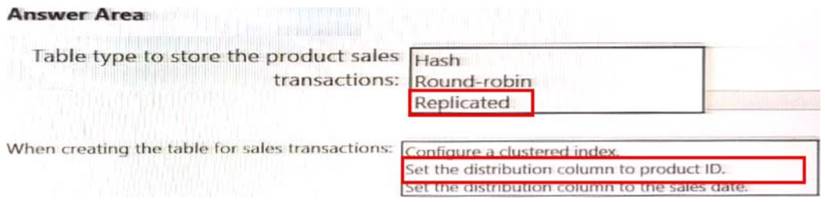
NEW QUESTION 15
You need to create an Azure Data Factory pipeline to process data for the following three departments at your company: Ecommerce, retail, and wholesale. The solution must ensure that data can also be processed for the entire company.
How should you complete the Data Factory data flow script? To answer, drag the appropriate values to the correct targets. Each value may be used once, more than once, or not at all. You may need to drag the split bar between panes or scroll to view content.
NOTE: Each correct selection is worth one point.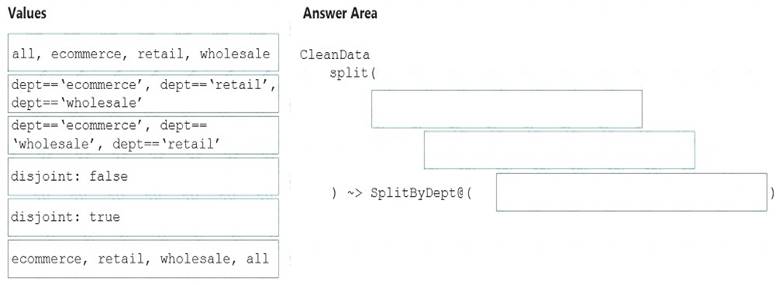
- A. Mastered
- B. Not Mastered
Answer: A
Explanation:
The conditional split transformation routes data rows to different streams based on matching conditions. The conditional split transformation is similar to a CASE decision structure in a programming language. The transformation evaluates expressions, and based on the results, directs the data row to the specified stream.
Box 1: dept=='ecommerce', dept=='retail', dept=='wholesale'
First we put the condition. The order must match the stream labeling we define in Box 3. Syntax:
<incomingStream> split(
<conditionalExpression1>
<conditionalExpression2>
disjoint: {true | false}
) ~> <splitTx>@(stream1, stream2, ..., <defaultStream>)
Box 2: discount : false
disjoint is false because the data goes to the first matching condition. All remaining rows matching the third condition go to output stream all.
Box 3: ecommerce, retail, wholesale, all Label the streams
Reference:
https://docs.microsoft.com/en-us/azure/data-factory/data-flow-conditional-split
NEW QUESTION 16
You have an enterprise data warehouse in Azure Synapse Analytics named DW1 on a server named Server1. You need to verify whether the size of the transaction log file for each distribution of DW1 is smaller than 160 GB.
What should you do?
- A. On the master database, execute a query against the sys.dm_pdw_nodes_os_performance_counters dynamic management view.
- B. From Azure Monitor in the Azure portal, execute a query against the logs of DW1.
- C. On DW1, execute a query against the sys.database_files dynamic management view.
- D. Execute a query against the logs of DW1 by using theGet-AzOperationalInsightSearchResult PowerShell cmdlet.
Answer: A
Explanation:
The following query returns the transaction log size on each distribution. If one of the log files is reaching 160 GB, you should consider scaling up your instance or limiting your transaction size.
-- Transaction log size SELECT
instance_name as distribution_db, cntr_value*1.0/1048576 as log_file_size_used_GB, pdw_node_id
FROM sys.dm_pdw_nodes_os_performance_counters WHERE
instance_name like 'Distribution_%'
AND counter_name = 'Log File(s) Used Size (KB)' References:
https://docs.microsoft.com/en-us/azure/sql-data-warehouse/sql-data-warehouse-manage-monitor
NEW QUESTION 17
You are planning the deployment of Azure Data Lake Storage Gen2. You have the following two reports that will access the data lake: Report1: Reads three columns from a file that contains 50 columns. Report2: Queries a single record based on a timestamp.
You need to recommend in which format to store the data in the data lake to support the reports. The solution must minimize read times.
What should you recommend for each report? To answer, select the appropriate options in the answer area. NOTE: Each correct selection is worth one point.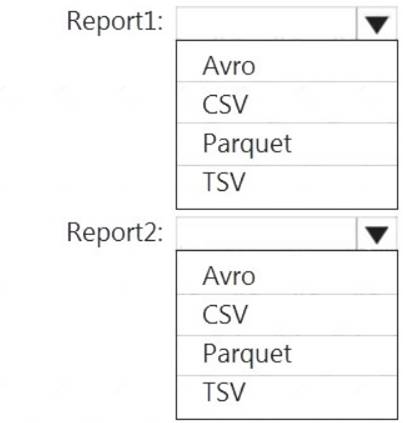
- A. Mastered
- B. Not Mastered
Answer: A
Explanation:
Report1: CSV
CSV: The destination writes records as delimited data. Report2: AVRO
AVRO supports timestamps.
Not Parquet, TSV: Not options for Azure Data Lake Storage Gen2. Reference:
https://streamsets.com/documentation/datacollector/latest/help/datacollector/UserGuide/Destinations/ADLS-G2
NEW QUESTION 18
Note: This question is part of a series of questions that present the same scenario. Each question in the series contains a unique solution that might meet the stated goals. Some question sets might have more than one correct solution, while others might not have a correct solution.
After you answer a question in this section, you will NOT be able to return to it. As a result, these questions will not appear in the review screen.
You plan to create an Azure Databricks workspace that has a tiered structure. The workspace will contain the following three workloads: A workload for data engineers who will use Python and SQL. A workload for jobs that will run notebooks that use Python, Scala, and SOL. A workload that data scientists will use to perform ad hoc analysis in Scala and R.
The enterprise architecture team at your company identifies the following standards for Databricks environments: The data engineers must share a cluster. The job cluster will be managed by using a request process whereby data scientists and data engineers provide packaged notebooks for deployment to the cluster. All the data scientists must be assigned their own cluster that terminates automatically after 120 minutes of inactivity. Currently, there are three data scientists.
You need to create the Databricks clusters for the workloads.
Solution: You create a High Concurrency cluster for each data scientist, a High Concurrency cluster for the data engineers, and a Standard cluster for the jobs.
Does this meet the goal?
- A. Yes
- B. No
Answer: B
Explanation:
Need a High Concurrency cluster for the jobs.
Standard clusters are recommended for a single user. Standard can run workloads developed in any language: Python, R, Scala, and SQL.
A high concurrency cluster is a managed cloud resource. The key benefits of high concurrency clusters are that they provide Apache Spark-native fine-grained sharing for maximum resource utilization and minimum query latencies.
Reference:
https://docs.azuredatabricks.net/clusters/configure.html
NEW QUESTION 19
You have a table in an Azure Synapse Analytics dedicated SQL pool. The table was created by using the following Transact-SQL statement.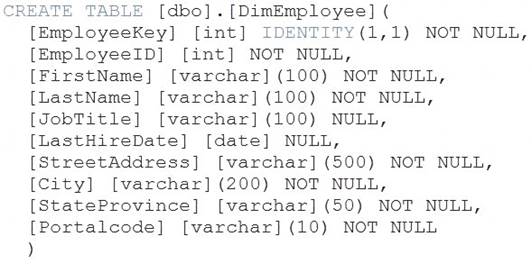
You need to alter the table to meet the following requirements: Ensure that users can identify the current manager of employees. Support creating an employee reporting hierarchy for your entire company.  Provide fast lookup of the managers’ attributes such as name and job title.
Which column should you add to the table?
- A. [ManagerEmployeeID] [int] NULL
- B. [ManagerEmployeeID] [smallint] NULL
- C. [ManagerEmployeeKey] [int] NULL
- D. [ManagerName] [varchar](200) NULL
Answer: A
Explanation:
Use the same definition as the EmployeeID column. Reference:
https://docs.microsoft.com/en-us/analysis-services/tabular-models/hierarchies-ssas-tabular
NEW QUESTION 20
......
P.S. Easily pass DP-203 Exam with 61 Q&As Certleader Dumps & pdf Version, Welcome to Download the Newest Certleader DP-203 Dumps: https://www.certleader.com/DP-203-dumps.html (61 New Questions)