Your success in Microsoft AZ-304 is our sole target and we develop all our AZ-304 braindumps in a way that facilitates the attainment of this target. Not only is our AZ-304 study material the best you can find, it is also the most detailed and the most updated. AZ-304 Practice Exams for Microsoft AZ-304 are written to the highest standards of technical accuracy.
Free demo questions for Microsoft AZ-304 Exam Dumps Below:
NEW QUESTION 1
You need to recommend a solution for protecting the content of the payment processing system. What should you include in the recommendation?
- A. Transparent Data Encryption (TDE)
- B. Azure Storage Service Encryption
- C. Always Encrypted with randomized encryption
- D. Always Encrypted with deterministic encryption
Answer: D
NEW QUESTION 2
You have an Azure subscription that is linked to an Azure Active Directory (Azure AD) tenant. The subscription contains 10 resource groups, one for each department at your company. Each department has a specific spending limit for its Azure resources.
You need to ensure that when a department reaches its spending limit, the compute resources of the department shut down automatically.
Which two features should you include in the solution? Each correct answer presents part of the solution.
NOTE: Each correct selection is worth one point.
- A. Azure Logic Apps
- B. Azure Monitor alerts
- C. the spending limit of an Azure account
- D. Cost Management budgets
- E. Azure Log Analytics alerts
Answer: CD
Explanation:
C: The spending limit in Azure prevents spending over your credit amount. All new customers who sign up for an Azure free account or subscription types that include credits over multiple months have the spending limit turned on by default. The spending limit is equal to the amount of credit and it can’t be changed.
D: Turn on the spending limit after removing
This feature is available only when the spending limit has been removed indefinitely for subscription types that include credits over multiple months. You can use this feature to turn on your spending limit automatically at the start of the next billing period. Sign in to the Azure portal as the Account Administrator.
  Search for Cost Management + Billing. Etc.
Reference:
https://docs.microsoft.com/en-us/azure/cost-management-billing/manage/spending-limit
NEW QUESTION 3
You need to recommend a solution for data of the historical transaction query system.
What should you include in the recommendation? To answer, Select the appropriate or options in the answer area.
NOTE: Each correct selection is worth one point
- A. Mastered
- B. Not Mastered
Answer: A
Explanation: 
NEW QUESTION 4
You have an on-premises network to which you deploy a virtual appliance.
You plan to deploy several Azure virtual machines and connect the on-premises network to Azure by using a Site-to-Site connection.
All network traffic that will be directed from the Azure virtual machines to a specific subnet must flow through the virtual appliance.
You need to recommend solutions to manage network traffic.
Which two options should you recommend? Each correct answer presents a complete solution.
- A. Configure Azure Traffic Manager.
- B. Implement an Azure virtual network.
- C. Implement Azure ExpressRoute.
- D. Configure a routing table.
Answer: CD
Explanation:
Connectivity can be from an any-to-any (IP VPN) network, a point-to-point Ethernet network, or a virtual cross-connection through a connectivity provider at a co-location facility. ExpressRoute connections do not go over the public Internet. This allows ExpressRoute connections to offer more reliability, faster speeds, lower latencies, and higher security than typical connections over the Internet.
Reference:
https://docs.microsoft.com/en-us/azure/vpn-gateway/vpn-gateway-forced-tunneling-rm https://docs.microsoft.com/en-us/azure/expressroute/expressroute-introduction
NEW QUESTION 5
What should you include in the identity management strategy to support the planned changes?
- A. Move all the domain controllers from corp.fabrikam.com to virtual networks in Azure.
- B. Deploy domain controllers for corp.fabrikam.com to virtual networks in Azure.
- C. Deploy a new Azure AD tenant for the authentication of new R&D projects.
- D. Deploy domain controllers for the rd.fabrikam.com forest to virtual networks in Azure.
Answer: B
Explanation:
Directory synchronization between Azure Active Directory (Azure AD) and corp.fabrikam.com must not be affected by a link failure between Azure and the on-premises network. (This requires domain controllers in Azure)
Users on the on-premises network must be able to authenticate to corp.fabrikam.com if an Internet link fails. (This requires domain controllers on-premises)
NEW QUESTION 6
You need to design a resource governance solution for an Azure subscription. The solution must meet the following requirements: Ensure that all ExpressRoute resources are created in a resource group named RG1. Delegate the creation of the ExpressRoute resources to an Azure Active Directory (Azure AD) group named Networking. Use the principle of least privilege.
What should you include in the solution? To answer, select the appropriate options in the answer area.
NOTE: Each correct selection is worth one point.
- A. Mastered
- B. Not Mastered
Answer: A
Explanation:
Box 1: An Azure policy assignment at the subscription level that has an exclusion Box 2: A custom RBAC role assignment at the level of RG1
Azure role-based access control (Azure RBAC) is the authorization system you use to manage access to Azure resources. To grant access, you assign roles to users, groups, service principals, or managed identities at a particular scope.
Reference:
https://docs.microsoft.com/en-us/azure/governance/policy/tutorials/create-and-manage
NEW QUESTION 7
Note: This question is part of a series of questions that present the same scenario. Each question in the series contains a unique solution that might meet the stated goals. Some question sets might have more than one correct solution. while others might not have a correct solution.
After you answer a question In this section, you will NOT be able to return to it As a result these questions will not appear In the review screen.
You have an on-premises Hyper-V cluster that hosts 20 virtual machines Some virtual machines run Windows Server 2016 and some run Linux
You plan to morale the virtual machine? to an Azure subscription
You need to recommend 9 solution 10 replicate the disks of the virtual machines to Azure. The solution must ensure that the virtual machines remain available during the migration of the disks.
Solution: You recommend implementing a Recovery Services vault and then using Azure Site Recovery. Dees this meet the goal?
- A. Yes
- B. No
Answer: A
Explanation:
Site Recovery can replicate on-premises VMware VMs, Hyper-V VMs, physical servers (Windows and Linux), Azure Stack VMs to Azure.
Note: Site Recovery helps ensure business continuity by keeping business apps and workloads running during outages. Site Recovery replicates workloads running on physical and virtual machines (VMs) from a primary site to a secondary location. When an outage occurs at your primary site, you fail over to secondary location, and access apps from there. After the primary location is running again, you can fail back to it.
References:
https://docs.microsoft.com/en-us/azure/site-recovery/site-recovery-overview
NEW QUESTION 8
You plan to deploy a network-intensive application to several Azure virtual machines. You need to recommend a solution that meets the following requirements: Minimizes the use of the virtual machine processors to transfer data Minimizes network latency
Which virtual machine size and feature should you use? To answer, select the appropriate options in the answer area.
NOTE: Each correct selection is worth one point.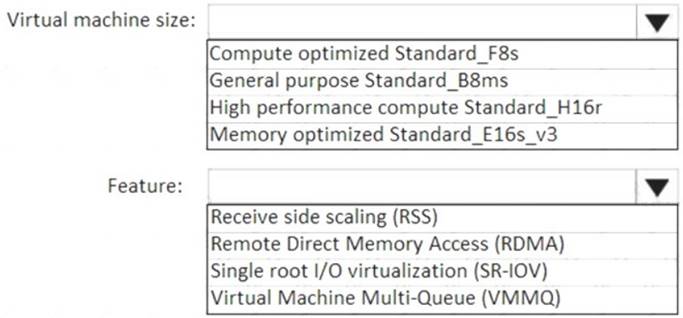
- A. Mastered
- B. Not Mastered
Answer: A
Explanation:
References:
https://docs.microsoft.com/en-us/azure/virtual-machines/windows/sizes-hpc#h-series
NEW QUESTION 9
Note: This question Is part of a series of questions that present the same scenario. Each question in the series contains a unique solution that might meet the stated goals. Some question sets might have more than one correct solution, while others might not have a correct solution.
After you answer a question In this section, you will NOT be able to return to It As a result, these questions will not appear In the review screen.
You have an on-premises Hyper-V cluster that hosts 20 virtual machines. Some virtual machines run Windows Server 2016 and some run Linux.
You plan to migrate the virtual machines to an Azure subscription.
You need to recommend a solution to replicate the disks of the virtual machines to Azure. The solution must ensure that the virtual machines remain available during the migration of the disks.
Solution: You recommend implementing an Azure Storage account that has a file service and a blob service, and then using the Data Migration Assistant
Does this meet the goal?
- A. Yes
- B. No
Answer: B
Explanation:
Data Migration Assistant is used to migrate SQL databases. Instead use Azure Site Recovery.
References:
https://docs.microsoft.com/en-us/azure/site-recovery/site-recovery-overview
NEW QUESTION 10
A company has a hybrid ASP.NET Web API application that is based on a software as a service (SaaS) offering.
Users report general issues with the data. You advise the company to implement live monitoring and use ad hoc queries on stored JSON data. You also advise the company to set up smart alerting to detect anomalies in the data.
You need to recommend a solution to set up smart alerting. What should you recommend?
- A. Azure Application Insights and Azure Monitor Logs
- B. Azure Site Recovery and Azure Monitor Logs
- C. Azure Data Lake Analytics and Azure Monitor Logs
- D. Azure Security Center and Azure Data Lake Store
Answer: C
Explanation:
Application Insights, a feature of Azure Monitor, is an extensible Application Performance Management (APM) service for developers and DevOps professionals. Use it to monitor your live applications. It will automatically detect performance anomalies, and includes powerful analytics tools to help you diagnose issues and to understand what users actually do with your app.
Reference:
https://docs.microsoft.com/en-us/azure/azure-monitor/app/app-insights-overview
NEW QUESTION 11
You need to deploy resources to host a stateless web app in an Azure subscription. The solution must meet the following requirements:
• Provide access to the full .NET framework.
• Provide redundancy if an Azure region fails.
• Grant administrators access to the operating system to install custom application dependencies.
Solution: You deploy an Azure virtual machine to two Azure regions, and you deploy an Azure Application Gateway.
Does this meet the goal?
- A. Yes
- B. No
Answer: B
Explanation:
You need to deploy two Azure virtual machines to two Azure regions, but also create a Traffic Manager profile.
NEW QUESTION 12
Your company purchases an app named App1.
You plan to tun App1 on seven Azure virtual machines In an Availability Set. The number of fault domains is set to 3. The number of update domains is set to 20.
You need to identity how many App1 instances will remain available during a period of planned maintenance. How many Appl instances should you identify?
- A. 1
- B. 2
- C. 6
- D. 7
Answer: C
Explanation:
Only one update domain is rebooted at a time. Here there are 7 update domain with one VM each (and 13 update domain with no VM).
Reference:
https://docs.microsoft.com/en-us/azure/virtual-machines/windows/manage-availability
NEW QUESTION 13
You are building an application that will run in a virtual machine (VM). The application will use Azure Managed Identity.
The application uses Azure Key Vault, Azure SQL Database, and Azure Cosmos DB. You need to ensure the application can use secure credentials to access these services.
Which authentication method should you recommend? To answer, select the appropriate options in the answer area.
NOTE: Each correct selection is worth one point.
- A. Mastered
- B. Not Mastered
Answer: A
Explanation:
Note: Managed identities for Azure resources is the new name for the service formerly known as Managed
Service Identity (MSI). Reference:
https://docs.microsoft.com/en-us/azure/active-directory/managed-identities-azure-resources/overview
NEW QUESTION 14
You design a solution for the web tier of WebApp1 as shown in the exhibit.
For each of the following statements, select Yes if the statement is true. Otherwise, select No.
- A. Mastered
- B. Not Mastered
Answer: A
Explanation:
Box 1: Yes
Any new deployments to Azure must be redundant in case an Azure region fails.
Traffic Manager uses DNS to direct client requests to the most appropriate service endpoint based on a
traffic-routing method and the health of the endpoints. An endpoint is any Internet-facing service hosted inside or outside of Azure. Traffic Manager provides a range of traffic-routing methods and endpoint monitoring options to suit different application needs and automatic failover models. Traffic Manager is resilient to failure, including the failure of an entire Azure region.
Box 2: Yes
Recent changes in Azure brought some significant changes in autoscaling options for Azure Web Apps (i.e. Azure App Service to be precise as scaling happens on App Service plan level and has effect on all Web Apps running in that App Service plan).
Box 3: No
Traffic Manager provides a range of traffic-routing methods and endpoint monitoring options to suit different application needs and automatic failover models. Traffic Manager is resilient to failure, including the failure of an entire Azure region.
Reference:
https://docs.microsoft.com/en-us/azure/traffic-manager/traffic-manager-overview https://blogs.msdn.microsoft.com/hsirtl/2017/07/03/autoscaling-azure-web-apps/
NEW QUESTION 15
You need to recommend a solution for configuring the Azure Multi-Factor Authentication (MFA) settings. What should you include in the recommendation? To answer, select the appropriate options in the answer area. NOTE: Each correct selection is worth one point.
- A. Mastered
- B. Not Mastered
Answer: A
Explanation:
References:
https://docs.microsoft.com/en-us/azure/active-directory/identity-protection/howto-sign-in-risk-policy https://docs.microsoft.com/en-us/azure/active-directory/identity-protection/howto-mfa-policy
NEW QUESTION 16
You are evaluating the components of the migration to Azure that require you to provision an Azure Storage account.
For each of the following statements, select Yes if the statement is true. Otherwise, select No. NOTE: Each correct selection is worth one point.
- A. Mastered
- B. Not Mastered
Answer: A
Explanation: 
NEW QUESTION 17
You have 70 TB of files on your on-premises file server.
You need to recommend solution for importing data to Azure. The solution must minimize cost. What Azure service should you recommend?
- A. Azure StorSimple
- B. Azure Batch
- C. Azure Data Box
- D. Azure Stack
Answer: C
Explanation:
Microsoft has engineered an extremely powerful solution that helps customers get their data to the Azure public cloud in a cost-effective, secure, and efficient manner with powerful Azure and machine learning at play. The solution is called Data Box.
Data Box and is in general availability status. It is a rugged device that allows organizations to have 100 TB of capacity on which to copy their data and then send it to be transferred to Azure.
Reference:
https://www.vembu.com/blog/what-is-microsoft-azure-data-box-disk-edge-heavy-gateway-overview/
NEW QUESTION 18
Note: This question is part of a series of questions that present the same scenario. Each question in the series contains a unique solution that might meet the stated goals. Some question sets might have more than one correct solution, while others might not have a correct solution.
After you answer a question in this section, you will NOT be able to return to it. As a result, these questions will not appear in the review screen.
You have an Azure Storage v2 account named Storage1. You plan to archive data to Storage1.
You need to ensure that the archived data cannot be deleted for five years. The solution must prevent administrators from deleting the data.
Solution: You create a file share, and you configure an access policy. Does this meet the goal?
- A. Yes
- B. No
Answer: B
Explanation:
Instead of a file share, an immutable Blob storage is required.
Time-based retention policy support: Users can set policies to store data for a specified interval. When a time-based retention policy is set, blobs can be created and read, but not modified or deleted. After the retention period has expired, blobs can be deleted but not overwritten.
Note: Set retention policies and legal holds
* 1. Create a new container or select an existing container to store the blobs that need to be kept in the immutable state. The container must be in a general-purpose v2 or Blob storage account.
* 2. Select Access policy in the container settings. Then select Add policy under Immutable blob storage.
* 3. To enable time-based retention, select Time-based retention from the drop-down menu.
* 4. Enter the retention interval in days (acceptable values are 1 to 146000 days). References:
https://docs.microsoft.com/en-us/azure/storage/blobs/storage-blob-immutable-storage https://docs.microsoft.com/en-us/azure/storage/blobs/storage-blob-immutability-policies-manage
NEW QUESTION 19
You are designing an order processing system in Azure that will contain the Azure resources shown in the following table.
The order processing system will have the following transaction flow: A customer will place an order by using App1. When the order is received, App1 will generate a message to check for product availability at vendor 1 and vendor 2. An integration component will process the message, and then trigger either Function1 or Function2 depending on the type of order. Once a vendor confirms the product availability, a status message for App1 will be generated by Function1 or Function2. All the steps of the transaction will be logged to storage1.
Which type of resource should you recommend for the integration component? D18912E1457D5D1DDCBD40AB3BF70D5D
Which type of resource should you recommend for the integration component?
- A. an Azure Data Factory pipeline
- B. an Azure Service Bus queue
- C. an Azure Event Grid domain
- D. an Azure Event Hubs capture
Answer: A
Explanation:
A data factory can have one or more pipelines. A pipeline is a logical grouping of activities that together perform a task.
The activities in a pipeline define actions to perform on your data.
Data Factory has three groupings of activities: data movement activities, data transformation activities, and control activities.
Azure Functions is now integrated with Azure Data Factory, allowing you to run an Azure function as a step in your data factory pipelines.
Reference:
https://docs.microsoft.com/en-us/azure/data-factory/concepts-pipelines-activities
NEW QUESTION 20
You have an Azure subscription that contains 100 virtual machines.
You plan to design a data protection strategy to encrypt the virtual disks.
You need to recommend a solution to encrypt the disks by using Azure Disk Encryption. The solution must provide the ability to encrypt operating system disks and data disks.
What should you include in the recommendation?
- A. a passphrase
- B. a certificate
- C. a key
- D. a secret
Answer: C
Explanation:
For enhanced virtual machine (VM) security and compliance, virtual disks in Azure can be encrypted. Disks are encrypted by using cryptographic keys that are secured in an Azure Key Vault. You control these cryptographic keys and can audit their use.
Reference:
https://docs.microsoft.com/en-us/azure/virtual-machines/windows/encrypt-disks
NEW QUESTION 21
......
P.S. Downloadfreepdf.net now are offering 100% pass ensure AZ-304 dumps! All AZ-304 exam questions have been updated with correct answers: https://www.downloadfreepdf.net/AZ-304-pdf-download.html (0 New Questions)