we provide Pinpoint Microsoft AZ-204 answers which are the best for clearing AZ-204 test, and to get certified by Microsoft Developing Solutions for Microsoft Azure (beta). The AZ-204 Questions & Answers covers all the knowledge points of the real AZ-204 exam. Crack your Microsoft AZ-204 Exam with latest dumps, guaranteed!
Online AZ-204 free questions and answers of New Version:
NEW QUESTION 1
You are developing a .NET Core model-view controller (MVC) application hosted on Azure for a health care system that allows providers access to their information.
You develop the following code: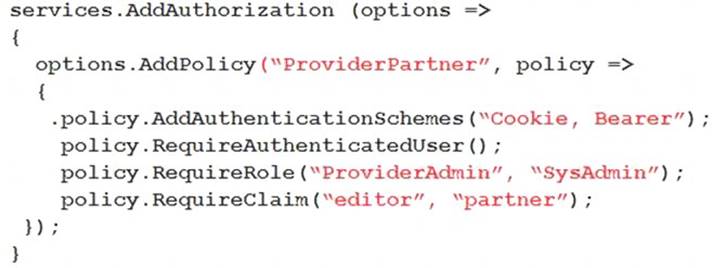
You define a role named SysAdmin.
You need to ensure that the application meets the following authorization requirements: Allow the ProviderAdmin and SysAdmin roles access to the Partner controller regardless of whether the user holds an editor claim of partner.
 Limit access to the Manage action of the controller to users with an editor claim of partner who are also members of the SysAdmin role.
How should you complete the code? To answer, drag the appropriate code segments to the correct locations. Each code segment may be used once, more than once, or not at all. You may need to drag the split bar between panes or scroll to view content.
NOTE: Each correct selection is worth one point.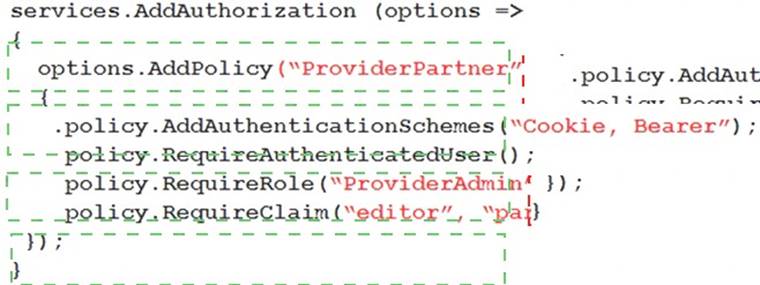
- A. Mastered
- B. Not Mastered
Answer: A
Explanation:
Box 1:
Allow the ProviderAdmin and SysAdmin roles access to the Partner controller regardless of whether the user holds an editor claim of partner.
Box 2:
Limit access to the Manage action of the controller to users with an editor claim of partner who are also members of the SysAdmin role.
NEW QUESTION 2
You are developing an application that use an Azure blob named data to store application data. The application creates blob snapshots to allow application state to be reverted to an earlier state. The Azure storage account has soft deleted enabled.
The system performs the following operations in order:
•The blob is updated
•Snapshot 1 is created.
•Snapshot 2 is created.
•Snapshot 1 is deleted.
A system error then deletes the data blob and all snapshots. You need to determine which application states can be restored.
What is the restorability of the application data? To answer, select the appropriate options in the answer area. NOTE: Each correct selection is worth one point.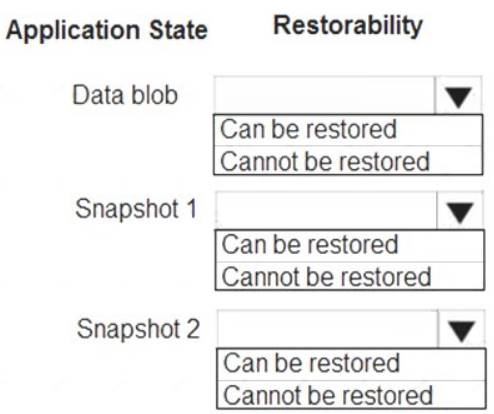
- A. Mastered
- B. Not Mastered
Answer: A
Explanation:
Box 1: Can be restored
When enabled, soft delete enables you to save and recover your data when blobs or blob snapshots are deleted. This protection extends to blob data that is erased as the result of an overwrite.
Box 2: Cannot be restored It has been deleted.
Box 3: Can be restored It has not been deleted. References:
https://docs.microsoft.com/en-us/azure/storage/blobs/storage-blob-soft-delete
NEW QUESTION 3
Note: This question is part of a series of questions that present the same scenario. Each question in the series contains a unique solution that might meet the stated goals. Some question sets might have more than one correct solution, while others might not have a correct solution.
After you answer a question in this question, you will NOT be able to return to it. As a result, these questions will not appear in the review screen.
You are developing a solution that will be deployed to an Azure Kubernetes Service (AKS) cluster. The solution will include a custom VNet, Azure Container Registry images, and an Azure Storage account.
The solution must allow dynamic creation and management of all Azure resources within the AKS cluster. You need to configure an AKS cluster for use with the Azure APIs.
Solution: Enable the Azure Policy Add-on for Kubernetes to connect the Azure Policy service to the GateKeeper admission controller for the AKS cluster. Apply a built-in policy to the cluster.
Does the solution meet the goal?
- A. Yes
- B. No
Answer: B
Explanation:
Instead create an AKS cluster that supports network policy. Create and apply a network to allow traffic only from within a defined namespace
References:
https://docs.microsoft.com/en-us/azure/aks/use-network-policies
NEW QUESTION 4
You develop a web application.
You need to register the application with an active Azure Active Directory (Azure AD) tenant.
Which three actions should you perform in sequence? To answer, move all actions from the list of actions to the answer area and arrange them in the correct order.
- A. Mastered
- B. Not Mastered
Answer: A
Explanation:
Register a new application using the Azure portal Sign in to the Azure portal using either a work or school account or a personal Microsoft account. If your account gives you access to more than one tenant, select your account in the upper right corner.
Set your portal session to the Azure AD tenant that you want. Search for and select Azure Active Directory. Under Manage, select App registrations. Select New registration. (Step 1) In Register an application, enter a meaningful application name to display to users. Specify who can use the application. Select the Azure AD instance. (Step 2) Under Redirect URI (optional), select the type of app you're building: Web or Public client (mobile & desktop). Then enter the redirect URI, or reply URL, for your application. (Step 3) When finished, select Register.
NEW QUESTION 5
Note: This question is part of a series of questions that present the same scenario. Each question in the series contains a unique solution that might meet the stated goals. Some question sets might have more than one correct solution, while others might not have a correct solution.
After you answer a question in this question, you will NOT be able to return to it. As a result, these questions will not appear in the review screen.
You are developing a website that will run as an Azure Web App. Users will authenticate by using their Azure Active Directory (Azure AD) credentials.
You plan to assign users one of the following permission levels for the website: admin, normal, and reader. A user’s Azure AD group membership must be used to determine the permission level. You need to configure authorization.
Solution: Configure the Azure Web App for the website to allow only authenticated requests and require Azure AD log on.
Does the solution meet the goal?
- A. Yes
- B. No
Answer: B
Explanation:
Instead in the Azure AD application’s manifest, set value of the groupMembershipClaims option to All. References:
https://blogs.msdn.microsoft.com/waws/2021/03/13/azure-app-service-authentication-aad-groups/
NEW QUESTION 6
You develop an app that allows users to upload photos and videos to Azure storage. The app uses a storage REST API call to upload the media to a blob storage account named Account1. You have blob storage
containers named Container1 and Container2. Uploading of videos occurs on an irregular basis.
You need to copy specific blobs from Container1 to Container2 in real time when specific requirements are met, excluding backup blob copies.
What should you do?
- A. Download the blob to a virtual machine and then upload the blob to Container2.
- B. Run the Azure PowerShell command Start-AzureStorageBlobCopy.
- C. Copy blobs to Container2 by using the Put Blob operation of the Blob Service REST API.
- D. Use AzCopy with the Snapshot switch blobs to Container2.
Answer: B
Explanation:
The Start-AzureStorageBlobCopy cmdlet starts to copy a blob. Example 1: Copy a named blob
C:PS>Start-AzureStorageBlobCopy -SrcBlob "ContosoPlanning2015" -DestContainer "ContosoArchives"
-SrcContainer "ContosoUploads"
This command starts the copy operation of the blob named ContosoPlanning2015 from the container named ContosoUploads to the container named ContosoArchives.
References:
https://docs.microsoft.com/en-us/powershell/module/azure.storage/start-azurestorageblobcopy?view=azurermps
NEW QUESTION 7
You are implementing a software as a service (SaaS) ASP.NET Core web service that will run as an Azure Web App. The web service will use an on-premises SQL Server database for storage. The web service also includes a WebJob that processes data updates. Four customers will use the web service.
•Each instance of the WebJob processes data for a single customer and must run as a singleton instance.
•Each deployment must be tested by using deployment slots prior to serving production data.
•Azure costs must be minimized.
•Azure resources must be located in an isolated network.
You need to configure the App Service plan for the Web App.
How should you configure the App Service plan? To answer, select the appropriate settings in the answer area. NOTE: Each correct selection is worth one point.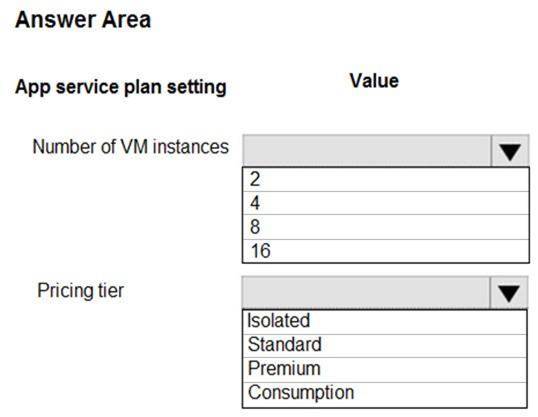
- A. Mastered
- B. Not Mastered
Answer: A
Explanation:
Number of VM instances: 4
You are not charged extra for deployment slots. Pricing tier: Isolated
The App Service Environment (ASE) is a powerful feature offering of the Azure App Service that gives network isolation and improved scale capabilities. It is essentially a deployment of the Azure App Service into a subnet of a customer’s Azure Virtual Network (VNet).
References:
https://azure.microsoft.com/sv-se/blog/announcing-app-service-isolated-more-power-scale-and-ease-of-use/
NEW QUESTION 8
You are using Azure Front Door Service.
You are expecting inbound files to be compressed by using Brotli compression. You discover that inbound XML files are not compressed. The files are 9 megabytes (MB) in size.
You need to determine the root cause for the issue.
To answer, select the appropriate options in the answer area.
NOTE: Each correct selection is worth one point.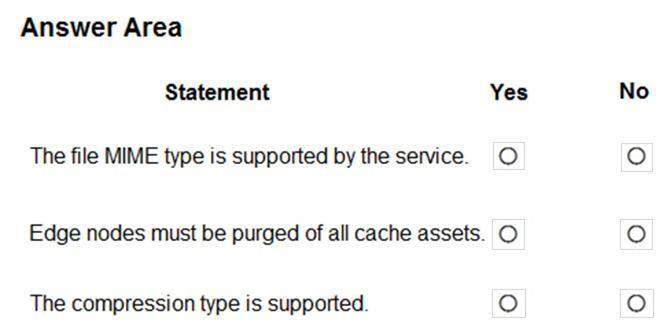
- A. Mastered
- B. Not Mastered
Answer: A
Explanation:
Box 1: No
Front Door can dynamically compress content on the edge, resulting in a smaller and faster response to your clients. All files are eligible for compression. However, a file must be of a MIME type that is eligible for compression list.
Box 2: No
Sometimes you may wish to purge cached content from all edge nodes and force them all to retrieve new updated assets. This might be due to updates to your web application, or to quickly update assets that contain incorrect information.
Box 3: Yes
These profiles support the following compression encodings: Gzip (GNU zip), Brotli Reference:
https://docs.microsoft.com/en-us/azure/frontdoor/front-door-caching
NEW QUESTION 9
You are working for Contoso, Ltd.
You define an API Policy object by using the following XML markup: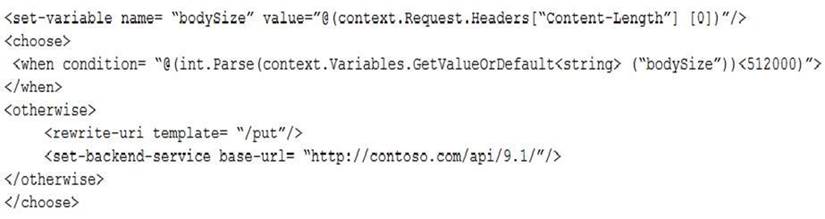
For each of the following statements, select Yes if the statement is true. Otherwise, select No.
NOTE: Each correct selection is worth one point.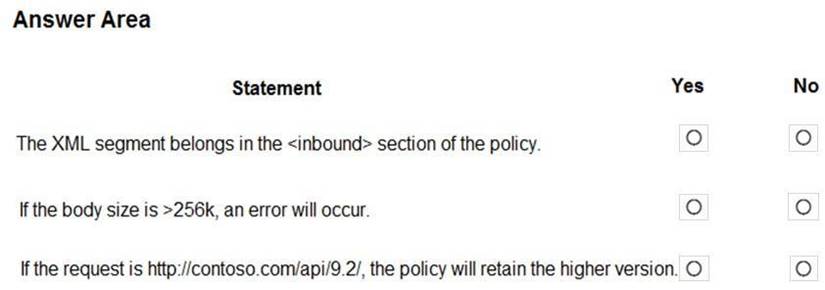
- A. Mastered
- B. Not Mastered
Answer: A
Explanation:
Box 1: Yes
Use the set-backend-service policy to redirect an incoming request to a different backend than the one specified in the API settings for that operation. Syntax: <set-backend-service base-url="base URL of the backend service" />
Box 2: No
The condition is on 512k, not on 256k. Box 3: No
The set-backend-service policy changes the backend service base URL of the incoming request to the one specified in the policy.
Reference:
https://docs.microsoft.com/en-us/azure/api-management/api-management-transformation-policies
NEW QUESTION 10
You need to secure the Shipping Function app.
How should you configure the app? To answer, select the appropriate options in the answer area.
NOTE: Each correct selection is worth one point.
- A. Mastered
- B. Not Mastered
Answer: A
Explanation:
Scenario: Shipping Function app: Implement secure function endpoints by using app-level security and include Azure Active Directory (Azure AD).
Box 1: Function
Box 2: JSON based Token (JWT)
Azure AD uses JSON based tokens (JWTs) that contain claims Box 3: HTTP
How a web app delegates sign-in to Azure AD and obtains a token
User authentication happens via the browser. The OpenID protocol uses standard HTTP protocol messages. References:
https://docs.microsoft.com/en-us/azure/active-directory/develop/authentication-scenarios
NEW QUESTION 11
You have an Azure App Services Web App. Azure SQL Database instance. Azure Storage Account and an Azure Redis Cache instance in a resource group.
A developer must be able to publish code to the web app. You must grant the developer the Contribute role to the web app
You need to grant the role.
What two commands can you use? Each correct answer presents a complete solution. NOTE: Each correct selection is worth one point.
- A. New-AzureRmRoleAssignment
- B. az role assignment create
- C. az role definition create
- D. New-AzureRmRoleDefinition
Answer: AB
Explanation:
References:
https://docs.microsoft.com/en-us/cli/azure/role/assignment?view=azure-cli-latest#az-role-assignment-create https://docs.microsoft.com/en-us/powershell/module/azurerm.resources/new-azurermroleassignment?view=azur
NEW QUESTION 12
You must implement Application Insights instrumentation capabilities utilizing the Azure Mobile Apps SDK to provide meaningful analysis of user interactions with a mobile app.
You need to capture the data required to implement the Usage Analytics feature of Application Insights. Which three data values should you capture? Each correct answer presents part of the solution
NOTE: Each correct selection is worth one point.
- A. Trace
- B. Session Id
- C. Exception
- D. User Id
- E. Events
Answer: ADE
Explanation:
Application Insights is a service for monitoring the performance and usage of your apps. This module allows you to send telemetry of various kinds (events, traces, etc.) to the Application Insights service where your data can be visualized in the Azure Portal.
Application Insights manages the ID of a session for you. References: https://github.com/microsoft/ApplicationInsights-Android
NEW QUESTION 13
You need to correct the VM issues.
Which tools should you use? To answer, select the appropriate options in the answer area.
NOTE: Each correct selection is worth one point.
- A. Mastered
- B. Not Mastered
Answer: A
Explanation:
Backup and Restore: Azure Backup
Scenario: The VM is critical and has not been backed up in the past. The VM must enable a quick restore from a 7-day snapshot to include in-place restore of disks in case of failure.
In-Place restore of disks in IaaS VMs is a feature of Azure Backup. Performance: Accelerated Networking
Scenario: The VM shows high network latency, jitter, and high CPU utilization.
Accelerated networking enables single root I/O virtualization (SR-IOV) to a VM, greatly improving its networking performance. This high-performance path bypasses the host from the datapath, reducing latency, jitter, and CPU utilization, for use with the most demanding network workloads on supported VM types.
References:
https://azure.microsoft.com/en-us/blog/an-easy-way-to-bring-back-your-azure-vm-with-in-place-restore/
NEW QUESTION 14
Note: This question is part of a series of questions that present the same scenario. Each question in the series contains a unique solution that might meet the stated goals. Some question sets might have more than one correct solution, while others might not have a correct solution.
After you answer a question in this section, you will NOT be able to return to it. As a result, these questions will not appear in the review screen.
Margie's Travel is an international travel and bookings management service. The company is expanding into restaurant bookings. You are tasked with implementing Azure Search tor the restaurants listed in their solution.
You create the index in Azure Search.
You need to import the restaurant data into the Azure Search service by using the Azure Search NET SDK. Solution:
* 1. Create a SearchServiceClient object to connect to the search index.
* 2. Create a DataContainer that contains the documents which must be added.
* 3. Create a DataSource instance and set its Container property to the DataContainer.
* 4. Set the DataSource property of the SearchServiceCIient Does the solution meet the goal?
- A. Yes
- B. No
Answer: B
Explanation:
Use the following method:
* 1.Create a SearchIndexClient object to connect to the search index
* 2.Create an IndexBatch that contains the documents which must be added.
* 3. Call the Documents.Index method of the SearchIndexClient and pass the IndexBatch. References:
https://docs.microsoft.com/en-us/azure/search/search-howto-dotnet-sdk
NEW QUESTION 15
You plan to create a Docker image that runs as ASP.NET Core application named ContosoApp. You have a setup script named setupScript.ps1 and a series of application files including ContosoApp.dll.
You need to create a Dockerfile document that meets the following requirements:
•Call setupScript.ps1 when the container is built.
•Run ContosoApp.dll when the container starts.
The Docker document must be created in the same folder where ContosoApp.dll and setupScript.ps1 are stored.
Which four commands should you use to develop the solution? To answer, move the appropriate commands from the list of commands to the answer area and arrange them in the correct order.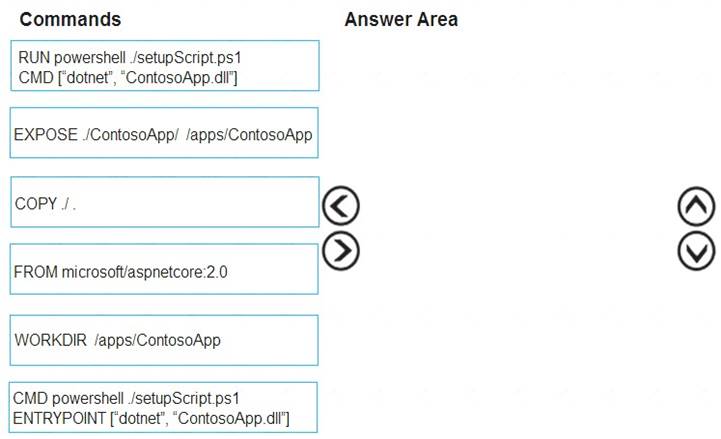
- A. Mastered
- B. Not Mastered
Answer: A
Explanation:
Step 1: WORKDIR /apps/ContosoApp Step 2: COPY ./The Docker document must be created in the same folder where ContosoApp.dll and setupScript.ps1 are stored.
Step 3: EXPOSE ./ContosApp/ /app/ContosoApp Step 4: CMD powershell ./setupScript.ps1 ENTRYPOINT ["dotnet", "ContosoApp.dll"]
You need to create a Dockerfile document that meets the following requirements:  Call setupScript.ps1 when the container is built. Run ContosoApp.dll when the container starts. References:
https://docs.microsoft.com/en-us/azure/app-service/containers/tutorial-custom-docker-image
NEW QUESTION 16
You need to configure Azure App Service to support the REST API requirements.
Which values should you use? To answer, select the appropriate options in the answer area.
NOTE: Each correct selection is worth one point.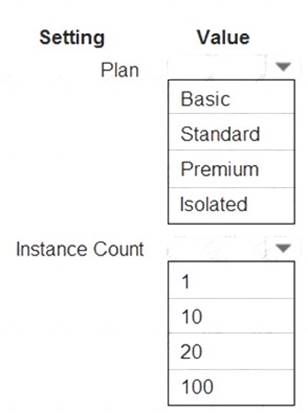
- A. Mastered
- B. Not Mastered
Answer: A
Explanation:
Plan: Standard
Standard support auto-scaling Instance Count: 10
Max instances for standard is 10. Scenario:
The REST API’s that support the solution must meet the following requirements: Allow deployment to a testing location within Azure while not incurring additional costs. Automatically scale to double capacity during peak shipping times while not causing application downtime.Minimize costs when selecting an Azure payment model. References:
https://azure.microsoft.com/en-us/pricing/details/app-service/plans/
NEW QUESTION 17
Note: This question is part of a series of questions that present the same scenario. Each question in the series contains a unique solution that might meet the stated goals. Some question sets might have more than one correct solution, while others might not have a correct solution.
After you answer a question in this section, you will NOT be able to return to it. As a result, these questions will not appear in the review screen.
You are developing an Azure solution to collect point-of-sale (POS) device data from 2,000 stores located throughout the world. A single device can produce 2 megabytes (MB) of data every 24 hours. Each store location has one to five devices that send data.
You must store the device data in Azure Blob storage. Device data must be correlated based on a device identifier. Additional stores are expected to open in the future.
You need to implement a solution to receive the device data.
Solution: Provision an Azure Event Grid. Configure event filtering to evaluate the device identifier. Does the solution meet the goal?
- A. Yes
- B. No
Answer: B
Explanation:
Instead use an Azure Service Bus, which is used order processing and financial transactions.
Note: An event is a lightweight notification of a condition or a state change. Event hubs is usually used reacting to status changes.
Reference:
https://docs.microsoft.com/en-us/azure/event-grid/compare-messaging-services
NEW QUESTION 18
You need to update the APIs to resolve the testing error.
How should you complete the Azure CLI command? To answer, select the appropriate options in the answer area.
NOTE: Each correct selection is worth one point.
- A. Mastered
- B. Not Mastered
Answer: A
Explanation:
Enable Cross-Origin Resource Sharing (CORS) on your Azure App Service Web App.
Enter the full URL of the site you want to allow to access your WEB API or * to allow all domains. Box 1: cors
Box 2: add
Box 3: allowed-origins
Box 4: http://testwideworldimporters.com/ References:
http://donovanbrown.com/post/How-to-clear-No-Access-Control-Allow-Origin-header-error-wit
h-Azure-App-Service
NEW QUESTION 19
Contoso, Ltd. provides an API to customers by using Azure API Management (APIM). The API authorizes users with a JWT token.
You must implement response caching for the APIM gateway. The caching mechanism must detect the user ID of the client that accesses data for a given location and cache the response for that user ID.
You need to add the following policies to the policies file:
• a set-variable policy to store the detected user identity
• a cache-lookup-value policy
• a cache-store-value policy
• a find-and-replace policy to update the response body with the user profile information
To which policy section should you add the policies? To answer, drag the appropriate sections to the correct policies. Each section may be used once, more than once, or not at all. You may need to drag the split bar between panes or scroll to view content
NOTE: Each correct selection is worth one point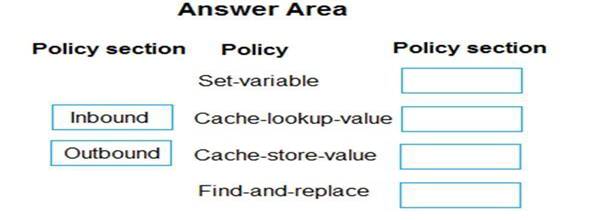
- A. Mastered
- B. Not Mastered
Answer: A
Explanation:
Box 1: Inbound.
A set-variable policy to store the detected user identity. Example:
<policies>
<inbound>
<!-- How you determine user identity is application dependent -->
<set-variable name="enduserid"
value="@(context.Request.Headers.GetValueOrDefault("Authorization","").Split(' ')[1].AsJwt()?.Subject)" /> Box 2: Inbound
A cache-lookup-value policy Example:
<inbound>
<base />
<cache-lookup vary-by-developer="true | false" vary-by-developer-groups="true | false" downstream-caching-type="none | private | public" must-revalidate="true | false">
<vary-by-query-parameter>parameter name</vary-by-query-parameter> <!-- optional, can repeated several times -->
</cache-lookup>
</inbound>
Box 3: Outbound
A cache-store-value policy. Example:
<outbound>
<base />
<cache-store duration="3600" />
</outbound> Box 4: Outbound
A find-and-replace policy to update the response body with the user profile information. Example:
<outbound>
<!-- Update response body with user profile-->
<find-and-replace from='"$userprofile$"'
to="@((string)context.Variables["userprofile"])" />
<base />
</outbound> Reference:
https://docs.microsoft.com/en-us/azure/api-management/api-management-caching-policies
https://docs.microsoft.com/en-us/azure/api-management/api-management-sample-cache-by-key
NEW QUESTION 20
ASP.NET Core API app by using C#. The API app will allow users to authenticate by using Twitter and Azure Active Directory (Azure AD).
Users must be authenticated before calling API methods. You must log the user’s name for each method call. You need to configure the API method calls.
Which values should you use? To answer, select the appropriate options in the answer area. NOTE: Each correct selection is worth one point.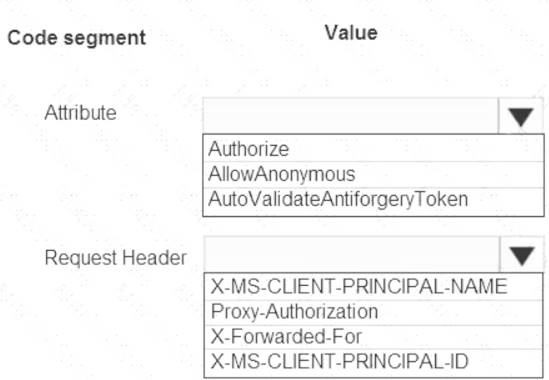
- A. Mastered
- B. Not Mastered
Answer: A
Explanation:
Box 1: Authorize
Box 2: X-MS-CLIENT-PRINCIPAL-NAME
App Service passes user claims to your application by using special headers. External requests aren't allowed to set these headers, so they are present only if set by App Service. Some example headers include:
X-MS-CLIENT-PRINCIPAL-NAME X-MS-CLIENT-PRINCIPAL-ID
Here's the set of headers you get from Easy Auth for a Twitter authenticated user:
{
"cookie": "AppServiceAuthSession=Lx43...xHDTA==", "x-ms-client-principal-name": "evilSnobu",
"x-ms-client-principal-id": "35....", "x-ms-client-principal-idp": "twitter",
"x-ms-token-twitter-access-token": "35...Dj",
"x-ms-token-twitter-access-token-secret": "OK3...Jx",
}
References:
https://docs.microsoft.com/en-us/azure/app-service/app-service-authentication-how-to
NEW QUESTION 21
You are developing a web app that is protected by Azure Web Application Firewall (WAF). All traffic to the web app is routed through an Azure Application Gateway instance that is used by multiple web apps. The web app address is contoso.azurewebsites.net.
All traffic must be secured with SSL. The Azure Application Gateway instance is used by multiple web apps. You need to configure the Azure Application Gateway for the app.
Which two actions should you perform? Each correct answer presents part of the solution. NOTE: Each correct selection is worth one point.
- A. In the Azure Application Gateway’s HTTP setting, enable the Use for App service setting.
- B. Convert the web app to run in an Azure App service environment (ASE).
- C. Add an authentication certificate for contoso.azurewebsites.net to the Azure Application gateway.
- D. In the Azure Application Gateway’s HTTP setting, set the value of the Override backend path option to contoso22.azurewebsites.net.
Answer: AD
Explanation:
D: The ability to specify a host override is defined in the HTTP settings and can be applied to any back-end pool during rule creation.
The ability to derive the host name from the IP or FQDN of the back-end pool members. HTTP settings also provide an option to dynamically pick the host name from a back-end pool member's FQDN if configured with the option to derive host name from an individual back-end pool member.
A (not C): SSL termination and end to end SSL with multi-tenant services.
In case of end to end SSL, trusted Azure services such as Azure App service web apps do not require whitelisting the backends in the application gateway. Therefore, there is no need to add any authentication certificates.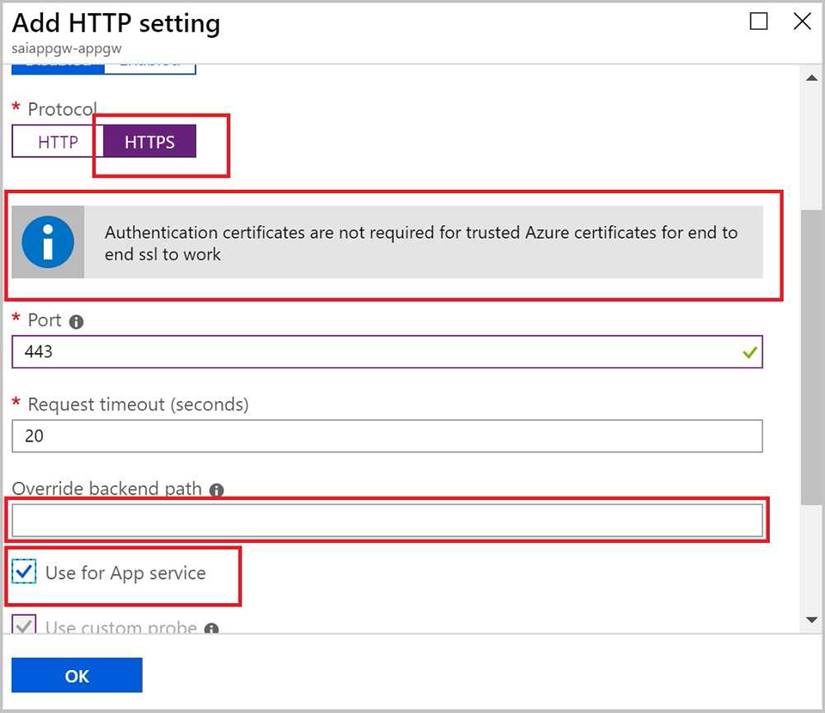
Reference:
https://docs.microsoft.com/en-us/azure/application-gateway/application-gateway-web-app-overview
NEW QUESTION 22
Note: This question is part of a series of questions that present the same scenario. Each question in the series contains a unique solution that might meet the stated goals. Some question sets might have more than one correct solution, while others might not have a correct solution.
After you answer a question in this question, you will NOT be able to return to it. As a result, these questions will not appear in the review screen.
You are developing a website that will run as an Azure Web App. Users will authenticate by using their Azure Active Directory (Azure AD) credentials.
You plan to assign users one of the following permission levels for the website: admin, normal, and reader. A user’s Azure AD group membership must be used to determine the permission level. You need to configure authorization.
Solution:
•Create a new Azure AD application’s manifest, set value of the groupMembershipClaims option to All.
•In the website, use the value of the groups claim from the JWI for the user to determine permissions. Does the solution meet the goal?
- A. Yes
- B. No
Answer: A
Explanation:
To configure Manifest to include Group Claims in Auth Token
* 1. Go to Azure Active Directory to configure the Manifest. Click on Azure Active Directory, and go to App registrations to find your application:
* 2. Click on your application (or search for it if you have a lot of apps) and edit the Manifest by clicking on it.
* 3. Locate the “groupMembershipClaims” setting. Set its value to either “SecurityGroup” or “All”. To help you decide which:
“SecurityGroup” - groups claim will contain the identifiers of all security groups of which the user is a member.
“All” - groups claim will contain the identifiers of all security groups and all distribution lists of which the user is a member
Now your application will include group claims in your manifest and you can use this fact in your code. References:
https://blogs.msdn.microsoft.com/waws/2021/03/13/azure-app-service-authentication-aad-groups/
NEW QUESTION 23
A company is developing a gaming platform. Users can join teams to play online and see leaderboards that include player statistics. The solution includes an entity named Team.
You plan to implement an Azure Redis Cache instance to improve the efficiency of data operations for entities that rarely change.
You need to invalidate the cache when team data is changed.
How should you complete the code? To answer, select the appropriate options in the answer area. NOTE: Each correct selection is worth one point.
- A. Mastered
- B. Not Mastered
Answer: A
Explanation:
Box 1: IDatabase cache = connection.GetDatabase();
Connection refers to a previously configured ConnectionMultiplexer. Box 2: cache.StringSet("teams",")
To specify the expiration of an item in the cache, use the TimeSpan parameter of StringSet. cache.StringSet("key1", "value1", TimeSpan.FromMinutes(90));
References:
https://azure.microsoft.com/sv-se/blog/lap-around-azure-redis-cache-preview/
NEW QUESTION 24
You develop a news and blog content delivery app for Windows devices.
A notification must arrive on a user's device when there is a new article available for them to view. You need to implement push notifications.
How should you complete the code segment? To answer, select the appropriate options in the answer area.
NOTE: Each correct selection is worth one point.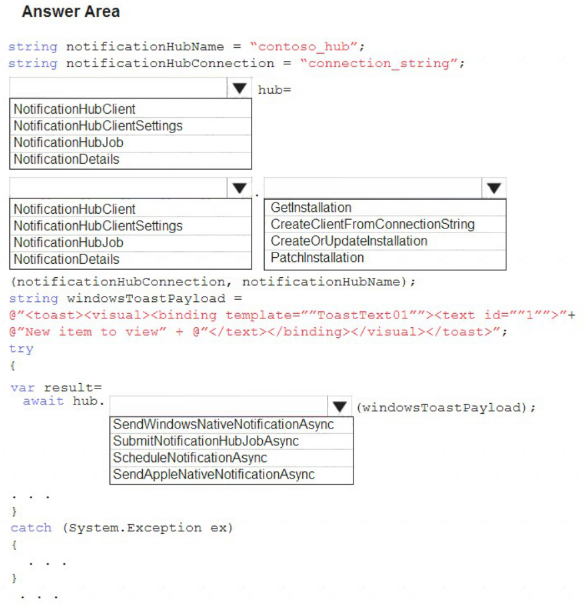
- A. Mastered
- B. Not Mastered
Answer: A
Explanation:
Box 1: NotificationHubClient
Box 2: NotificationHubClient
Box 3: CreateClientFromConnectionString
// Initialize the Notification Hub
NotificationHubClient hub = NotificationHubClient.CreateClientFromConnectionString(listenConnString, hubName);
Box 4: SendWindowsNativeNotificationAsync Send the push notification.
var result = await hub.SendWindowsNativeNotificationAsync(windowsToastPayload); References:
https://docs.microsoft.com/en-us/azure/notification-hubs/notification-hubs-push-notification-registration-manag
https://github.com/MicrosoftDocs/azure-docs/blob/master/articles/app-service-mobile/app-service-mobile-windo
NEW QUESTION 25
......
P.S. Certifytools now are offering 100% pass ensure AZ-204 dumps! All AZ-204 exam questions have been updated with correct answers: https://www.certifytools.com/AZ-204-exam.html (135 New Questions)