We offers AZ-100 Exam Questions. "Microsoft Azure Infrastructure and Deployment", also known as AZ-100 exam, is a Microsoft Certification. This set of posts, Passing the AZ-100 exam with AZ-100 Dumps, will help you answer those questions. The AZ-100 Study Guides covers all the knowledge points of the real exam. 100% real AZ-100 Study Guides and revised by experts!
Check AZ-100 free dumps before getting the full version:
NEW QUESTION 1
You need to prepare the environment to meet the authentication requirements.
Which two actions should you perform? Each correct answer presents part of the solution.
NOTE Each correct selection is worth one point.
- A. Azure Active Directory (AD) Identity Protection and an Azure policy
- B. a Recovery Services vault and a backup policy
- C. an Azure Key Vault and an access policy
- D. an Azure Storage account and an access policy
Answer: BD
Explanation: D: Seamless SSO works with any method of cloud authentication - Password Hash Synchronization or Pass-through Authentication, and can be enabled via Azure AD Connect.
B: You can gradually roll out Seamless SSO to your users. You start by adding the following Azure AD URL to all or selected users' Intranet zone settings by using Group Policy in Active Directory: https://autologon.microsoftazuread-sso.com
Topic 2, Contoso Ltd
Overview
Contoso, Ltd. is a manufacturing company that has offices worldwide. Contoso works with partner organizations to bring products to market.
Contoso products are manufactured by using blueprint files that the company authors and maintains.
Existing Environment
Currently, Contoso uses multiple types of servers for business operations, including the following:
File servers
Domain controllers
Microsoft SQL Server servers
Your network contains an Active Directory forest named contoso.com. All servers and client computers are joined to Active Directory.
You have a public-facing application named App1. App1 is comprised of the following three tiers:
A SQL database
A web front end
A processing middle tier
Each tier is comprised of five virtual machines. Users access the web front end by using HTTPS only.
Requirements Planned Changes
Contoso plans to implement the following changes to the infrastructure: Move all the tiers of App1 to Azure.
Move the existing product blueprint files to Azure Blob storage.
Create a hybrid directory to support an upcoming Microsoft Office 365 migration project.
Technical Requirements
Contoso must meet the following technical requirements:
Move all the virtual machines for App1 to Azure.
Minimize the number of open ports between the App1 tiers.
Ensure that all the virtual machines for App1 are protected by backups.
Copy the blueprint files to Azure over the Internet.
Ensure that the blueprint files are stored in the archive storage tier.
Ensure that partner access to the blueprint files is secured and temporary.
Prevent user passwords or hashes of passwords from being stored in Azure.
Use unmanaged standard storage for the hard disks of the virtual machines.
Ensure that when users join devices to Azure Active Directory (Azure AD), the users use a mobile phone to verify their identity.
Minimize administrative effort whenever possible.
User Requirements
Contoso identifies the following requirements for users:
Ensure that only users who are part of a group named Pilot can join devices to Azure AD. Designate a new user named Admin1 as the service administrator of the Azure subscription. Ensure that a new user named User3 can create network objects for the Azure subscription.
NEW QUESTION 2
Note: This question is part of a series of questions that present the same scenario. Each question in the series contains a unique solution that might meet the stated goals. Some question sets might have more than one correct solution, while others might not have a correct solution.
After you answer a question in this section, you will NOT be able to return to it. As a result, these questions will not appear in the review screen.
You have an Azure subscription named Subscription1. Subscription1 contains a resource group named RG1. RG1 contains resources that were deployed by using templates.
You need to view the date and time when the resources were created in RG1. Solution: From the RG1 blade, you click Automation script.
Does this meet the goal?
- A. Yes
- B. No
Answer: B
NEW QUESTION 3
Click to expand each objective. To connect to the Azure portal, type https://portal.azure.com in the browser address bar.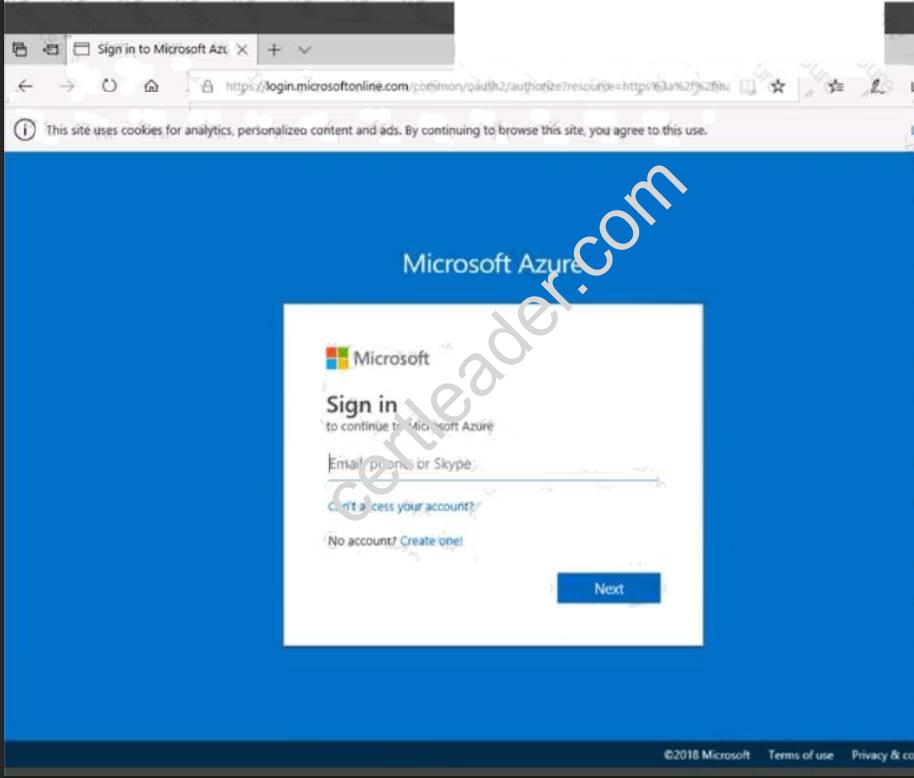
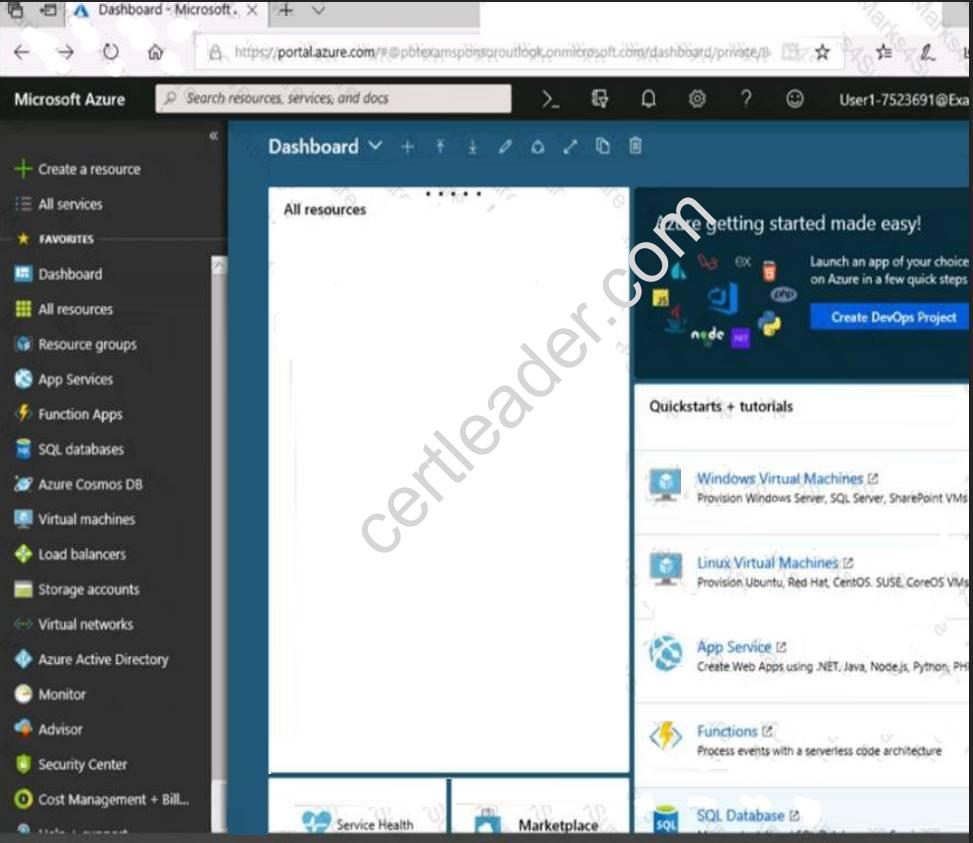
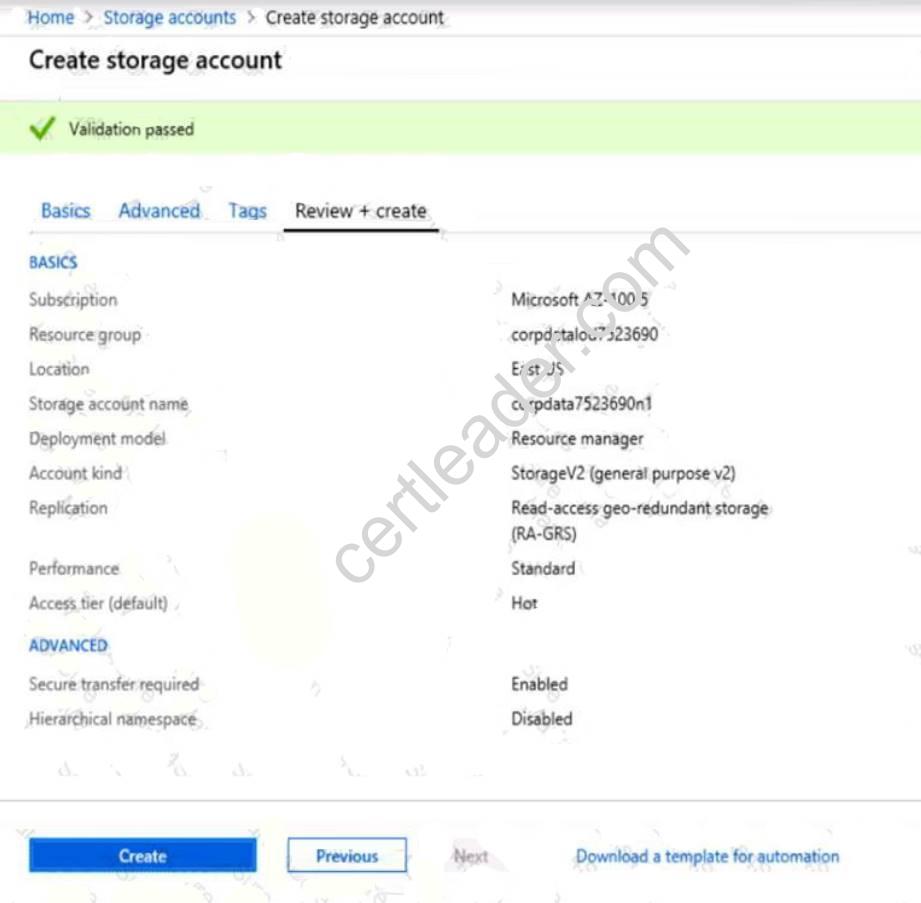
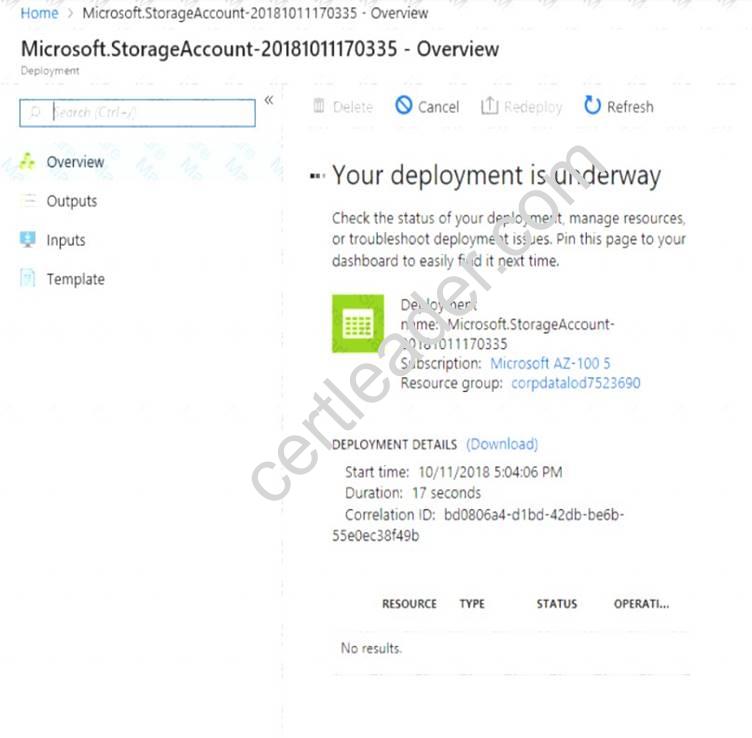
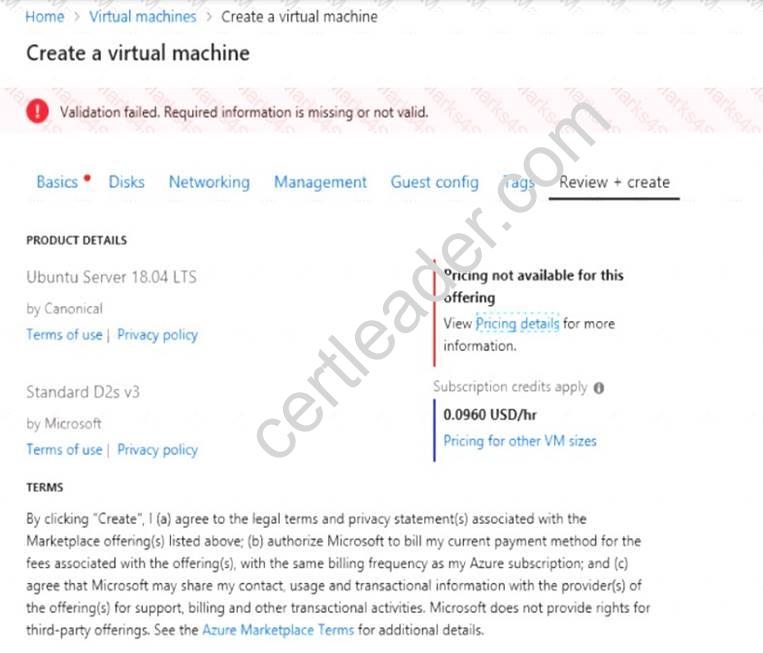
When you are finished performing all the tasks, click the ‘Next’ button.
Note that you cannot return to the lab once you click the ‘Next’ button. Scoring occur in the background while you complete the rest of the exam.
Overview
The following section of the exam is a lab. In this section, you will perform a set of tasks in a live environment. While most functionality will be available to you as it would be in a live environment, some functionality (e.g., copy and paste, ability to navigate to external websites) will not be possible by design. Scoring is based on the outcome of performing the tasks stated in the lab. In other words, it doesn’t matter how you accomplish the task, if you successfully perform it, you will earn credit for that task.
Labs are not timed separately, and this exam may have more than one lab that you must complete. You can use as much time as you would like to complete each lab. But, you should manage your time appropriately to ensure that you are able to complete the lab(s) and all other sections of the exam in the time provided.
Please note that once you submit your work by clicking the Next button within a lab, you will NOT be able to return to the lab.
To start the lab
You may start the lab by clicking the Next button.
You plan to create 100 Azure virtual machines on each of the following three virtual networks:  VNET1005a VNET1005b VNET1005c
All the network traffic between the three virtual networks will be routed through VNET1005a.
You need to create the virtual networks, and then to ensure that all the Azure virtual machines can connect to other virtual machines by using their private IP address. The solution must NOT require any virtual network gateways and must minimize costs.
What should you do from the Azure portal before you configure IP routing?
Answer:
Explanation: Step 1: Click Create a resource in the portal.
Step 2: Enter Virtual network in the Search the Marketplace box at the top of the New pane that appears. Click Virtual network when it appears in the search results.
Step 3: Select Classic in the Select a deployment model box in the Virtual Network pane that appears, then click Create.
Step 4: Enter the following values on the Create virtual network (classic) pane and then click Create: Name: VNET1005a
Address space: 10.0.0.0/16 Subnet name: subnet0 Resource group: Create new
Subnet address range: 10.0.0.0/24
Subscription and location: Select your subscription and location.
Step 5: Repeat steps 3-5 for VNET1005b (10.1.0.0/16, 10.1.0.0/24), and for VNET1005c 10.2.0.0/16, 10.2.0.0/24).
References: https://docs.microsoft.com/en-us/azure/virtual-network/create-virtual-network-classic
NEW QUESTION 4
You configure Azure AD Connect for Azure Active Directory Seamless Single Sign-On (Azure AD Seamless SSO) for an on-premises network. Users report that when they attempt to access myapps.microsoft.com, they are prompted multiple times to sign in and are forced to use an account name that ends with onmicrosoft.com.
You discover that there is a UPN mismatch between Azure AD and the on-premises Active Directory. You need to ensure that the users can use single-sign on (SSO) to access Azure resources.
What should you do first?
- A. From the on-premises network, deploy Active Directory Federation Services (AD FS).
- B. From Azure AD, add and verify a custom domain name.
- C. From the on-premises network, request a new certificate that contains the Active Directory domain name.
- D. From the server that runs Azure AD Connect, modify the filtering options.
Answer: B
Explanation: Azure AD Connect lists the UPN suffixes that are defined for the domains and tries to match them with a custom domain in Azure AD. Then it helps you with the appropriate action that needs to be taken. The Azure AD sign-in page lists the UPN suffixes that are defined for on-premises Active Directory and displays the corresponding status against each suffix. The status values can be one of the following:
State: Verified
Azure AD Connect found a matching verified domain in Azure AD. All users for this domain can sign in by using their on-premises credentials.
State: Not verified
Azure AD Connect found a matching custom domain in Azure AD, but it isn't verified. The UPN suffix of the users of this domain will be changed to the default .onmicrosoft.com suffix after synchronization if the domain isn't verified.
Action Required: Verify the custom domain in Azure AD.
References: https://docs.microsoft.com/en-us/azure/active-directory/hybrid/plan-connect-user-signin
NEW QUESTION 5
You have an Azure subscription that contains the resources in the following table.
To which subnets can you apply NSG1?
- A. the subnets on VNet2 only
- B. the subnets on VNet1 only
- C. the subnets on VNet2 and VNet3 only
- D. the subnets on VNet1, VNet2, and VNet3
- E. the subnets on VNet3 only
Answer: E
Explanation: All Azure resources are created in an Azure region and subscription. A resource can only be created in a virtual network that exists in the same region and subscription as the resource.
References: https://docs.microsoft.com/en-us/azure/virtual-network/virtual-network-vnet-plan-design-arm
NEW QUESTION 6
You have 100 Azure subscriptions. All the subscriptions are associated to the same Azure Active Directory (Azure AD) tenant named contoso.com.
You are a global administrator.
You plan to create a report that lists all the resources across all the subscriptions. You need to ensure that you can view all the resources in all the subscriptions.
What should you do?
- A. From the Azure portal, modify the profile settings of your account.
- B. From Windows PowerShell, run the Add-AzureADAdministrativeUnitMember cmdlet.
- C. From Windows PowerShell, run the New-AzureADUserAppRoleAssignment cmdlet.
- D. From the Azure portal, modify the properties of the Azure AD tenant.
Answer: C
Explanation: The New-AzureADUserAppRoleAssignment cmdlet assigns a user to an application role in Azure Active Directory (AD). Use it for the application report.
References:
https://docs.microsoft.com/en-us/powershell/module/azuread/new-azureaduserapproleassignment?view=azuread
NEW QUESTION 7
Click to expand each objective. To connect to the Azure portal, type https://portal.azure.com in the browser address bar.
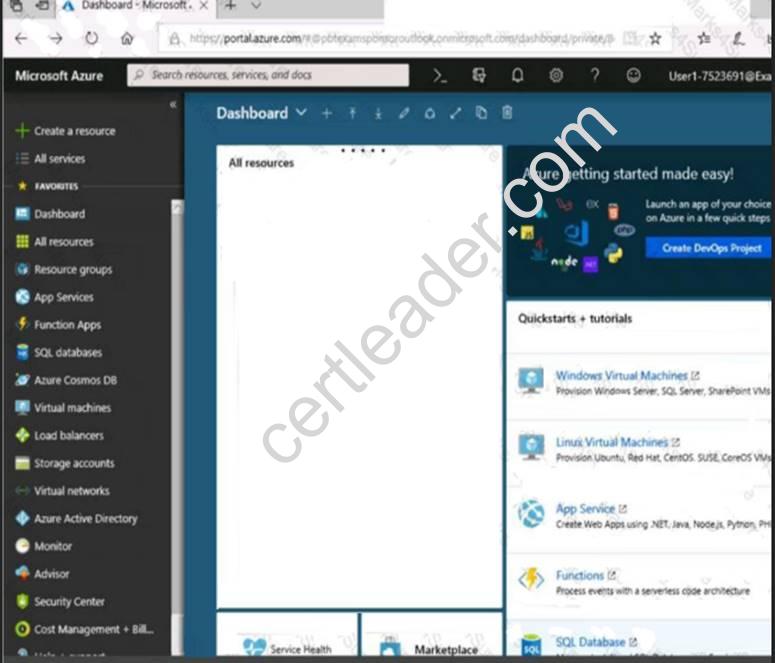
When you are finished performing all the tasks, click the ‘Next’ button.
Note that you cannot return to the lab once you click the ‘Next’ button. Scoring occur in the background while you complete the rest of the exam.
Overview
The following section of the exam is a lab. In this section, you will perform a set of tasks in a live environment. While most functionality will be available to you as it would be in a live environment, some functionality (e.g., copy and paste, ability to navigate to external websites) will not be possible by design. Scoring is based on the outcome of performing the tasks stated in the lab. In other words, it doesn’t matter how you accomplish the task, if you successfully perform it, you will earn credit for that task.
Labs are not timed separately, and this exam may have more than one lab that you must complete. You can use as much time as you would like to complete each lab. But, you should manage your time appropriately to ensure that you are able to complete the lab(s) and all other sections of the exam in the time provided.
Please note that once you submit your work by clicking the Next button within a lab, you will NOT be able to return to the lab.
To start the lab
You may start the lab by clicking the Next button.
You plan to protect on-premises virtual machines and Azure virtual machines by using Azure Backup. You need to prepare the backup infrastructure in Azure. The solution must minimize the cost of storing the backups in Azure.
What should you do from the Azure portal?
Answer:
Explanation: First, create Recovery Services vault.
Step 1: On the left-hand menu, select All services and in the services list, type Recovery Services. As you type, the list of resources filters. When you see Recovery Services vaults in the list, select it to open the Recovery Services vaults menu.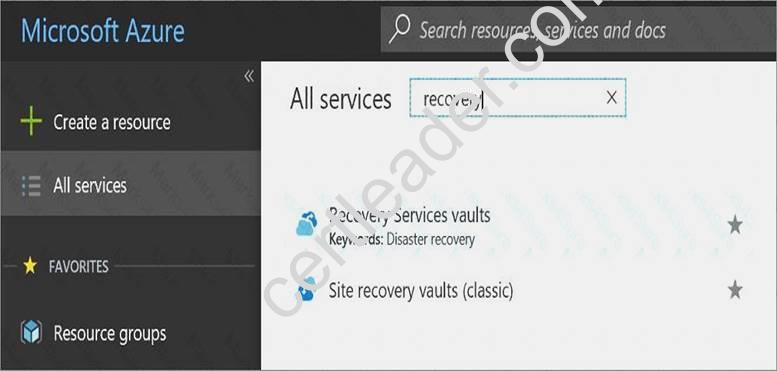
Step 2: In the Recovery Services vaults menu, click Add to open the Recovery Services vault menu.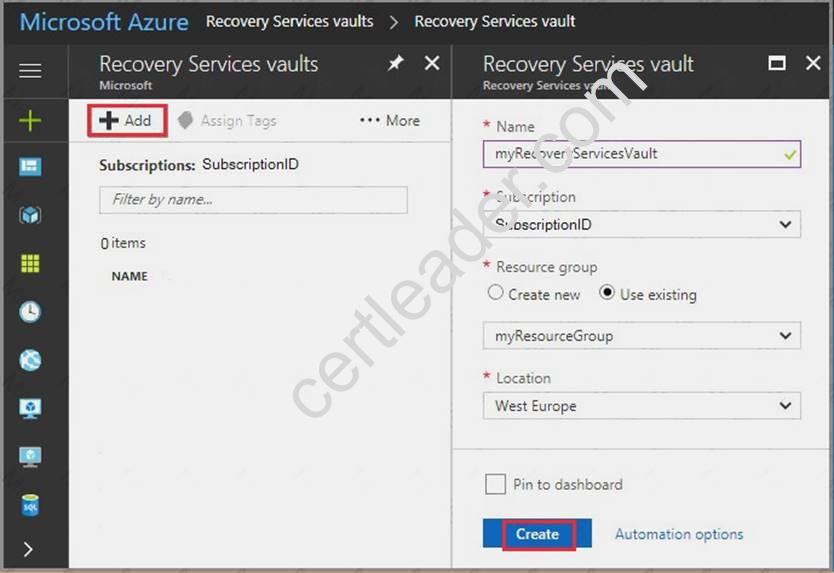
Step 3: In the Recovery Services vault menu, for example, Type myRecoveryServicesVault in Name.
The current subscription ID appears in Subscription. If you have additional subscriptions, you could choose another subscription for the new vault.
For Resource group select Use existing and choose myResourceGroup. If myResourceGroup doesn't exist, select Create new and type myResourceGroup.
From the Location drop-down menu, choose West Europe. Click Create to create your Recovery Services vault.
References: https://docs.microsoft.com/en-us/azure/backup/tutorial-backup-vm-at-scale
NEW QUESTION 8
You have an Azure Active Directory (Azure AD) domain that contains 5,000 user accounts. You create a new user account named AdminUser1.
You need to assign the User administrator administrative role to AdminUser1. What should you do from the user account properties?
- A. From the Directory role blade, modify the directory role.
- B. From the Groups blade, invite the user account to a new group.
- C. From the Licenses blade, assign a new license.
Answer: A
Explanation: Assign a role to a user Sign in to the Azure portal with an account that's a global admin or privileged role admin for the directory. Select Azure Active Directory, select Users, and then select a specific user from the list. For the selected user, select Directory role, select Add role, and then pick the appropriate admin roles from the Directory roles list, such as Conditional access administrator. Press Select to save. References:
https://docs.microsoft.com/en-us/azure/active-directory/fundamentals/active-directory-users-assign-role-azure-p
NEW QUESTION 9
Note: This question is part of a series of questions that present the same scenario. Each question in the series contains a unique solution that might meet the stated goals. Some question sets might have more than one correct solution, while others might not have a correct solution.
After you answer a question in this section, you will NOT be able to return to it. As a result, these questions will not appear in the review screen.
You have an Azure subscription named Subscription1. Subscription1 contains a resource group named RG1. RG1 contains resources that were deployed by using templates.
You need to view the date and time when the resources were created in RG1.
Solution: From the Subscriptions blade, you select the subscription, and then click Programmatic deployment. Does this meet the goal?
- A. Yes
- B. No
Answer: B
NEW QUESTION 10
You have an Azure Active Directory (Azure AD) tenant named contosocloud.onmicrosoft.com. Your company has a public DNS zone for contoso.com.
You add contoso.com as a custom domain name to Azure AD. You need to ensure that Azure can verify the domain name. Which type of DNS record should you create?
- A. PTR
- B. MX
- C. NSEC3
- D. RRSIG
Answer: B
NEW QUESTION 11
You plan to create an Azure Storage account in the Azure region of East US 2. You need to create a storage account that meets the following requirements: Replicates synchronously Remains available if a single data center in the region fails
How should you configure the storage account? To answer, select the appropriate options in the answer area. NOTE: Each correct selection is worth one point.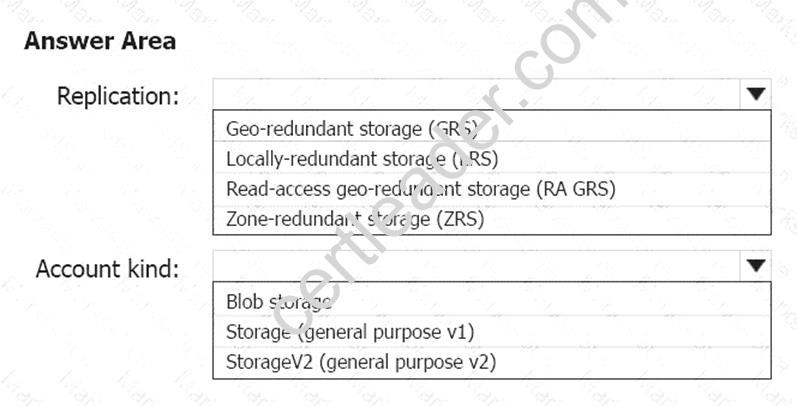
Answer:
Explanation: Box 1: Zone-redundant storage (ZRS)
Zone-redundant storage (ZRS) replicates your data synchronously across three storage clusters in a single region.
LRS would not remain available if a data center in the region fails GRS and RA GRS use asynchronous replication.
Box 2: StorageV2 (general purpose V2) ZRS only support GPv2.
References:
https://docs.microsoft.com/en-us/azure/storage/common/storage-redundancy https://docs.microsoft.com/en-us/azure/storage/common/storage-redundancy-zrs
NEW QUESTION 12
You have an Azure Active Directory (Azure AD) tenant named adatum.com. Adatum.com contains the groups in the following table.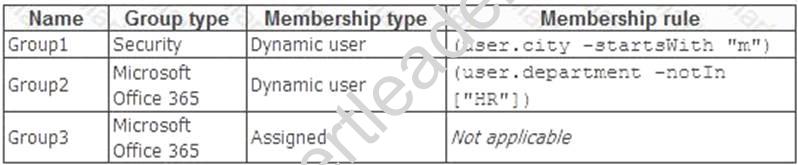
You create two user accounts that are configured as shown in the following table.
To which groups do User1 and User2 belong? To answer. select the appropriate options in the answer area. NOTE: Each correct selection is worth one point.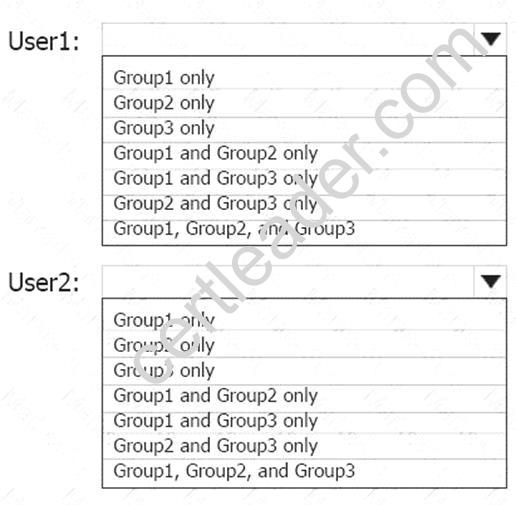
Answer:
Explanation: Box 1: Group 1 only First rule applies
Box 2: Group1 and Group2 only Both membership rules apply.
References: https://docs.microsoft.com/en-us/sccm/core/clients/manage/collections/create-collections
NEW QUESTION 13
Overview
The following section of the exam is a lab. In this section, you will perform a set of tasks in a live environment. While most functionality will be available to you as it would be in a live environment, some functionality (e.g., copy and paste, ability to navigate to external websites) will not be possible by design.
Scoring is based on the outcome of performing the tasks stated in the lab. In other words, it doesn’t matter how you accomplish the task, if you successfully perform it, you will earn credit for that task.
Labs are not timed separately, and this exam may have more than one lab that you must complete. You can use as much time as you would like to complete each lab. But, you should manage your time appropriately to ensure that you are able to complete the lab(s) and all other sections of the exam in the time provided.
Please note that once you submit your work by clicking the Next button within a lab, you will NOT be able to return to the lab.
To start the lab
You may start the lab by clicking the Next button. You recently created a virtual machine named Web01.
You need to attach a new 80-GB standard data disk named Web01-Disk1 to Web01.
What should you do from the Azure portal?
Answer:
Explanation: Add a data disk
Step 1. In the Azure portal, from the menu on the left, selecVt irtual machines.
Step 2. Select the Web01 virtual machine from the list.
Step 3. On the Virtual machine
page, , in Essentials, selecDt isks.
Step 4. On the Disks
page, select the Web01-Disk1 from the list of existing disks.
Step 5. In the Disks pane, click + Add data disk.
Step 6. Click the drop-down menu for Name to view a list of existing managed disks accessible to your Azure subscription. Select the managed disk Web01-Disk1 to attach:
References:
https://docs.microsoft.com/en-us/azure/virtual-machines/linux/attach-disk-portal
NEW QUESTION 14
Note: This question is part of a series of questions that present the same scenario. Each question in the series contains a unique solution that might meet the stated goals. Some question sets might have more than one correct solution, while others might not have a correct solution.
After you answer a question in this section, you will NOT be able to return to it. As a result, these questions will not appear in the review screen.
You have an Azure virtual machine named VM1. VM1 was deployed by using a custom Azure Resource Manager template named ARM1.json.
You receive a notification that VM1 will be affected by maintenance. You need to move VM1 to a different host immediately.
Solution: From the Redeploy blade, you click Redeploy. Does this meet the goal?
- A. Yes
- B. No
Answer: A
Explanation: When you redeploy a VM, it moves the VM to a new node within the Azure infrastructure and then powers it back on, retaining all your configuration options and associated resources.
References: https://docs.microsoft.com/en-us/azure/virtual-machines/windows/redeploy-to-new-node
NEW QUESTION 15
Click to expand each objective. To connect to the Azure portal, type https://portal.azure.com in the browser address bar.


When you are finished performing all the tasks, click the ‘Next’ button.
Note that you cannot return to the lab once you click the ‘Next’ button. Scoring occur in the background while you complete the rest of the exam.
Overview
The following section of the exam is a lab. In this section, you will perform a set of tasks in a live environment. While most functionality will be available to you as it would be in a live environment, some functionality (e.g., copy and paste, ability to navigate to external websites) will not be possible by design. Scoring is based on the outcome of performing the tasks stated in the lab. In other words, it doesn’t matter how you accomplish the task, if you successfully perform it, you will earn credit for that task.
Labs are not timed separately, and this exam may have more than one lab that you must complete. You can use as much time as you would like to complete each lab. But, you should manage your time appropriately to ensure that you are able to complete the lab(s) and all other sections of the exam in the time provided.
Please note that once you submit your work by clicking the Next button within a lab, you will NOT be able to return to the lab.
To start the lab
You may start the lab by clicking the Next button.
You plan to configure VM1 to be accessible from the Internet.
You need to add a public IP address to the network interface used by VM1. What should you do from Azure portal?
Answer:
Explanation: You can add private and public IP addresses to an Azure network interface by completing the steps that follow.
Step 1: In Azure portal, click More services > type virtual machines in the filter box, and then click Virtual machines.
Step 2: In the Virtual machines pane, click the VM you want to add IP addresses to. Click Network interfaces in the virtual machine pane that appears, and then select the network interface you want to add the IP addresses to. In the example shown in the following picture, the NIC named myNIC from the VM named myVM is selected:
Step 3: In the pane that appears for the NIC you selected, click IP configurations. Step 4: Click Create public IP address.
Step 5: In the Create public IP address pane that appears, enter a Name, select an IP address assignment type, a Subscription, a Resource group, and a Location, then click Create, as shown in the following picture:
References:
https://docs.microsoft.com/en-us/azure/virtual-network/virtual-network-multiple-ip-addresses-portal
NEW QUESTION 16
You need to recommend a solution for App1. The solution must meet the technical requirements. What should you include in the recommendation? To answer, select the appropriate options in the answer area.
NOTE: Each correct selection is worth one point.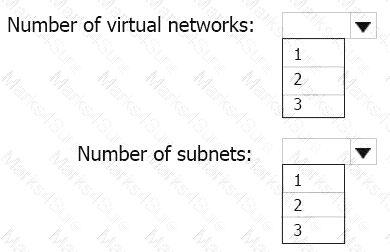
Answer:
Explanation: This reference architecture shows how to deploy VMs and a virtual network configured for an N-tier application, using SQL Server on Windows for the data tier.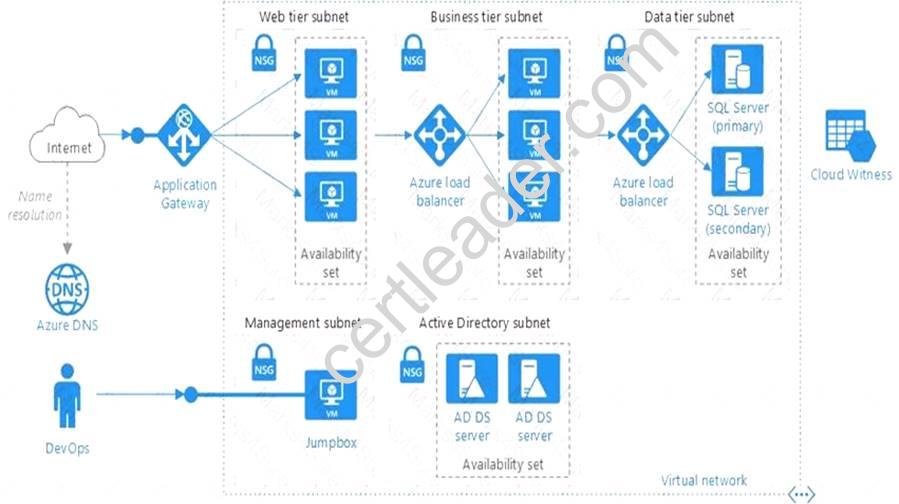
Scenario: You have a public-facing application named App1. App1 is comprised of the following three tiers:
A SQL database
A web front end
A processing middle tier
Each tier is comprised of five virtual machines. Users access the web front end by using HTTPS only.
Technical requirements include:
Move all the virtual machines for App1 to Azure.
Minimize the number of open ports between the App1 tiers.
References: https://docs.microsoft.com/en-us/azure/architecture/reference-architectures/n-tier/n-tier-sql-server
NEW QUESTION 17
You have an Azure subscription that contains a resource group named RG1. RG1 contains 100 virtual machines.
Your company has three cost centers named Manufacturing, Sales, and Finance. You need to associate each virtual machine to a specific cost center.
What should you do?
- A. Add an extension to the virtual machines.
- B. Modify the inventory settings of the virtual machine.
- C. Assign tags to the virtual machines.
- D. Configure locks for the virtual machine.
Answer: C
Explanation: References:
https://docs.microsoft.com/en-us/azure/billing/billing-getting-started https://docs.microsoft.com/en-us/azure/azure-resource-manager/resource-group-using-tags
NEW QUESTION 18
You have an Azure subscription named Subscrption1 that is associated to an Azure Active Directory (Azure AD) tenant named AAD1.
Subscription1 contains the objects in the following table: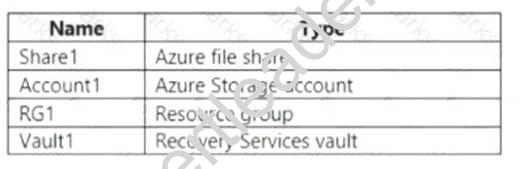
You plan to create a single backup policy for Vault1. To answer, select the appropriate options in the answer area.
NOTE: Each correct selection is worth one point.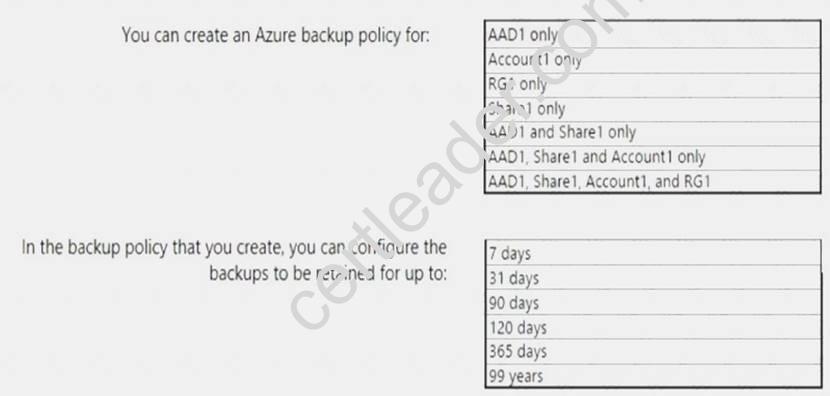
Answer:
Explanation: Box 1: RG1 only Box 2: 99 years
With the latest update to Azure Backup, customers can retain their data for up to 99 years in Azure.
Note: A backup policy defines a matrix of when the data snapshots are taken, and how long those snapshots are retained.
The backup policy interface looks like this: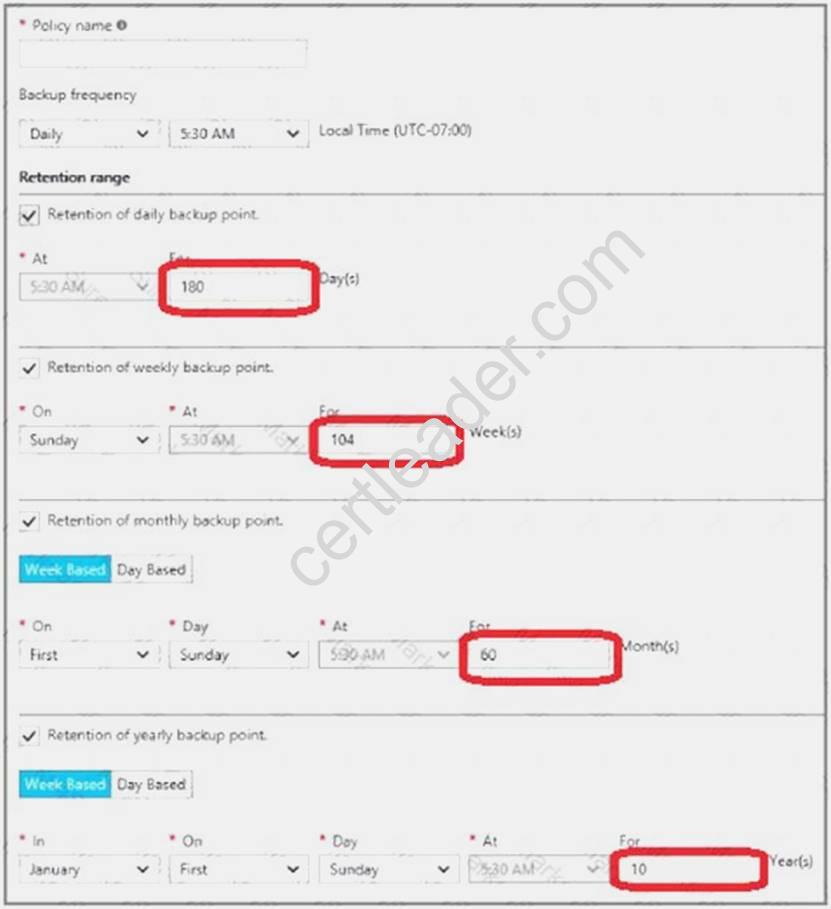
References:
https://docs.microsoft.com/en-us/azure/backup/backup-azure-vms-first-look-arm#defining-a-backup-policy
https://blogs.microsoft.com/firehose/2015/02/16/february-update-to-azure-backup-includes-data-retention-up-to-
NEW QUESTION 19
You have an Azure subscription named Subscription1. Subscription1 contains the virtual machines in the following table.
Subscription1 contains a virtual network named VNet1 that has the subnets in the following table.
VM3 has a network adapter named NIC3. IP forwarding is enabled on NIC3. Routing is enabled on VM3. You create a route table named RT1. RT1 is associated to Subnet1 and Subnet2 and contains the routes in the following table.
You apply RT1 to Subnet1.
For each of the following statements, select Yes if the statement is true. Otherwise, select No. NOTE: Each correct selection is worth one point.
Answer:
Explanation: Box 1: Yes
Traffic from VM1 and VM2 can reach VM3 thanks to the routing table, and as IP forwarding is enabled on VM3, traffic from VM3 can reach VM1.
Box 2: No
VM3, which has IP forwarding, must be turned on, in order for traffic from VM2 to reach VM1. Box 3: Yes
The traffic from VM1 will reach VM3, which thanks to IP forwarding, will send the traffic to VM2. References: https://www.quora.com/What-is-IP-forwarding
NEW QUESTION 20
You have an Azure subscription that contains 100 virtual machines. You regularly create and delete virtual machines.
You need to identify unused disks that can be deleted. What should you do?
- A. From Microsoft Azure Storage Explorer, view the Account Management properties.
- B. From the Azure portal, configure the Advisor recommendations.
- C. From Cloudyn, open the Optimizer tab and create a report.
- D. From Cloudyn, create a Cost Management report.
Answer: A
Explanation: References:
https://cloud.netapp.com/blog/reduce-azure-storage-costs
100% Valid and Newest Version AZ-100 Questions & Answers shared by 2passeasy, Get Full Dumps HERE: https://www.2passeasy.com/dumps/AZ-100/ (New 106 Q&As)