Cause all that matters here is passing the AHIP AHM-520 exam. Cause all that you need is a high score of AHM-520 Health Plan Finance and Risk Management exam. The only one thing you need to do is downloading Examcollection AHM-520 exam study guides now. We will not let you down with our money-back guarantee.
Free AHM-520 Demo Online For AHIP Certifitcation:
NEW QUESTION 1
The Arista Health Plan is evaluating the following four groups that have applied for group
healthcare coverage:
✑ The Blaise Company, a large private employer
✑ The Colton County Department of Human Services (DHS)
✑ A multiple-employer group comprised of four companies
✑ The Professional Society of Daycare Providers
With respect to the relative degree of risk to Arista represented by these four companies, the company that would most likely expose Arista to the lowest risk is the:
- A. Blaise Company
- B. Colton County DHS
- C. Multiple-employer group
- D. Professional Society of Daycare Providers
Answer: A
NEW QUESTION 2
The following statements are about federal laws and regulations which affect health plans that offer products and services to the employer group market. Select the answer choice containing the correct statement.
- A. Amendments to the HMO Act of 1973 require federally qualified HMOs to adjust a group's prior premiums on the basis of the group's experience during the prior rating period.
- B. The Consolidated Omnibus Budget Reconciliation Act (COBRA) of 1986 requires that, if a plan sponsor elects to terminate its group coverage with a health plan, then the health plan must continue its coverage for the COBRA-qualified beneficiaries in the group.
- C. The Health Insurance Portability and Accountability Act (HIPAA) of 1996 generally requires the guaranteed renewal of healthcare coverage for certain individuals and for both small and large groups, regardless of the health status of any member.
- D. The Mental Health Parity Act (MHPA) of 1996 mandates that all health plans must offer benefits for mental healthcare.
Answer: C
NEW QUESTION 3
Several federal agencies establish rules and requirements that affect health plans. One of these agencies is the Department of Labor (DOL), which is primarily responsible for ______.
- A. Issuing regulations pertaining to the Health Insurance Portability and Accountability Act (HIPAA) of 1996
- B. Administering the Medicare and Medicaid programs
- C. Administering ERISA, which imposes various documentation, appeals, reporting, and disclosure requirements on employer group health plans
- D. Administering the Federal Employees Health BenefitsProgram (FEHBP), which providesvoluntary health insurance coverage to federal employees, retirees, and dependents
Answer: C
NEW QUESTION 4
The Fairway health plan is a for-profit health plan that issues stock. The following data was taken from Fairway's financial statements:
✑ Current assets.....$5,000,000
✑ Total assets.....6,000,000
✑ Current liabilities.....2,500,000
✑ Total liabilities.....3,600,000
✑ Stockholders' equity.....2,400,000
Fairway's total revenues for the previous financial period were $7,200,000, and its net income for that period was $180,000.
For the previous financial period, Fairway's net profit margin was
- A. 2.50%
- B. 3.00%
- C. 3.60%
- D. 7.50%
Answer: A
NEW QUESTION 5
The following statements are about a health plan's underwriting of small groups. Select the answer choice containing the correct statement.
- A. Almost all states prohibit health plan s from rejecting a small group because of the nature of the business in which the small business is engaged.
- B. Most states prohibit health plans from setting participation levels as a requirement for coverage, even when coverage is otherwise guaranteed issue.
- C. In underwriting small groups, a health plan's underwriters typically consider both the characteristics of the group members and of the employer.
- D. Generally, a health plan's underwriters require small employers to contribute at least 80% of the cost of the healthcare coverage.
Answer: C
NEW QUESTION 6
One true statement about a type of capitation known as a percent-of-premium arrangement is that this arrangement
- A. Is the most common type of capitation
- B. Is less attractive to providers when the arrangement sets provisions to limit risk
- C. Sets provider reimbursement at a specific dollar amount per plan member
- D. Transfers some of the risk associated with underwriting and rating from a health plan to a provider
Answer: D
NEW QUESTION 7
In order to print all of its forms in-house, the Prism health plan is considering the purchase of 10 new printers at a total cost of $30,000. Prism estimates that the proposed printers have a useful life of 5 years. Under its current system, Prism spends $10,000 a year to have forms printed by a local printing company. Assume that Prism selects a 15% discount rate based on its weighted-average costs of capital. The cash inflows for each year, discounted to their present value, are shown in the following chart: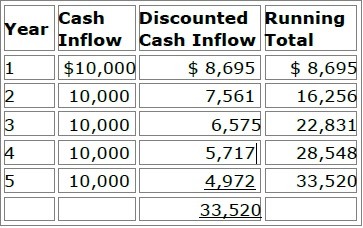
Prism will use both the payback method and the discounted payback methodto analyze the worthiness of this potential capital investment. Prism's decisionrule is to accept all proposed capital projects that have payback periods offour years or less.
After analyzing this information, Prism would accept this proposed capitalproject under
- A. Both the payback method and the discounted payback method
- B. The payback method but not the discounted payback method
- C. The discounted payback method but not the payback method
- D. Neither the payback method nor the discounted payback method
Answer: B
NEW QUESTION 8
One true statement about cash-basis accounting is that
- A. Cash receipt, but not cash disbursement, is an important component of cash-basis accounting
- B. Most companies use a pure cash-basis accounting system
- C. Cash-basis accounting records revenue according to the realization principle and expenses according to the matching principle
- D. Health insurance companies and health plans that fall under the jurisdiction of state insurance commissioners must report some items on a cash basis for statutory reporting purposes
Answer: D
NEW QUESTION 9
Users of the Fulcrum Health Plan financial information include:
✑ The independent auditors who review Fulcrum's financial statements
✑ Fulcrum's controller (comptroller)
✑ Fulcrum's plan members
✑ The providers that deliver healthcare services to Fulcrum plan members
✑ Fulcrum's competitors
Of these users, the ones that most likely can correctly be classified as external users with a direct financial interest in Fulcrum are the
- A. Independent auditors, the plan members, the providers, and the
- B. Competitors only
- C. Independent auditors, the controller, and the providers only
- D. Controller and the competitors only
- E. Plan members and the providers only
Answer: D
NEW QUESTION 10
Geena Falk is eligible for both Medicare and Medicaid coverage. If Ms. Falk incurs a covered expense, then:
- A. Medicaid will be M
- B. Falk’s primary insurer
- C. Medicare will be M
- D. Falk’s primary insurer
- E. Either Medicare or Medicaid will be M
- F. Falk’s primary insurer depending on her election
- G. Medicare and Medicaid will each be responsible for one-half of M
- H. Falk’s covered expense
Answer: B
NEW QUESTION 11
The Puma health plan uses return on investment (ROI) and residual income (RI) to measure the performance of its investment centers. Two of these investment centers are identified as X and Y. Investment Center X earns $10,000,000 in operating income on controllable investments of $50,000,000, and it has total revenues of $60,000,000. Investment Center Y earns $2,000,000 in operating income on controllable investments of $8,000,000, and it has total revenues of $10,000,000. Both centers have a minimum required rate of return of 15%.
One likely way in which Investment Center X or Y could effectively increase its ROI is by
- A. Focusing only on increasing its total revenues
- B. Increasing its controllable investments
- C. Increasing total revenues, accompanied by a proportionate increase in operating income
- D. Increasing expenses in order to increase operating income
Answer: C
NEW QUESTION 12
The physicians who work for the Sunrise Health Plan, a staff model HMO, are paid a salary that is not augmented with another type of incentive plan. Compared to the use of a traditional reimbursement method, Sunrise's use of a salary reimbursement method is more likely to
- A. Encourage Sunrise's physicians to perform services that are not medically necessary
- B. Completely eliminate service risk for Sunrise's physicians
- C. Decrease Sunrise's liability for any negligent acts of the physicians in the plan's network of providers
- D. Help stabilize expenses for Sunrise
Answer: D
NEW QUESTION 13
The risk-based capital formula for health plans defines a number of risks that can impact a health plan’s solvency. These categories reflect the fact that the level of risk faced by health plans is significantly impacted by provider reimbursement methods that shift utilization risk to providers. The following statements are about the effect of a health plan transferring utilization risk to providers. Select the answer choice containing the correct statement:
- A. The net effect of using provider reimbursement contracts to transfer risk is that the health plan’s net worth requirement increases.
- B. Once the health plan has transferred utilization risk to its providers, it is relieved of the legal obligation to provide medical services to plan members in the event of the provider’s insolvency.
- C. The greater the amount of risk the health plan transfers to providers, the larger the credit-risk factor becomes in the health plan’s RBC formula.
- D. By decreasing its utilization risk, the health plan increases its underwriting risk.
Answer: C
NEW QUESTION 14
The following statements are about various reimbursement arrangements that health plans have with hospitals. Select the answer choice containing the correct statement.
- A. A sliding scale per-diem charges arrangement differs from a sliding scale discount on charges arrangement in that only a sliding scale per-diem charges arrangement is based on total volume of admissions and outpatient procedures.
- B. Under a typical reimbursement arrangement that is based on diagnosisrelated groups (DRGs), if the payment amount is fixed on the basis of diagnosis, then any reduction in costs resulting from a reduction in days will go to the health plan rather than to the hospital.
- C. A negotiated straight per-diem charge requires payment of a single charge for a day in the hospital, regardless of any actual charges or costs incurred during the hospital stay.
- D. A straight discount on charges arrangement is the most common reimbursement method in markets with high levels of health plans.
Answer: C
NEW QUESTION 15
Health plans sometimes use global fees to reimburse providers. Health plans would use this method of provider reimbursement for all of the following reasons EXCEPT that global fees
- A. Eliminate any motivation the providermay have to engage in churning
- B. Transfer some of the risk of overutilization of care from the health plan to the providers
- C. Eliminate the practice of upcoding within specific treatments
- D. Reward providers who deliver cost-effective care
Answer: A
NEW QUESTION 16
The Jasmine Company, which self funds the health plan for its 200 employees, has established a 501(c)(9) trust as a means of addressing possible claims fluctuations under the health plan. Thisplan is not a part of a collective bargaining process. A potential disadvantage to Jasmine of using a 501(c)(9) trust is that
- A. The cost of maintaining the trust may be prohibitive to Jasmine
- B. The trust must always maintain enough assets to pay the health plan's claims that have been incurred but not yet paid
- C. Jasmine is prohibited from earning any return on the trust assets
- D. The contributions to this trust are not deductible for federal income tax purposes
Answer: A
NEW QUESTION 17
Cascade Hospital has negotiated with the McBee Health Plan a straight per-diem rate of $1,000 per day for medical admissions. One of McBee’s plan members was admitted to Cascade for 10 days. Total billed charges equaled $10,000, of which $2,000 were for noncovered items. This information indicates that, for this admission, the amount that McBee was obligated to reimburse Cascade was:
- A. $0
- B. $8,000
- C. $10,000
- D. $12,000
Answer: C
NEW QUESTION 18
In a fee-for-service (FFS) reimbursement method, providers are paid per treatment or per service that they provide. One typical benefit of FFS reimbursement is that it:
- A. Is highly effective in preventing excessive services that take the form of churning, unbundling, and upcoding
- B. Provides physicians who attempt to control costs with a higher rate of compensation than is provided to physicians who make the effort to control costs
- C. Is relatively easy to initiate, especially in markets where managed care penetration is low
- D. Guards against the practice of defensive medicine
Answer: B
NEW QUESTION 19
......
P.S. Certleader now are offering 100% pass ensure AHM-520 dumps! All AHM-520 exam questions have been updated with correct answers: https://www.certleader.com/AHM-520-dumps.html (215 New Questions)